
Research on ice grains from moons like Enceladus and Europa shows potential for detecting signs of life, paving the way for upcoming space missions with advanced detection instruments.
The ice-encrusted oceans of some of the moons orbiting Saturn and Jupiter are leading candidates in the search for extraterrestrial life. A new lab-based study led by the University of Washington in Seattle and the Freie Universität Berlin shows that individual ice grains ejected from these planetary bodies may contain enough material for instruments headed there in the fall to detect signs of life, if such life exists.
“For the first time we have shown that even a tiny fraction of cellular material could be identified by a mass spectrometer onboard a spacecraft,” said lead author Fabian Klenner, a UW postdoctoral researcher in Earth and space sciences. “Our results give us more confidence that using upcoming instruments, we will be able to detect lifeforms similar to those on Earth, which we increasingly believe could be present on ocean-bearing moons.”
The open-access study was published on March 22 in Science Advances. Other authors in the international team are from The Open University in the U.K.; NASA’s Jet Propulsion Laboratory; the University of Colorado, Boulder; and the University of Leipzig.
Scientific Advances and Space Missions
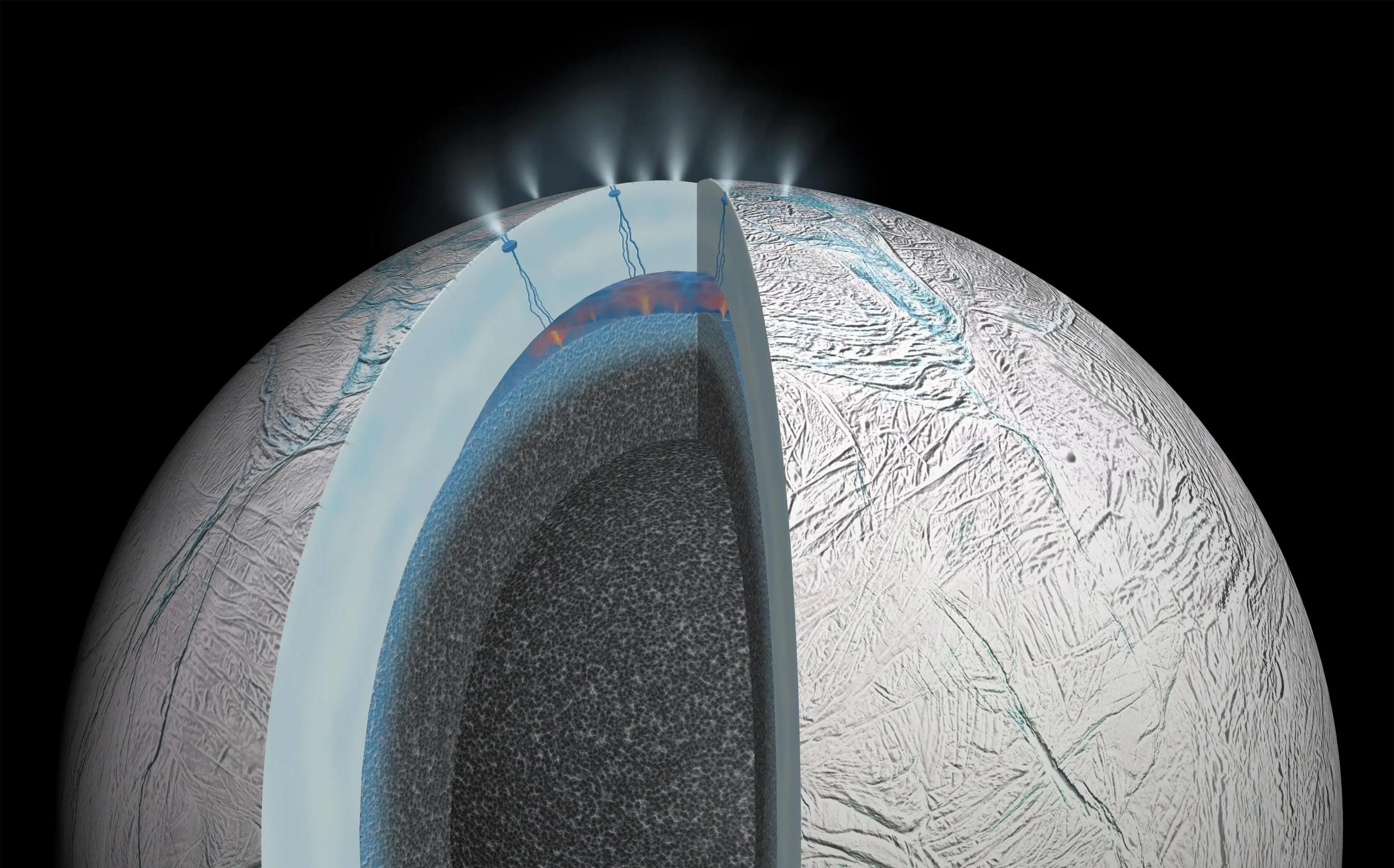
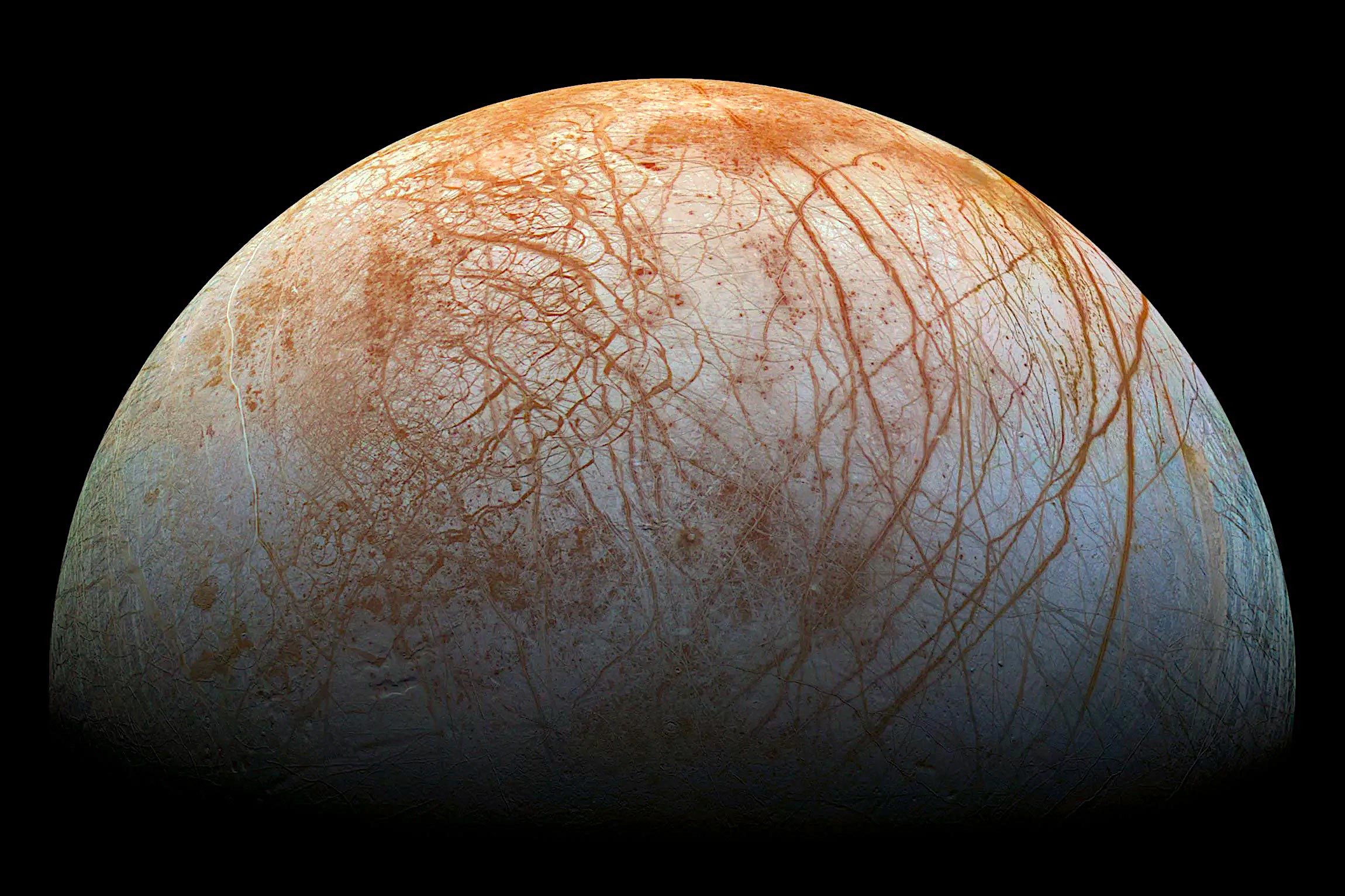
The Cassini mission that ended in 2017 discovered parallel cracks near the south pole of Saturn’s moon Enceladus. Emanating from these cracks are plumes containing gas and ice grains. NASA’s Europa Clipper mission, scheduled to launch in October, will carry more instruments to explore in even more detail an icy moon of Jupiter, Europa.
To prepare for that mission, researchers are studying what this new generation of instruments might find. It is technically prohibitive to directly simulate grains of ice flying through space at 4 to 6 kilometers per second to hit an observational instrument, as the actual collision speed will be. Instead, the authors used an experimental setup that sends a thin beam of liquid water into a vacuum, where it disintegrates into droplets. They then used a laser beam to excite the droplets and mass spectral analysis to mimic what instruments on the space probe will detect.
Newly published results show that instruments slated to go on future missions, like the SUrface Dust Analyzer onboard Europa Clipper, can detect cellular material in one out of hundreds of thousands of ice grains.
Potential for Discovering Life
The study focused on Sphingopyxis alaskensis, a common bacterium in waters off Alaska. While many studies use the bacterium Escherichia coli as a model organism, this single-celled organism is much smaller, lives in cold environments, and can survive with few nutrients. All these things make it a better candidate for potential life on the icy moons of Saturn or Jupiter.
“They are extremely small, so they are in theory capable of fitting into ice grains that are emitted from an ocean world like Enceladus or Europa,” Klenner said.
Results show that the instruments can detect this bacterium, or portions of it, in a single ice grain. Different molecules end up in different ice grains. The new research shows that analyzing single ice grains, where biomaterial may be concentrated, is more successful than averaging across a larger sample containing billions of individual grains.
A recent study led by the same researchers showed evidence of phosphate on Enceladus. This planetary body now appears to contain energy, water, phosphate, other salts and carbon-based organic material, making it increasingly likely to support lifeforms similar to those found on Earth.
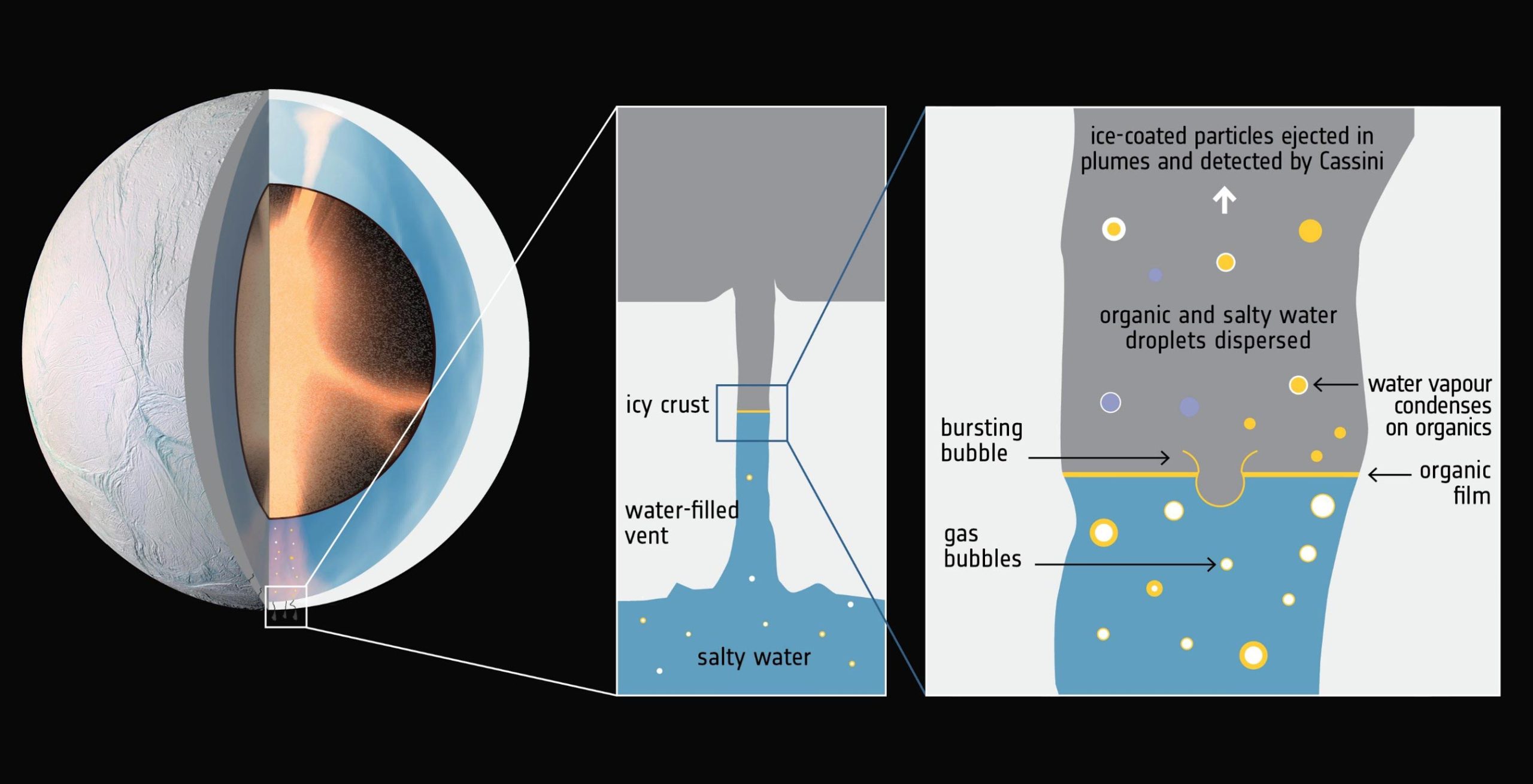
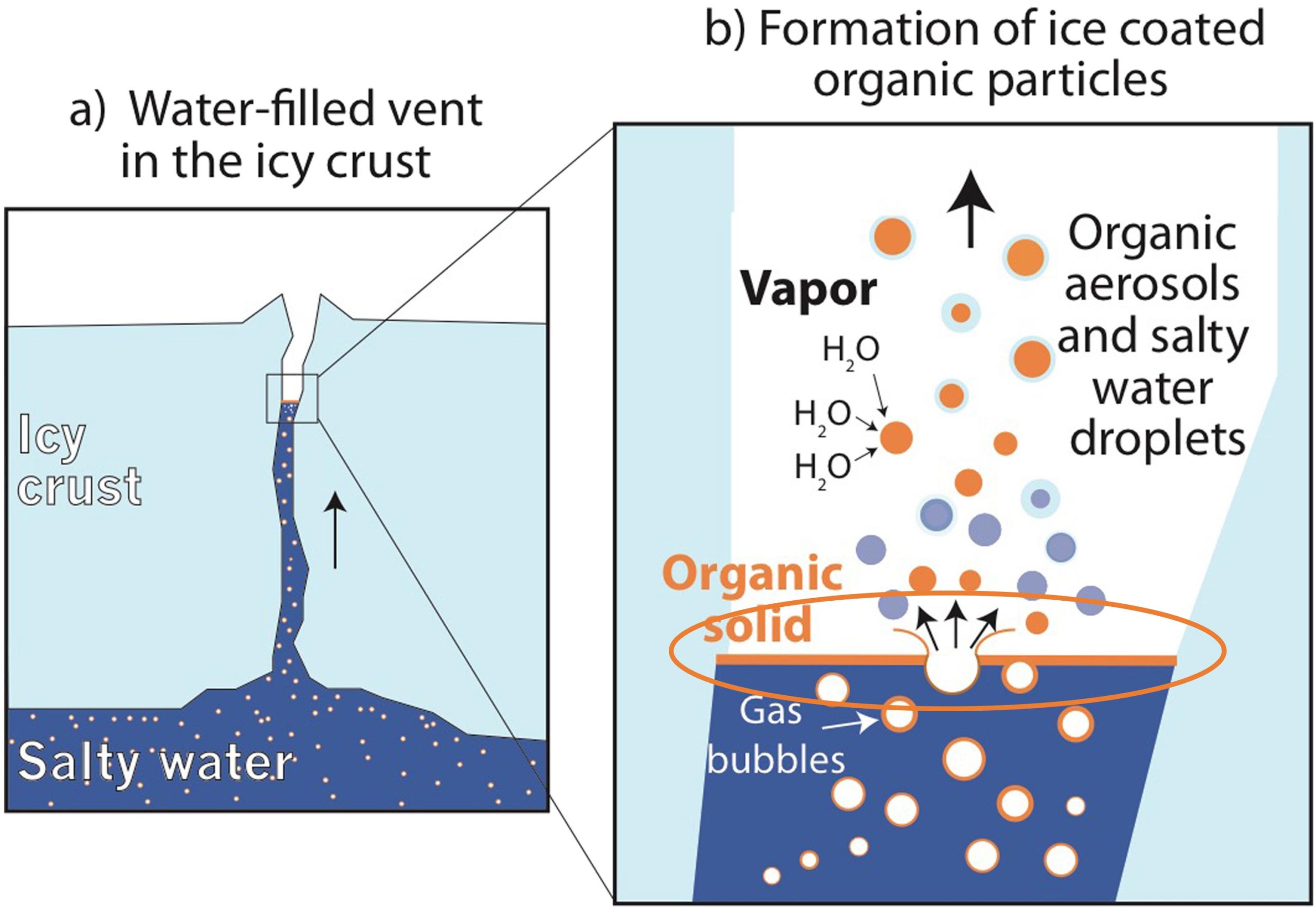
The authors hypothesize that if bacterial cells are encased in a lipid membrane, like those on Earth, then they would also form a skin on the ocean’s surface. On Earth, ocean scum is a key part of sea spray that contributes to the smell of the ocean. On an icy moon where the ocean is connected to the surface (e.g., through cracks in the ice shell), the vacuum of outer space would cause this subsurface ocean to boil. Gas bubbles rise through the ocean and burst at the surface, where cellular material gets incorporated into ice grains within the plume.
“We here describe a plausible scenario for how bacterial cells can, in theory, be incorporated into icy material that is formed from liquid water on Enceladus or Europa and then gets emitted into space,” Klenner said.
The SUrface Dust Analyzer onboard Europa Clipper will be higher-powered than instruments on past missions. This and future instruments also will for the first time be able to detect ions with negative charges, making them better suited to detecting fatty acids and lipids.
“For me, it is even more exciting to look for lipids, or for fatty acids, than to look for building blocks of DNA, and the reason is because fatty acids appear to be more stable,” Klenner said.
“With suitable instrumentation, such as the SUrface Dust Analyzer on NASA’s Europa Clipper space probe, it might be easier than we thought to find life, or traces of it, on icy moons,” said senior author Frank Postberg, a professor of planetary sciences at the Freie Universität Berlin. “If life is present there, of course, and cares to be enclosed in ice grains originating from an environment such as a subsurface water reservoir.”
Reference: “How to identify cell material in a single ice grain emitted from Enceladus or Europa” by Fabian Klenner, Janine Bönigk, Maryse Napoleoni, Jon Hillier, Nozair Khawaja, Karen Olsson-Francis, Morgan L. Cable, Michael J. Malaska, Sascha Kempf, Bernd Abel and Frank Postberg, 22 March 2024, Science Advances.
DOI: 10.1126/sciadv.adl0849
The study was funded by the European Research Council, NASA and the German Research Foundation (DFG). Other co-authors are Janine Bönigk, Maryse Napoleoni, Jon Hillier and Nozair Khawaja at the Freie Universität Berlin; Karen Olsson-Francis at The Open University in the U.K.; Morgan Cable and Michael Malaska at the NASA Jet Propulsion Laboratory; Sascha Kempf at the University of Colorado, Boulder; and Bernd Abel at the University of Leipzig.
Never miss a breakthrough: Join the SciTechDaily newsletter.
Follow us on Google and Google News.