
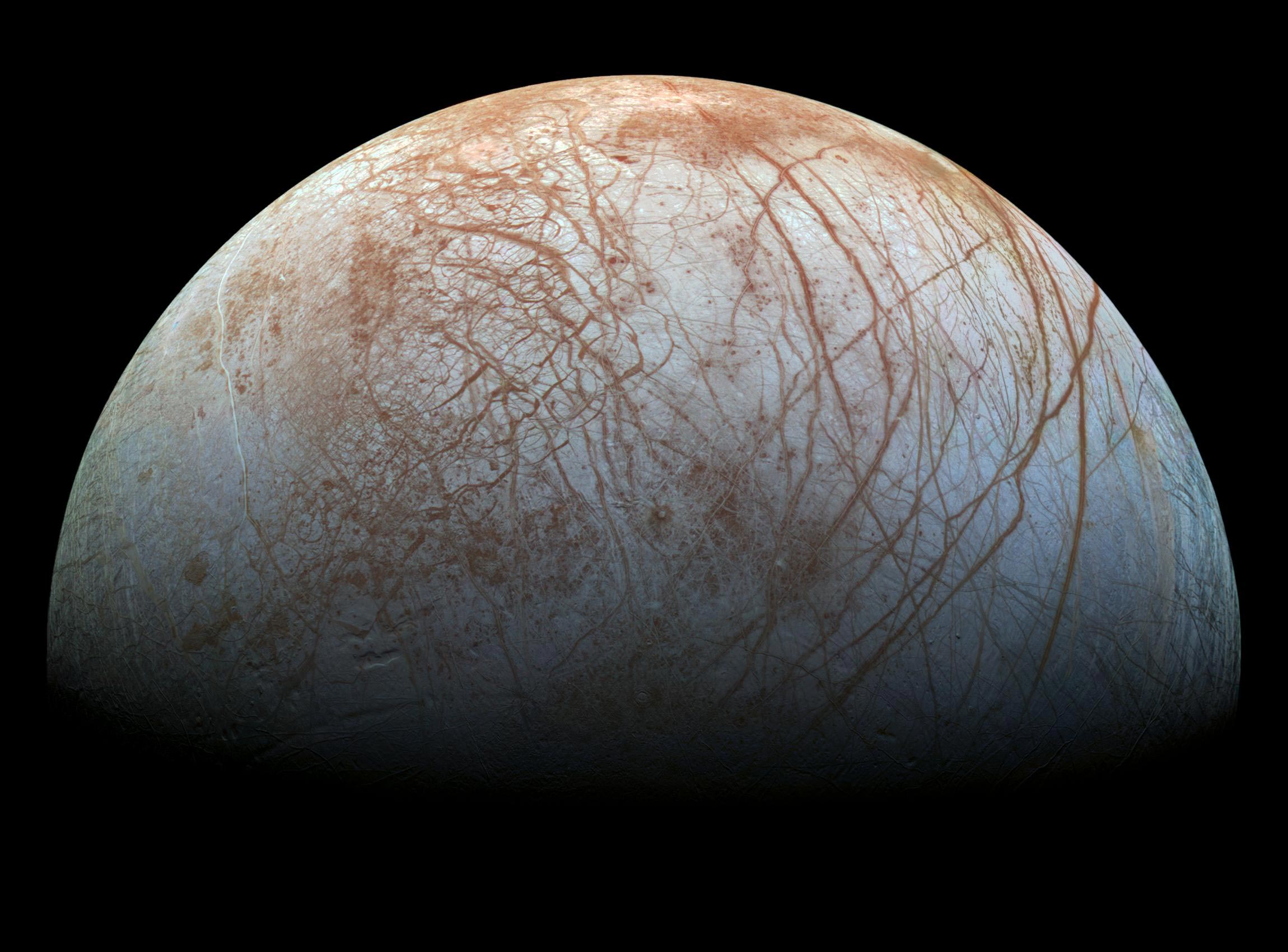
Jupiter’s moon Europa and its global ocean may currently have conditions suitable for life. Scientists are studying processes on the icy surface as they prepare to explore.
It’s easy to see the impact of space debris on our Moon, where the ancient, battered surface is covered with craters and scars. Jupiter’s icy moon Europa withstands a similar trouncing – along with a punch of super-intense radiation. As the uppermost surface of the icy moon churns, material brought to the surface is zapped by high-energy electron radiation accelerated by Jupiter.
NASA-funded scientists are studying the cumulative effects of small impacts on Europa’s surface as they prepare to explore the distant moon with the Europa Clipper mission and study the possibilities for a future lander mission. Europa is of particular scientific interest because its salty ocean, which lies beneath a thick layer of ice, may currently have conditions suitable for existing life. That water may even make its way into the icy crust and onto the moon’s surface.
New research and modeling estimate how far down that surface is disturbed by the process called “impact gardening.” The work, published July 12 in Nature Astronomy, estimates that the surface of Europa has been churned by small impacts to an average depth of about 12 inches (30 centimeters) over tens of millions of years. And any molecules that might qualify as potential biosignatures, which include chemical signs of life, could be affected at that depth.

That’s because the impacts would churn some material to the surface, where radiation would likely break the bonds of any potential large, delicate molecules generated by biology. Meanwhile, some material on the surface would be pushed downward, where it could mix with the subsurface.
“If we hope to find pristine, chemical biosignatures, we will have to look below the zone where impacts have been gardening,” said lead author Emily Costello, a planetary research scientist at the University of Hawaii at Manoa. “Chemical biosignatures in areas shallower than that zone may have been exposed to destructive radiation.”
Going Deeper
While impact gardening has long been understood to be likely taking place on Europa and other airless bodies in the solar system, the new modeling provides the most comprehensive picture yet of the process. In fact, it is the first to take into account secondary impacts caused by debris raining back down onto Europa’s surface after being kicked up by an initial impact. The research makes the case that Europa’s mid- to high-latitudes would be less affected by the double whammy of impact gardening and radiation.
“This work broadens our understanding of the fundamental processes on surfaces across the solar system,” said Cynthia Phillips, a Europa scientist at NASA’s Jet Propulsion Laboratory in Southern California and a co-author of the study. “If we want to understand the physical characteristics and how planets in general evolve, we need to understand the role impact gardening has in reshaping them.”
Managed by JPL for NASA, Europa Clipper will help develop that understanding. The spacecraft, targeting a 2024 launch, will conduct a series of close flybys of Europa as it orbits Jupiter. It will carry instruments to thoroughly survey the moon, as well as sample the dust and gases that are kicked up above the surface.
More About the Mission
Missions such as Europa Clipper contribute to the field of astrobiology, the interdisciplinary research on the variables and conditions of distant worlds that could harbor life as we know it. While Europa Clipper is not a life-detection mission, it will conduct detailed reconnaissance of Europa and investigate whether the icy moon, with its subsurface ocean, has the capability to support life. Understanding Europa’s habitability will help scientists better understand how life developed on Earth and the potential for finding life beyond our planet.
Managed by Caltech in Pasadena, California, JPL leads the development of the Europa Clipper mission in partnership with APL for NASA’s Science Mission Directorate in Washington. The Planetary Missions Program Office at NASA’s Marshall Space Flight Center in Huntsville, Alabama, executes program management of the Europa Clipper mission.
Never miss a breakthrough: Join the SciTechDaily newsletter.
Follow us on Google and Google News.
3 Comments
ALL THESE WORLDS ARE YOURS
EXCEPT EUROPA
ATTEMPT NO LANDING THERE
That’s all they ever say about those moons. “May harbor life”. We will never know in our lifetime. They are to busy sending probes to Mars and wasting money. China is passing them. The Venus mission I can understand because they are probably trying to figure out how our sister planet came to be the way that it is and if we are headed in the same direction. Sadly though all we will ever get is the answer “May harbor life.”
So they have completely destroyed here and now want to take this mess to the rest of the universe heed Steven Hawkings warning to you you’ll never get the chance to much up the universe