
Close Menu
    Facebook X (Twitter) Instagram
    SciTechDaily
    • Biology
    • Chemistry
    • Earth
    • Health
    • Physics
    • Science
    • Space
    • Technology
    Facebook X (Twitter) Pinterest YouTube RSS
    SciTechDaily
    Home»Space»Astronomers Confirm Galaxies in the Early Universe
    Space

    Astronomers Confirm Galaxies in the Early Universe

    By Megan Watzke, Harvard-Smithsonian Center for AstrophysicsJuly 30, 20181 Comment3 Mins Read
    Facebook Twitter Pinterest Telegram LinkedIn WhatsApp Email Reddit
    Share
    Facebook Twitter LinkedIn Pinterest Telegram Email Reddit
    High Resolution SMA Imaging
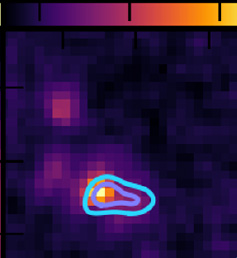
    The Spitzer infrared image of a distant infrared luminous galaxy, overlaid with millimeter intensity contours of the source from the Submillimeter Array (the field of view of the image is about 10 arcseconds). Astronomers have studied about sixty similar luminous galaxies in early evolutionary stages whose light has been traveling toward us for about ten billion years. Credit: NASA/Hill et al.

    Astronomers in the past decade have detected thousands of galaxies dating from epochs only a few billion years after the big bang. Many of them, discovered in deep optical and near-infrared surveys, are low-mass galaxies, and are faint and difficult to study. More luminous, massive star-forming galaxies should are present but these large objects are difficult to assemble so early in cosmic time and there are not as many of them. These star forming galaxies contain dust that absorbs stellar radiation and emits strongly at far infrared and submillimeter wavelengths; the Herschel Space Observatory surveys spotted about ten thousand candidate sources whose infrared colors suggested there were distant galaxies.

    Harvard-Smithsonian Center for Astrophysics (CfA) astronomer Glen Petitpas was a member of a large team of astronomers who used the SCUBA-2 (Submillimeter Common User Bolometer Array) instrument to confirm 188 of the reddest of these sources as indeed being distant, dusty star formation galaxies, typically so far away that their light has been traveling towards us for over eleven billion years, and so bright that they must be making stars at a rate many thousands of times faster than does the Milky Way.

    In a related paper, Petitpas was joined by CfA astronomers Mark Gurwell, Giovanni Fazio, and David Wilner and their colleagues to use the Submillimeter Array to image some distant SCUBA-2 galaxies (although a set that is a bit closer than the above sample: their light has only been traveling for a bit over ten billion years). They targeted seventy galaxies with the SMA and detected sixty-two of them, including three pairs of galaxies that can be classified as colliding systems (the others may also include some mergers that are not spatially separable). The scientists show that the descendants of such huge galaxies in our local universe are probably massive elliptical galaxies, and that about ten percent of their stars probably formed in short bursts of activity in this earlier phase of their evolution.

    Publications:

    • “High-Resolution SMA Imaging of Bright Submillimetre Sources from the SCUBA-2 Cosmology Legacy Survey” by Ryley Hill, Scott C. Chapman, Douglas Scott, Glen Petitpas, Ian Smail, Edward L. Chapin, Mark A. Gurwell, Ryan Perry, Andrew W. Blain, Malcolm N. Bremer, Chian-Chou Chen, James S. Dunlop, Duncan Farrah, Giovanni G. Fazio, James E. Geach, Paul Howson, R. J. Ivison, Kevin Lacaille, Michał J. Michałowski, James M. Simpson, A. M. Swinbank, Paul P. van der Werf and David J. Wilner, 21 March 2018, MNRAS.
      DOI: 10.1093/mnras/sty746
    • “Red, Redder, Reddest: SCUBA-2 Imaging of Colour-Selected Herschel Sources” by S Duivenvoorden, S Oliver, J M Scudder, J Greenslade, D A Riechers, S M Wilkins, V Buat, S C Chapman, D L Clements, A Cooray, K E K Coppin, H Dannerbauer, G De Zotti, J S Dunlop, S A Eales, A Efstathiou, D Farrah, J E Geach, W S Holland, P D Hurley, R J Ivison, L Marchetti, G Petitpas, M T Sargent, D Scott, M Symeonidis, M Vaccari, J D Vieira, L Wang, J Wardlow and M Zemcov, 15 March 2018, MNRAS.
      DOI: 10.1093/mnras/sty691

    Never miss a breakthrough: Join the SciTechDaily newsletter.
    Follow us on Google and Google News.

    Astronomy Cosmology Harvard-Smithsonian Center for Astrophysics
    Share. Facebook Twitter Pinterest LinkedIn Email Reddit

    Related Articles

    Astronomers Just Reconstructed a Galaxy’s 12-Billion-Year History

    Webb’s Mysterious “Little Red Dots” May Be the Cradle of the First Black Holes

    Mysterious Radio Signals Reveal What’s Hiding Between Galaxies

    Cosmic Mystery Solved: Astronomers Have Discovered the Universe’s “Missing” Matter

    Invisible Storm Lights Up Galaxy Cluster With Record-Breaking Radio Glow

    Herschel Observations Help Identify the Physical Processes Underway in Cold, Dense Clouds

    CfA Scientists Measure the Rate of Expansion of the Universe

    New Study Challenges Planck Results

    Calculations Show the Ideal Time to Study the Cosmos

    1 Comment

    1. VALERIY POLULYAKH on July 30, 2018 7:09 am

      There are some very complicated issues of galaxy formation. Unfortunately, here is the same problem as with the stars. The origin of galaxies remains unclear, in spite of huge activity in the field. What the “formation” means? It means that we have the material that is assembling into galaxies.

      Reply
    Leave A Reply Cancel Reply

    • Facebook
    • Twitter
    • Pinterest
    • YouTube

    Don't Miss a Discovery

    Subscribe for the Latest in Science & Tech!

    Trending News

    Artificial Sweeteners May Harm Future Generations, Study Suggests

    Splashdown! NASA Artemis II Returns From Record-Breaking Moon Mission

    What If Consciousness Exists Beyond Your Brain

    Scientists Finally Crack the 100-Million-Year Evolutionary Mystery of Squid and Cuttlefish

    Beyond “Safe Levels”: Study Challenges What We Know About Pesticides and Cancer

    Researchers Have Found a Dietary Compound That Increases Longevity

    Scientists Baffled by Bizarre “Living Fossil” From 275 Million Years Ago

    Your IQ at 23 Could Predict Your Wealth at 27, Study Finds

    Follow SciTechDaily
    • Facebook
    • Twitter
    • YouTube
    • Pinterest
    • Newsletter
    • RSS
    SciTech News
    • Biology News
    • Chemistry News
    • Earth News
    • Health News
    • Physics News
    • Science News
    • Space News
    • Technology News
    Recent Posts
    • What if Dark Matter Has Two Forms? Bold New Hypothesis Could Explain a Cosmic Mystery
    • Researchers Expose Hidden Chemistry of “Ore-Forming” Elements in Biology
    • Geologists Reveal the Americas Collided Earlier Than We Thought
    • 20x Difference: Study Reveals True Source of Airborne Microplastics
    • Scientists Uncover Hidden Force Powering Yellowstone’s Supervolcano
    Copyright © 1998 - 2026 SciTechDaily. All Rights Reserved.
    • Science News
    • About
    • Contact
    • Editorial Board
    • Privacy Policy
    • Terms of Use

    Type above and press Enter to search. Press Esc to cancel.