
Close Menu
    Facebook X (Twitter) Instagram
    SciTechDaily
    • Biology
    • Chemistry
    • Earth
    • Health
    • Physics
    • Science
    • Space
    • Technology
    Facebook X (Twitter) Pinterest YouTube RSS
    SciTechDaily
    Home»Space»Astronomers Dedicate the Birth of a New Black Hole to Stephen Hawking
    Space

    Astronomers Dedicate the Birth of a New Black Hole to Stephen Hawking

    By Yana Khlyustova, Lomonosov Moscow State UniversityMarch 22, 2018No Comments3 Mins Read
    Facebook Twitter Pinterest Telegram LinkedIn WhatsApp Email Reddit
    Share
    Facebook Twitter LinkedIn Pinterest Telegram Email Reddit
    Scientists Dedicate Birth of a New Black Hole to Stephen Hawking
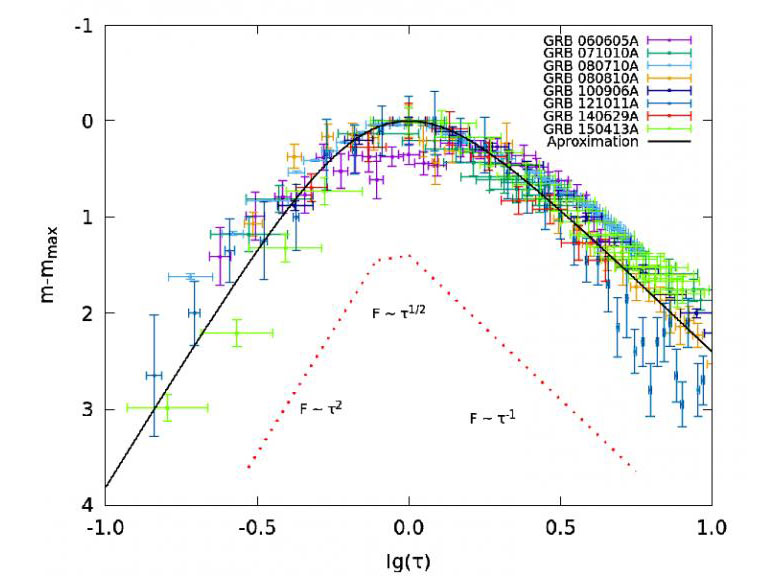
    This is an SOS-emission light curve. Credit: Vladimir Lipunov

    One of the MASTER Global Robotic Net telescopes (MSU) located on Tenerife (Spain, Canary Islands) helped the scientists observe the gamma-ray burst caused by the collapse of a star and the formation of a black hole in its place. Usual telescopes are unable to point to gamma-ray bursts error-boxes fast enough to monitor the change in its brightness and obtain any information about its source. A report on the discovery that MASTER MSU scientists dedicated to the physicist Stephen Hawking, was published in The Astronomer’s Telegram.

    Gamma-ray bursts are registered by space observatories quite often – every day. These energy outbursts follow the collisions of neutron stars or a collapse of a massive star causing it to turn to a neutron star, a quark star, or a black hole. Huge amounts of energy are released in these cases, and telescopes can detect gamma-ray bursts even if they happen millions or even billions of light years away from the Earth. Gamma-ray bursts last from several milliseconds to dozens of seconds and are registered in different ranges.

    “The main task of MASTER Global Robotic Net is to see the early optic emission until the burst fades down. In the optical range we saw the whole event from the beginning to end. This is a rare occasion that happens only twice or thrice a year, and as a rule, such observations are carried out using MASTER robotic telescopes,” commented Vladimir Lipunov, Professor of the Faculty of Physics at MSU and the Head of MASTER Global Robotic Net.

    Astronomers also managed to obtain the light curve of the gamma-ray burst (it was assigned the code GRB180316A) and to calculate its exact coordinates. The light curve met the ideal shape noticed in several different gamma-ray bursts and named SOS-emission (Smooth Optical Self-similar Emission) in 2017. The name is a reference to the source of such a gamma-ray burst – the death of a star.

    The advantages of the MASTER system compared to similar ones lies in the quality of controlling and online own reducing mathematical software (MASTER-robot), the number of telescopes, and their locations (eight units are situated in different parts of Eurasia, in South America, in the south of Africa, and on the Canary Islands). Another feature is the targeting system that allows the telescopes to quickly focus on gamma-ray bursts optical counterparts, sources of gravitation waves, high energy neutrino, ultrahigh energy bursts, and other events. All these factors created the best conditions for the observation of the gamma-ray burst in the optic range.

    Never miss a breakthrough: Join the SciTechDaily newsletter.
    Follow us on Google and Google News.

    Astronomy Astrophysics Black Hole Lomonosov Moscow State University Stephen Hawking
    Share. Facebook Twitter Pinterest LinkedIn Email Reddit

    Related Articles

    NASA Investigates an “Old Faithful” Active Galaxy That Erupts Every 114 Days

    Unexpected Discovery: Hubble Space Telescope Uncovers Concentration of Small Black Holes

    Deepening Mystery: Astronomers on the Hunt for a Missing Supermassive Black Hole [Video]

    When Galaxies Collide: How Galactic Collisions Can Starve Massive Black Holes

    Massive Stellar Triples Leading to Sequential Binary Black-Hole Mergers

    Astronomers Discover Earliest Supermassive Black Hole and Quasar in the Universe – 1000x More Luminous Than the Milky Way

    Most Distant Quasar Discovered Sheds Light on How Supermassive Black Holes Grow

    Deepening Astronomical Mystery: On the Hunt for a Missing Giant Black Hole

    Supermassive Black Hole’s Dust Ring May Be Casting Shadows From Heart of a Galaxy

    Leave A Reply Cancel Reply

    • Facebook
    • Twitter
    • Pinterest
    • YouTube

    Don't Miss a Discovery

    Subscribe for the Latest in Science & Tech!

    Trending News

    Breakthrough Bowel Cancer Trial Leaves Patients Cancer-Free for Nearly 3 Years

    Natural Compound Shows Powerful Potential Against Rheumatoid Arthritis

    100,000-Year-Old Neanderthal Fossils in Poland Reveal Unexpected Genetic Connections

    Simple “Gut Reset” May Prevent Weight Gain After Ozempic or Wegovy

    2.8 Days to Disaster: Scientists Warn Low Earth Orbit Could Suddenly Collapse

    Common Food Compound Shows Surprising Power Against Superbugs

    5 Simple Ways To Remember More and Forget Less

    The Atomic Gap That Could Cost the Semiconductor Industry Billions

    Follow SciTechDaily
    • Facebook
    • Twitter
    • YouTube
    • Pinterest
    • Newsletter
    • RSS
    SciTech News
    • Biology News
    • Chemistry News
    • Earth News
    • Health News
    • Physics News
    • Science News
    • Space News
    • Technology News
    Recent Posts
    • After 37 Years, the World’s Longest-Running Soil Warming Experiment Uncovers a Startling Climate Secret
    • NASA Satellite Captures First-Ever High-Res View of Massive Pacific Tsunami
    • ADHD Isn’t Just a Deficit: Study Reveals Powerful Hidden Strengths
    • Scientists Uncover “Astonishing” Hidden Property of Light
    • Scientists Discover Stem Cells That Could Regrow Teeth and Bone
    Copyright © 1998 - 2026 SciTechDaily. All Rights Reserved.
    • Science News
    • About
    • Contact
    • Editorial Board
    • Privacy Policy
    • Terms of Use

    Type above and press Enter to search. Press Esc to cancel.