
Close Menu
    Facebook X (Twitter) Instagram
    SciTechDaily
    • Biology
    • Chemistry
    • Earth
    • Health
    • Physics
    • Science
    • Space
    • Technology
    Facebook X (Twitter) Pinterest YouTube RSS
    SciTechDaily
    Home»Space»Astronomers Deduce the Characteristics of Nanodust
    Space

    Astronomers Deduce the Characteristics of Nanodust

    By Harvard-Smithsonian Center for AstrophysicsSeptember 9, 2013No Comments3 Mins Read
    Facebook Twitter Pinterest Telegram LinkedIn WhatsApp Email Reddit
    Share
    Facebook Twitter LinkedIn Pinterest Telegram Email Reddit
    Astronomers Deduce the Characteristics of Nanodust
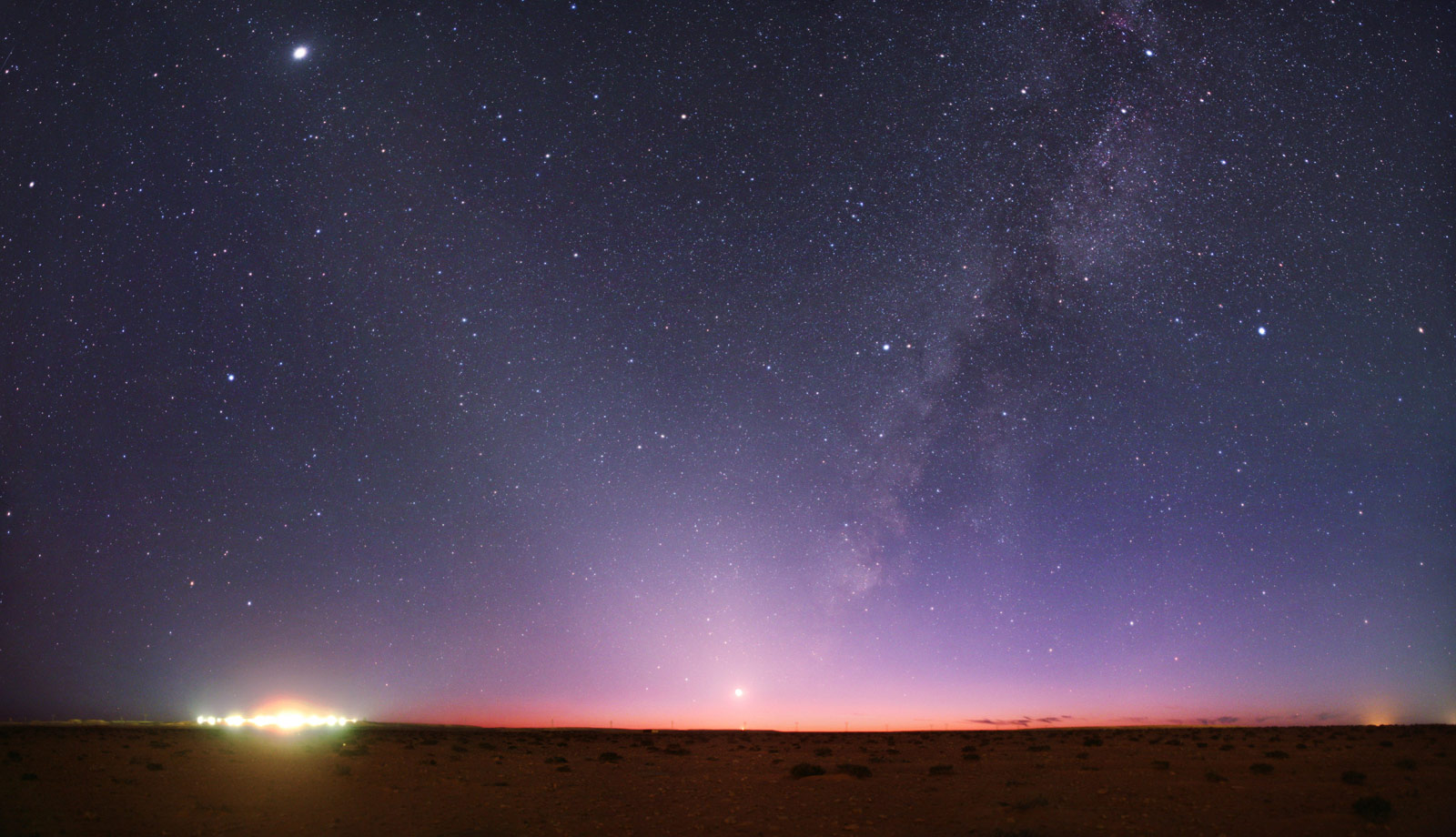
    Zodiacal light scattered from dust grains in our solar system is seen rising diagonally up to the left in this image, as the plane of the Milky Way rises up to the right. Scientists have used the STEREO spacecraft to study tiny nanodust particles in the solar system. Credit: Tunc Tezel, TWAN; APOD

    A team of astronomers has used the Low Frequency Receiver onboard the twin Solar Terrestrial Relations Observatory spacecraft to deduce the characteristics of nanodust, showing that this nanometer-scale dust is a significant contributor to the total mass in interplanetary space.

    In our solar system, dust particles are abundant, created by asteroid collisions and by the evaporation of comets. These particles are the source of the zodiacal light, a diffuse glow in the night sky that extends along the ecliptic (the plane of the solar system) and which is seen from Earth stretching along the zodiac, most easily after sunset or before sunrise. It is so faint that moonlight is enough to mask it.

    The gravity of the planets affects the distribution of these dust particles. The Earth, for example, collects dust in a series of patches which lie in a ring along the Earth’s orbit. New measurements used radio instruments on twin interplanetary spacecraft to study nanometer-scale dust particles, or “nanodust.” A grain of nanodust is smaller than a wavelength of optical light, and unlike the roughly ten times larger grains responsible for the zodiacal light, nanodust is too small to efficiently scatter sunlight and can only be detected using space instruments. When a grain of nanodust impacts a spacecraft, it creates an expanding cloud of ionized gas which can lead to a voltage pulse between a spacecraft’s body and its antenna, which can then be sensed. Nanodust can be accelerated by the interplanetary magnetic field to the speed of the solar wind — significantly faster than the orbital speeds of heavier dust grains. Because the electrical signal induced by a dust grain depends more strongly on its impact speed than on its mass, nanodust produces a strong signal despite its being lightweight.

    CfA astronomers Gaetan Le Chat and Justin Kasper, along with eight colleagues, used the Low Frequency Receiver onboard the twin Solar TErrestrial RElations Observatory (STEREO) spacecraft in an extensive program spanning seven years to deduce the characteristics of nanodust. The two STEREO spacecraft are in solar orbits with one ahead of the Earth and one trailing behind. On average, the spacecraft recorded about fifty nanodust impacts (voltage pulses) every second, with occasional bursts of up to a thousand hits. The scientists analyzed over seven hundred thousand measurements to conclude that nanodust is a significant contributor to the total mass of material in interplanetary space, in agreement with earlier estimates, and to begin to characterize its properties. Although STEREO was designed to study solar storms, not nanodust, the new results not only help complete the picture of our solar system, they show how innovative scientists can sometimes squeeze added science from workhorse instruments.

    Reference: “Interplanetary Nanodust Detection by the Solar Terrestrial Relations Observatory/WAVES Low Frequency Receiver” by G. Le Chat, A. Zaslavsky, N. Meyer-Vernet, K. Issautier, S. Belheouane, F. Pantellini, M. Maksimovic, I. Zouganelis, S. D. Bale and J. C. Kasper, 29 March 2013, Solar Physics.
    DOI: 10.1007/s11207-013-0268-x
    arXiv:1303.1109


    Never miss a breakthrough: Join the SciTechDaily newsletter.
    Follow us on Google and Google News.

    Astronomy Astrophysics Harvard-Smithsonian Center for Astrophysics
    Share. Facebook Twitter Pinterest LinkedIn Email Reddit

    Related Articles

    X-Ray Emission From Mysterious Dark Matter

    Analyzing Dust Storm Sequences on Mars

    Intriguing Remains of a Rare Stellar Explosion Discovered in Milky Way Center

    Puzzling Astrophysics of Quasars in the Early Universe

    Four Exoplanets – Including a Super-Earth Planet – Discovered by High School Students

    Massive Rotating Stars in the Pleiades Cluster

    Astronomers Discover First Cloudless, Jupiter-Like Planet – “Smoking Gun Evidence”

    Chandra X-ray Observatory Studies Extraordinary Magnetar [Video]

    Chandra Studies Extraordinary Magnetar: Fastest Spinning and Possibly the Youngest Magnetar Known

    Leave A Reply Cancel Reply

    • Facebook
    • Twitter
    • Pinterest
    • YouTube

    Don't Miss a Discovery

    Subscribe for the Latest in Science & Tech!

    Trending News

    New Pill Lowers Stubborn Blood Pressure and Protects the Kidneys

    Humans May Have Hidden Regenerative Powers, New Study Suggests

    Scientists Just Solved the Mystery of Why Crabs Walk Sideways

    Doctors Are Surprised by What This Vaccine Is Doing to the Heart

    This Popular Supplement May Boost Your Brain, Not Just Your Muscles

    Scientists Say This Simple Supplement May Actually Reverse Heart Disease

    Warming Oceans Could Trigger a Dangerous Methane Surge

    This Simple Movement Could Be Secretly Cleaning Your Brain

    Follow SciTechDaily
    • Facebook
    • Twitter
    • YouTube
    • Pinterest
    • Newsletter
    • RSS
    SciTech News
    • Biology News
    • Chemistry News
    • Earth News
    • Health News
    • Physics News
    • Science News
    • Space News
    • Technology News
    Recent Posts
    • Astronomers Stunned by Ancient Galaxy With No Spin
    • Physicists May Be on the Verge of Discovering “New Physics” at CERN
    • AI Learns To Work Backward and Reveal Hidden Forces in Nature
    • Scientists Warn of Rising Male Childlessness As Global Fertility Changes
    • New Discovery Challenges Decades-Old Theory of DNA Damage and Aging
    Copyright © 1998 - 2026 SciTechDaily. All Rights Reserved.
    • Science News
    • About
    • Contact
    • Editorial Board
    • Privacy Policy
    • Terms of Use

    Type above and press Enter to search. Press Esc to cancel.