
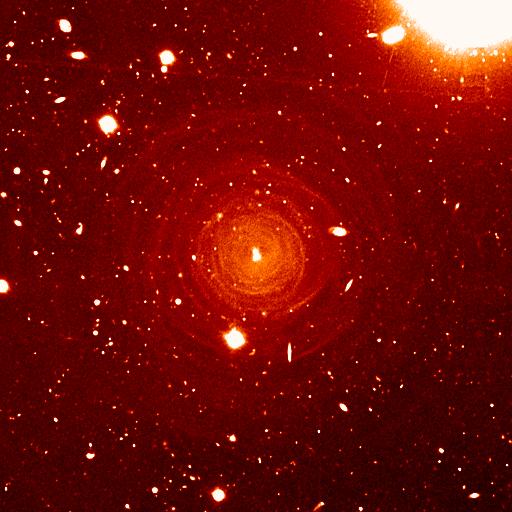
After decades of speculation and searching, astronomers have discovered the important dust-forming molecule Si-C-Si (disilicon carbide) in space.
The space between stars is not empty — it contains a vast reservoir of diffuse material with about 5-10% of the total mass of our Milky Way galaxy. Most of the material is gas, but about 1% of this mass (quite a lot in astronomical terms) takes the form of tiny dust grains made predominantly of silicates (sand is also silicates), although grains can also be composed of carbon and other elements. The dust grains contain a large fraction of many important elements in the universe like silicon, carbon, and iron. They also play several crucially important roles. They are essential to the chemistry that takes place in the interstellar medium by providing gas molecules with a surface on which to react with other molecules. They absorb ultraviolet and optical light, re-emitting the energy as infrared light, and thus they both constrain what astronomers can see and control much of the energy balance in the interstellar medium. Not least, in the early stages of a star’s evolution the dust can coagulate into large clumps — the first step towards forming planets.
Where does all this dust come from? Interstellar grains are synthesized in two main types of sources: the inner winds of a class of evolved stars, and the ejecta of supernovae. The grains form out of molecular seeds. In evolved stars, such seeds might be molecules like TiO, VO, ZrO, C_2, CN, or C_3, species that have been known for a hundred years; supernovae also have numerous possible constituent elements. Because the carbon monoxide (CO) molecule is extremely stable, it uses up nearly all of the carbon or oxygen (whichever happens to be less abundant). Thus, if the oxygen is less abundant than carbon, there is some carbon left over and available for the grains. Carbon-rich stars are ones that have this excess carbon. The dust forms from nucleation seeds that grow as molecules condense onto them via numerous steps, which are still quite mysterious, particularly the first step of forming the nucleation seeds.
One likely seed is predicted to be the molecule Si-C-Si (disilicon carbide), but it had never been identified in space. Analogous molecules have been found, like Si-C-C (SiC_2), and both SiC molecules and grains are known, and so the search for disilicon carbide has been underway for several decades. Now CfA astronomers Mike McCarthy, Carl Gottlieb, Nimesh Patel, N. Reilly, and Ken Young and their colleagues have reported detecting 112 transitions of the disilicon carbide in the extended atmosphere of the evolved, carbon-rich star RW Leo. Their success is largely due to their own, new laboratory measurements that determined more accurate values for the line frequencies. The team then used the Submillimeter Array and the IRAM submillimeter telescope to search in RW Leo, which was already well-known for hosting a rich family of carbon-bearing molecules.
The observations of disilicon carbide are in good (though not perfect) agreement with the chemical model expectations, lending credibility to the theory but highlighting some needed corrections to the model of the source. The molecule is roughly ten times less abundant in this source as is its cousin, SiC_2. These two molecules are thought to be the most abundant silicon-carbon species in the dust-forming part of the stellar environment, and they surely play a key role in making dust grains.
Reference: “Discovery of SiCSi in IRC+10216: A missing link between gas and dust carriers of SiC bonds” by J. Cernicharo, M. C. McCarthy, C. A. Gottlieb, M. Agúndez, L. Velilla Prieto, J. H. Baraban, P. B. Changala, M. Guélin, C. Kahane, M. A. Martin- Drumel, N. A. Patel, N. J. Reilly, J. F. Stanton, G. Quintana-Lacaci, S. Thorwirth and K. H. Young, 25 June 2015, The Astrophysical Journal Letters.
DOI: 10.1088/2041-8205/806/1/L3
Never miss a breakthrough: Join the SciTechDaily newsletter.
Follow us on Google and Google News.
2 Comments
Is this the dark matter we have been searching for and speculating over ?!
No.