
Close Menu
    Facebook X (Twitter) Instagram
    SciTechDaily
    • Biology
    • Chemistry
    • Earth
    • Health
    • Physics
    • Science
    • Space
    • Technology
    Facebook X (Twitter) Pinterest YouTube RSS
    SciTechDaily
    Home»Space»Astronomers Discover Giant Halos Around Early Galaxies
    Space

    Astronomers Discover Giant Halos Around Early Galaxies

    By The Royal Astronomical SocietyJanuary 12, 2017No Comments5 Mins Read
    Facebook Twitter Pinterest Telegram LinkedIn WhatsApp Email Reddit
    Share
    Facebook Twitter LinkedIn Pinterest Telegram Email Reddit
    Photons Struggle to Escape Distant Galaxies
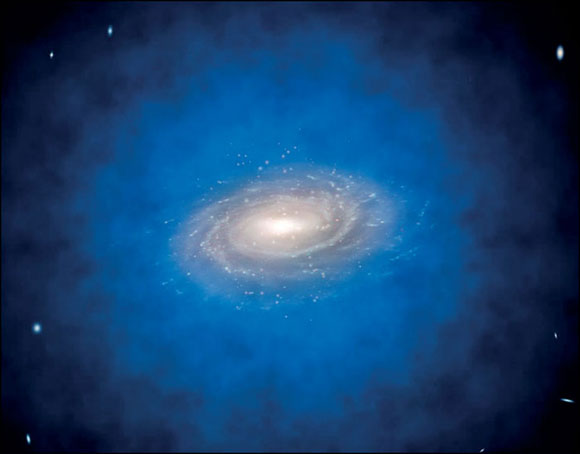
    The artistic impression shows a Milky Way type galaxy in the local Universe, surrounded by a much larger halo of blue, faint light, made of Lyman-alpha photons. While these photons were produced around hot, young stars in much more central regions, they struggle to escape the galaxies, suffering many absorptions and re-emissions as they try to escape, and creating these giant halos. For typical distant galaxies, only a few per cent actually make it out at all. This is what astronomers have now been able to see for similar galaxies that existed 11 billion years ago, in a very young, active Universe. This has important implications for studying the young Universe, where these photons are remarkably important, but are usually measured over only the very central component of each galaxy. Credit: ESO/L. Calçada.

    Using the Isaac Newton Telescope, a team of astronomers has discovered giant halos of photons around early Milky Way type galaxies.

    In order to understand how our own Milky Way galaxy formed and evolved, astronomers rely on observing distant galaxies. As their light takes billions of years to reach us, telescopes can be used as time machines, as long as we have a clear indicator to pinpoint the distance to the objects being observed. As with closer galaxies, stars, and planets, astronomers use the technique of spectroscopy to analyze their light, dispersing it into a spectrum.

    Scientists then look for characteristic features (spectral lines) that tell them about properties including the composition, temperature, and movement of the object. With the most distant galaxies, only one spectral feature typically stands out, the so-called Lyman-alpha line associated with hydrogen gas.

    Jorryt Matthee comments: “Newly born stars in very distant galaxies are hot enough to break apart hydrogen in surrounding clouds of gas, which then shines brightly in Lyman-alpha light, in theory, the strongest such features observable in a distant galaxy. Yet in practice, Lyman-alpha photons struggle to escape galaxies as gas and dust block and diverge their travel paths, making it a complex process to understand.”

    Using the Isaac Newton Telescope (INT) on La Palma in the Canary Islands, astronomers developed a unique experiment to study almost 1000 distant galaxies. They surveyed the sky using the Wide Field Camera and custom-made filters, in order to measure where the Lyman-alpha is produced, how much of it there is, and where it comes out of galaxies.

    Astronomers Discover Giant Halos Around Early Milky Way Type Galaxies
    The figure shows some of the observations conducted with the Isaac Newton Telescope in La Palma and with the UKIRT telescope in Hawaii of one of the (almost 1000) young Milky Way type galaxies in the very early Universe. The results allowed astronomers to measure where, and how many, photons were produced (indicated by the red contour lines), and then compare with those that have actually escaped (blue contour lines) these distant galaxies. The results reveal large haloes of Lyman-alpha photons that struggled to escape, while the vast majority of these photons never make it out at all. Credit: J. Matthee/D. Sobral.

    David Sobral says: “We have used dozens of dedicated nights on the INT to understand how Lyman-alpha photons escape, and from which galaxies. We looked back in time 11 billion years, essentially the limit of where we can identify distant galaxies and study them in detail. Most importantly, we were able to predict accurately how many Lyman-alpha photons were effectively produced in each galaxy and where this happened. Then we compared them with the ones that actually reach the INT.”

    The results show that only 1-2% of those photons escape from the centers of galaxies like the Milky Way. Even if we account for all the photons at a large distance from the center, fewer than 10% escape.

    “Galaxies forming stars in the distant Universe seem to be surrounded by an impressively large, faint halo of Lyman-alpha photons that had to travel for hundreds of thousands of light years in an almost endless series of absorption and re-emission events, until they were finally free. We now need to understand exactly how and why that happens,” adds Sobral.

    When the James Webb Space Telescope begins operation in 2018, astronomers expect to be able to look even further back in time, opening up a new window on the first galaxies and stars. Studying how the escape fraction evolves over time can tell us about the kind of stars producing these photons, and the properties of interstellar and intergalactic gas.

    Reference:

    “The CALYMHA survey: Lyα escape fraction and its dependence on galaxy properties at z = 2.23” by Jorryt Matthee, David Sobral, Iván Oteo, Philip Best, Ian Smail, Huub Röttgering and Ana Paulino-Afonso, 10 February 2016, Monthly Notices of the Royal Astronomical Society.
    DOI: 10.1093/mnras/stw322

    “The CALYMHA survey: Lyα luminosity function and global escape fraction of Lyα photons at z=2.23” by David Sobral, Jorryt Matthee, Philip Best, Andra Stroe, Huub Röttgering, Iván Oteo, Ian Smail, Leah Morabito and Ana Paulino-Afonso, 30 November 2016, Monthly Notices of the Royal Astronomical Society.
    DOI: 10.1093/mnras/stw3090

    Never miss a breakthrough: Join the SciTechDaily newsletter.
    Follow us on Google and Google News.

    Astronomy Astrophysics Cosmology Lancaster University Royal Astronomical Society
    Share. Facebook Twitter Pinterest LinkedIn Email Reddit

    Related Articles

    Star Vanishes for 200 Days in One of the Longest Cosmic Dimming Events Ever Recorded

    Is the Universe Slowing Down? Stunning New Evidence Says Yes

    Dark Energy May Be an Illusion: Scientists Uncover a “Lumpy” Universe

    Planet 2MASS J2126 is 1 Trillion Kilometers Away from Its Parent Star

    Astronomers Discover an Oversized Black Hole That is 350 Million Times the Mass of Our Sun

    Two Massive Stars with Magnetic Fields Discovered in Binary System Epsilon Lupi

    A New Catalog of the Visible Milky Way

    Interactions between Cold Dark Matter and Radiation Leads to a Dramatic Reduction in Satellite Galaxies

    Dark Energy Survey Reveals a Rare Superluminous Supernova

    Leave A Reply Cancel Reply

    • Facebook
    • Twitter
    • Pinterest
    • YouTube

    Don't Miss a Discovery

    Subscribe for the Latest in Science & Tech!

    Trending News

    Massive Study Warns Marijuana Use in Teens Is Linked to Serious Mental Illness

    Scientists Discover a Completely Unexpected Way T Cells Kill Cancer

    Scientists Just Found the Solar System’s Original “Planet Factory”

    Study Warns Widely Used Food Preservatives Linked to High Blood Pressure and Heart Disease

    New Treatment Could Reverse Osteoarthritis Within Weeks

    Physicists Have Measured “Negative Time” in Bizarre Quantum Experiment

    The Deadly Tapeworm Spreading Across America Has Reached the Pacific Northwest

    Could Low Vitamin D Be Making Your Pain Worse?

    Follow SciTechDaily
    • Facebook
    • Twitter
    • YouTube
    • Pinterest
    • Newsletter
    • RSS
    SciTech News
    • Biology News
    • Chemistry News
    • Earth News
    • Health News
    • Physics News
    • Science News
    • Space News
    • Technology News
    Recent Posts
    • Scientists Have Discovered These Deadly Parasites Are Secretly Swapping DNA
    • What Scientists Found Inside a 117-Year-Old Woman Reveals New Clues to Long Life
    • Breakthrough Technique Reveals Atomic Secrets of Record-Breaking Superconductors
    • The Future of Work Belongs to People Who Master AI
    • Scientists Challenge a 70-Year-Old Theory of Language With a Surprising Discovery
    Copyright © 1998 - 2026 SciTechDaily. All Rights Reserved.
    • Science News
    • About
    • Contact
    • Editorial Board
    • Privacy Policy
    • Terms of Use

    Type above and press Enter to search. Press Esc to cancel.