
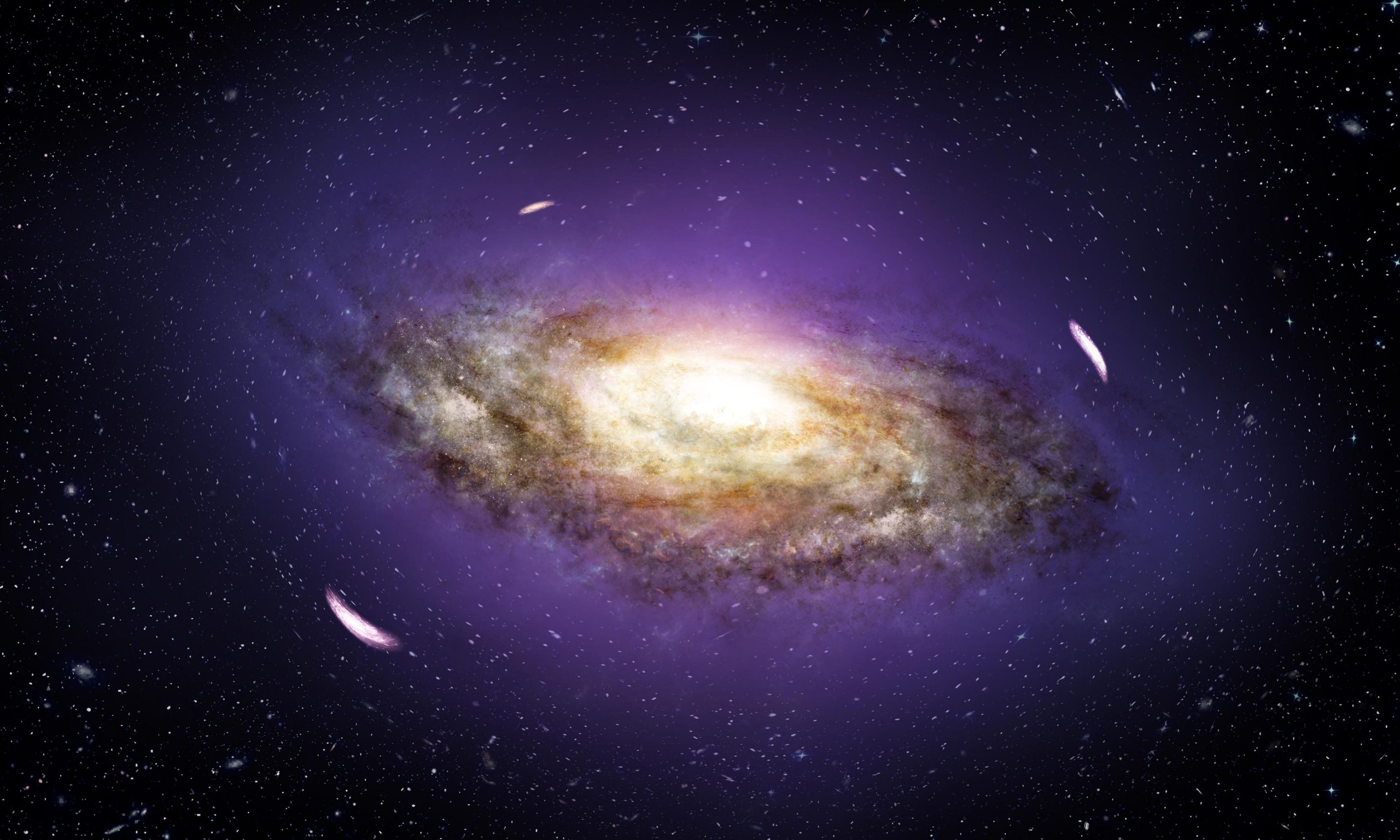
A small team of astronomers have found a new way to ‘see’ the elusive dark matter halos that surround galaxies, with a new technique 10 times more precise than the previous-best method. The work is published in Monthly Notices of the Royal Astronomical Society.
Scientists currently estimate that up to 85% of the mass in the universe is effectively invisible. This ‘dark matter’ cannot be observed directly, because it does not interact with light in the same way as the ordinary matter that makes up stars, planets, and life on Earth.
So how do we measure what cannot be seen? The key is to measure the effect of gravity that the dark matter produces.

Pol Gurri, the PhD student at Swinburne University of Technology who led the new research, explains: “It’s like looking at a flag to try to know how much wind there is. You cannot see the wind, but the flag’s motion tells you how strongly the wind is blowing.”
The new research focuses on an effect called weak gravitational lensing, which is a feature of Einstein’s general theory of relativity. “The dark matter will very slightly distort the image of anything behind it,” says Associate Professor Edward Taylor, who was also involved in the research. “The effect is a bit like reading a newspaper through the base of a wine glass.”
Weak gravitational lensing is already one of the most successful ways to map the dark matter content of the Universe. Now, the Swinburne team has used the ANU 2.3m Telescope in Australia to map how gravitationally lensed galaxies are rotating. “Because we know how stars and gas are supposed to move inside galaxies, we know roughly what that galaxy should look like,” says Gurri. “By measuring how distorted the real galaxy images are, then we can figure out how much dark matter it would take to explain what we see.”

The new research shows how this velocity information enables a much more precise measurement of the lensing effect than is possible using shape alone. “With our new way of seeing the dark matter,” Gurri says, “we hope to get a clearer picture of where the dark matter is, and what role it plays in how galaxies form.”
Future space missions such as NASA’s Nancy Grace Roman Space Telescope and the European Space Agency’s Euclid Space Telescope are designed, in part, to make these kinds of measurements based on the shapes of hundreds of millions of galaxies. “We have shown that we can make a real contribution to these global efforts with a relatively small telescope built in the 1980s, just by thinking about the problem in a different way,” adds Taylor.
Reference: “The first shear measurements from precision weak lensing” by Pol Gurri, Edward N Taylor and Christopher J Fluke, 21 September 2020, Monthly Notices of the Royal Astronomical Society.
DOI: 10.1093/mnras/staa2893
Never miss a breakthrough: Join the SciTechDaily newsletter.
Follow us on Google and Google News.
7 Comments
I was thinking about the dark matter theory? And then I looked at the picture on the front page of the article and I realized it looked earilly simular to a picture of a ship wreck when lit from behind. Reflecting light. Does a fresh water fish think salt water has dark matter but really it’s just salt. Or in this case gas and not dark matter
Darek matter isn’t a specific theory, it is a fact and part of the current cosmology – which is a theory. It is better to think about dark matter as a huge part of the universe, which enables galaxies to form and hugely shape them gravitationally.
If you are asking why scientists separate out it from the visible matter it isn’t just because it is “dark”# today but it behaved very differently when the cosmic background radiation evolved. Anyone can see the difference in the cosmic background spectra peaks for themselves [“The Genome of the Universe” @ Galileo’s Pendulum].
9times out of 10 the simplest answer is the right answer something to think about.can’t keep making new things up to try and account for mistakes better to say yep that was wrong and move on. Or at the very least change your Trane of thought good luck
… business as usual…
When I look up at the sky at night, what are the black root looking or black branching formations that seem to start in space and spread out the closer it hits the ground. I can see this this all around us at night and have never been able to find any info on it.
I don’t know what you see. Can’t you take a photo – an amateur astronomer may help if you need equipment – and check if it is something that only you see or if it is a feature of the night sky?
And if the latter, you may do an image search on Google Image for references or – failing that – ask your amateur astronomer friend if it is something old or new.
Seems promising! An more detailed way to observe dark matter:
“As a result, traditional WL approaches stack (or combine) sets of lensed systems with similar properties to obtain a significant, but averaged, measurement …”
“A clear limitation of traditional WL is the very large number of galaxies required to recover the lensing signal (∼10 000; e.g. Niemi, Kitching & Cropper 2015; van Uitert et al. 2016), and the fact that the measurements can only be interpreted in terms of a population average.”
“Instead of measuring the distortion in the shape of galaxies, this new kind of WL, hereafter precision WL, aims to measure the lensing effects in the galaxies’ velocity fields.”
“Precision WL relates this break in velocity axisymmetry to the lensing mass of the system.”
“… the mean observed shear represents a detection of the lensing signal at ≳ 99.4 per cent confidence.”
“The utility of these new techniques for precision WL are currently limited by the number of galaxies we can target.”