
Close Menu
    Facebook X (Twitter) Instagram
    SciTechDaily
    • Biology
    • Chemistry
    • Earth
    • Health
    • Physics
    • Science
    • Space
    • Technology
    Facebook X (Twitter) Pinterest YouTube RSS
    SciTechDaily
    Home»Space»Astronomers Discover “Old Young” Stars in the Eagle Nebula
    Space

    Astronomers Discover “Old Young” Stars in the Eagle Nebula

    By Harvard-Smithsonian Center for AstrophysicsNovember 11, 2013No Comments4 Mins Read
    Facebook Twitter Pinterest Telegram LinkedIn WhatsApp Email Reddit
    Share
    Facebook Twitter LinkedIn Pinterest Telegram Email Reddit
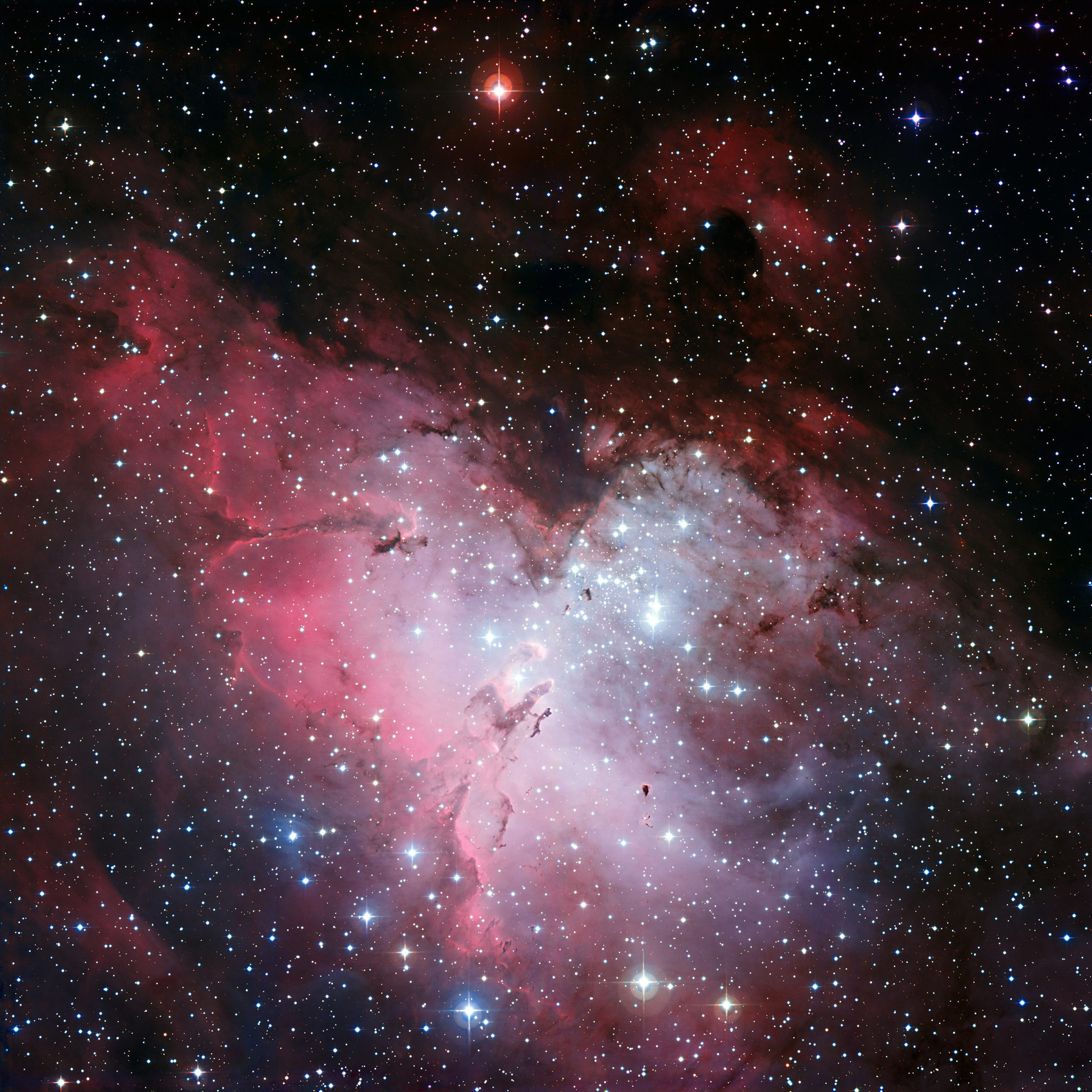
    Image of the Eagle Nebula Shows Old Young Stars
    A composite infrared/optical image of the Eagle Nebula (Messier 16). The so-called “Pillars of Creation” can be seen at the center. Astronomers have discovered that the cluster of hot stars to the upper right contains many “old young” stars – stars that are still in their pre-main-sequence stage of life hosting circumstellar disks of material, but yet are about 16 million years old, many millions of years older than most other young stars in this first phase of life. Credit: ESO

    While studying 110 stars located in the Eagle Nebula, astronomers discovered pre-main-sequence stars that were red in color and showed evidence for accretion, but were much older than expected, around sixteen million years old and possibly as much as thirty million years old.

    The early stages of a star’s life are critical both for the star and for any future planets that might develop around it. The process of star formation, once thought to involve just the simple coalescence of material under the influence of gravity, actually entails a complex series of stages, with the youngest stars assembling circumstellar disks of material, possibly preplanetary in nature. In the current models, conservation of angular momentum during the collapse of cloud cores leads to the formation of these discs. The presence and evolution of these circumstellar discs is important both for the planets that form from them and for the star itself.

    Stars start their lives by burning deuterium, an easier fuel to ignite than hydrogen (although it is less abundant). Stars that burn hydrogen are called main-sequence stars (the Sun is one), and they can continue in this stage of life for ten billion years or more depending on their mass (at least for stars of the Sun’s mass or less). Stars young enough to still primarily burn deuterium are called pre-main-sequence stars, and this stage of their life typically lasts a few hundreds of thousands of years or less (also depending sensitively on the initial mass of the star). The reason that circumstellar disks are so important for young stars (and not just for their planets) is because during the pre-main-sequence phase the star continues to grow in mass, and its growth comes from accreting gas from this disc. The time-scale of disc dissipation therefore sets crucial constraints for models of both star and planet development.

    Understanding these early stages has been difficult for astronomers, in part because they take place in nurseries heavily obscured by dust, but they are critically important to an understanding of how our young solar system and its planets were born and evolved. CfA astronomer Mario Guarcello and three colleagues examined 110 stars located in the Eagle Nebula (associated with the so-called “Pillars of Creation,” a star-forming region made famous by its dramatic Hubble portrait). These stars were red in color, typical of pre-main-sequence stars, and like young stars they also showed evidence for accretion, but they were peculiar in being considerably less red than expected. The team analyzed the X-ray emission of the stars, their red color, total luminosity, and the abundance of certain elements. The astronomers found convincingly that these pre-main-sequence stars are old – in fact, around sixteen million years old and possibly as much as thirty million years old, making them the largest sample of such “old young” stars known. Besides improving our understanding of how stars develop, the team also determined the characteristic lifetime for the pre-planetary disks in these systems: it can last for about six million years, giving planets around such stars a longer time to form than had been imagined.

    Reference: “Pre-main-sequence stars older than 8 Myr in the Eagle nebula” by Guido De Marchi, Nino Panagia, M. G. Guarcello and Rosaria Bonito, 17 September 2013, Monthly Notices of the Royal Astronomical Society.
    DOI: 10.1093/mnras/stt1499
    arXiv:1307.8446

    Never miss a breakthrough: Join the SciTechDaily newsletter.
    Follow us on Google and Google News.

    Astronomy Astrophysics Harvard-Smithsonian Center for Astrophysics Stellar Evolution
    Share. Facebook Twitter Pinterest LinkedIn Email Reddit

    Related Articles

    Harvard Astrophysicists Examine the Properties of Pre-Stellar Cores

    Astronomers Explore the First Three Billion Years of Stars

    Seismic Analysis of Young Stars Reveals Their Evolution

    Dark Stars – Astronomers Investigate if Dark Matter Influenced the Development of Stars

    SMA Reveals New Insights Into How Cosmic Seeds Grow Into Massive Stars

    New Algorithm Allows Astronomers to Track the Process of Star Formation in the Early Universe

    TW Hydrae Provides Insight About the Birth of Our Sun

    Herschel Discovers the Earliest Known Starburst Galaxy

    Masers as Evolutionary Indicators for Star Formation

    Leave A Reply Cancel Reply

    • Facebook
    • Twitter
    • Pinterest
    • YouTube

    Don't Miss a Discovery

    Subscribe for the Latest in Science & Tech!

    Trending News

    Scientists May Have Found the Key to Jupiter and Saturn’s Moon Mystery

    Scientists Uncover Brain Changes That Link Pain to Depression

    Saunas May Do More Than Raise Body Temperature – They Activate Your Immune System

    Exercise in a Pill? Metformin Shows Surprising Effects in Cancer Patients

    Hidden Oceans of Magma Could Be Protecting Alien Life

    New Study Challenges Alzheimer’s Theories: It’s Not Just About Plaques

    Artificial Sweeteners May Harm Future Generations, Study Suggests

    Splashdown! NASA Artemis II Returns From Record-Breaking Moon Mission

    Follow SciTechDaily
    • Facebook
    • Twitter
    • YouTube
    • Pinterest
    • Newsletter
    • RSS
    SciTech News
    • Biology News
    • Chemistry News
    • Earth News
    • Health News
    • Physics News
    • Science News
    • Space News
    • Technology News
    Recent Posts
    • Humans Owe Their Eyes to a Tiny One-Eyed “Cyclops”
    • Researchers Capture Quantum Interference in One of Nature’s Rarest Atoms
    • Ancient DNA Reveals Irish Goats Have a 3,000-Year-Old Lineage Still Alive Today
    • Historians Reveal Secrets of the Strange Hat Wars That Shook Early Modern England
    • “A Plague Is Upon Us”: The Mass Death That Changed an Ancient City Forever
    Copyright © 1998 - 2026 SciTechDaily. All Rights Reserved.
    • Science News
    • About
    • Contact
    • Editorial Board
    • Privacy Policy
    • Terms of Use

    Type above and press Enter to search. Press Esc to cancel.