
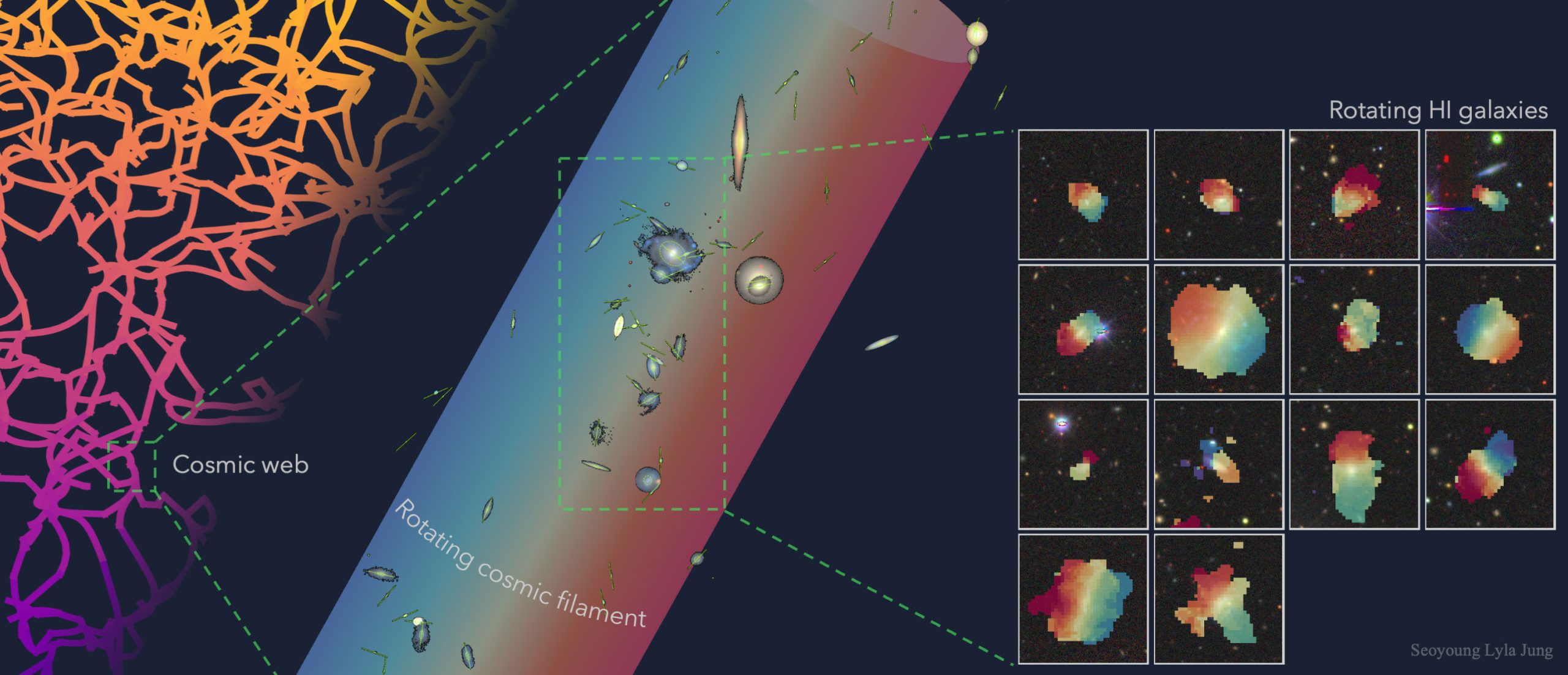
Researchers have found a razor-thin, rotating string of galaxies inside a massive cosmic filament, revealing unexpected alignments that challenge models of how galaxies gain their spin.
An international research group led by the University of Oxford has uncovered one of the most extensive rotating structures ever documented: a “razor-thin” chain of galaxies positioned within a massive, spinning cosmic filament located 140 million light-years from Earth. The discovery, reported in the Monthly Notices of the Royal Astronomical Society, may help clarify how galaxies first developed in the early Universe.
Cosmic filaments represent the largest structural features known in the Universe. They consist of enormous, thread-like networks made of galaxies and dark matter that create a kind of cosmic framework. These structures also guide matter and momentum toward galaxies in their vicinity.
When nearby filaments host numerous galaxies that rotate in the same direction, and when the entire filament appears to turn as a whole, they provide rare opportunities to examine how galaxies acquired their present-day rotation and gas content. They also allow scientists to test ideas about how large-scale cosmic rotation forms over tens of millions of light-years.
A Razor-Thin Galaxy String Inside a Massive Filament
In the new research, scientists identified 14 hydrogen-rich galaxies arranged in a narrow, elongated formation measuring about 5.5 million light-years in length and 117,000 light-years in width. This slim arrangement lies within a much larger filament that stretches roughly 50 million light-years and hosts more than 280 additional galaxies.
Many of the galaxies in this region seem to rotate in the same direction as the filament itself, far more frequently than would be expected from a random orientation. This pattern challenges existing models and indicates that large cosmic structures may shape galaxy rotation more powerfully, or over longer periods of time, than previously understood.
The researchers found that the galaxies on either side of the filament’s spine are moving in opposite directions, suggesting that the entire structure is rotating. Using models of filament dynamics, they inferred the rotation velocity of 110 km/s and estimated the radius of the filament’s dense central region at approximately 50 kiloparsecs (about 163,000 light-years).
Insights Into Galactic Spin and Cosmic Dynamics
Co-lead author Dr. Lyla Jung (Department of Physics, University of Oxford) said: “What makes this structure exceptional is not just its size, but the combination of spin alignment and rotational motion. You can liken it to the teacups ride at a theme park. Each galaxy is like a spinning teacup, but the whole platform- the cosmic filament -is rotating too. This dual motion gives us rare insight into how galaxies gain their spin from the larger structures they live in.”
The filament appears to be a young, relatively undisturbed structure. Its large number of gas-rich galaxies and low internal motion – a so-called “dynamically cold” state – suggest it’s still in an early stage of development.
Since hydrogen is the raw material for star formation, galaxies that contain much hydrogen gas are actively gathering or retaining fuel to form stars. Studying these galaxies can therefore give a window into early or ongoing stages of galaxy evolution.
Tracing Gas Flows Through the Cosmic Web
Hydrogen-rich galaxies are also excellent tracers of gas flow along cosmic filaments. Because atomic hydrogen is more easily disturbed by motion, its presence helps reveal how gas is funnelled through filaments into galaxies -offering clues about how angular momentum flows through the cosmic web to influence galaxy morphology, spin, and star formation.
The discovery could also inform future efforts to model intrinsic alignments of galaxies, a potential contaminant in upcoming weak lensing cosmology surveys with the European Space Agency’s Euclid mission and the Vera C. Rubin Observatory in Chile.
Co-lead author Dr. Madalina Tudorache (Institute of Astronomy, University of Cambridge / Department of Physics, University of Oxford) added: “This filament is a fossil record of cosmic flows. It helps us piece together how galaxies acquire their spin and grow over time.”
Multi-Observatory Effort and International Collaboration
The international team used data from South Africa’s MeerKAT radio telescope, one of the world’s most powerful telescopes, comprising an array of 64 interlinked satellite dishes. This spinning filament was discovered using a deep survey of the sky called MIGHTEE, which is led by Professor of Astrophysics Matt Jarvis (Department of Physics, University of Oxford). This was combined with optical observations from the Dark Energy Spectroscopic Instrument (DESI) and Sloan Digital Sky Survey (SDSS) to reveal a cosmic filament exhibiting both coherent galaxy spin alignment and bulk rotation.
Professor Jarvis said: “This really demonstrates the power of combining data from different observatories to obtain greater insights into how large structures and galaxies form in the Universe. Such studies can only be achieved by large groups with diverse skill sets, and in this case, it was really made possible by winning an ERC Advanced Grant/UKIR Frontiers Research Grant, which funded the co-lead authors.”
Reference: “A 15 Mpc rotating galaxy filament at redshift z = 0.032” by Madalina N Tudorache, S L Jung, M J Jarvis, I Heywood, A A Ponomareva, A A Vărăşteanu, N Maddox, T Yasin and M Glowacki, 4 December 2025, Monthly Notices of the Royal Astronomical Society.
DOI: 10.1093/mnras/staf2005
The study also involved researchers from University of Cambridge University of the Western Cape Rhodes University, South African Radio Astronomy Observatory, University of Hertfordshire, University of Bristol, University of Edinburgh, and University of Cape Town.
Never miss a breakthrough: Join the SciTechDaily newsletter.
Follow us on Google and Google News.