

UC Berkeley astronomers found a hidden black hole roaming far from the galaxy’s core. It may eventually merge with the central black hole and release gravitational waves.
Astronomers have identified nearly 100 cases of massive black holes feasting on stars, almost all located in the dense centers of large galaxies, where these black holes usually reside.
Now, UC Berkeley astronomers have discovered the first known case of a massive black hole tearing apart a star far from the galaxy’s core, which also contains its own central black hole.
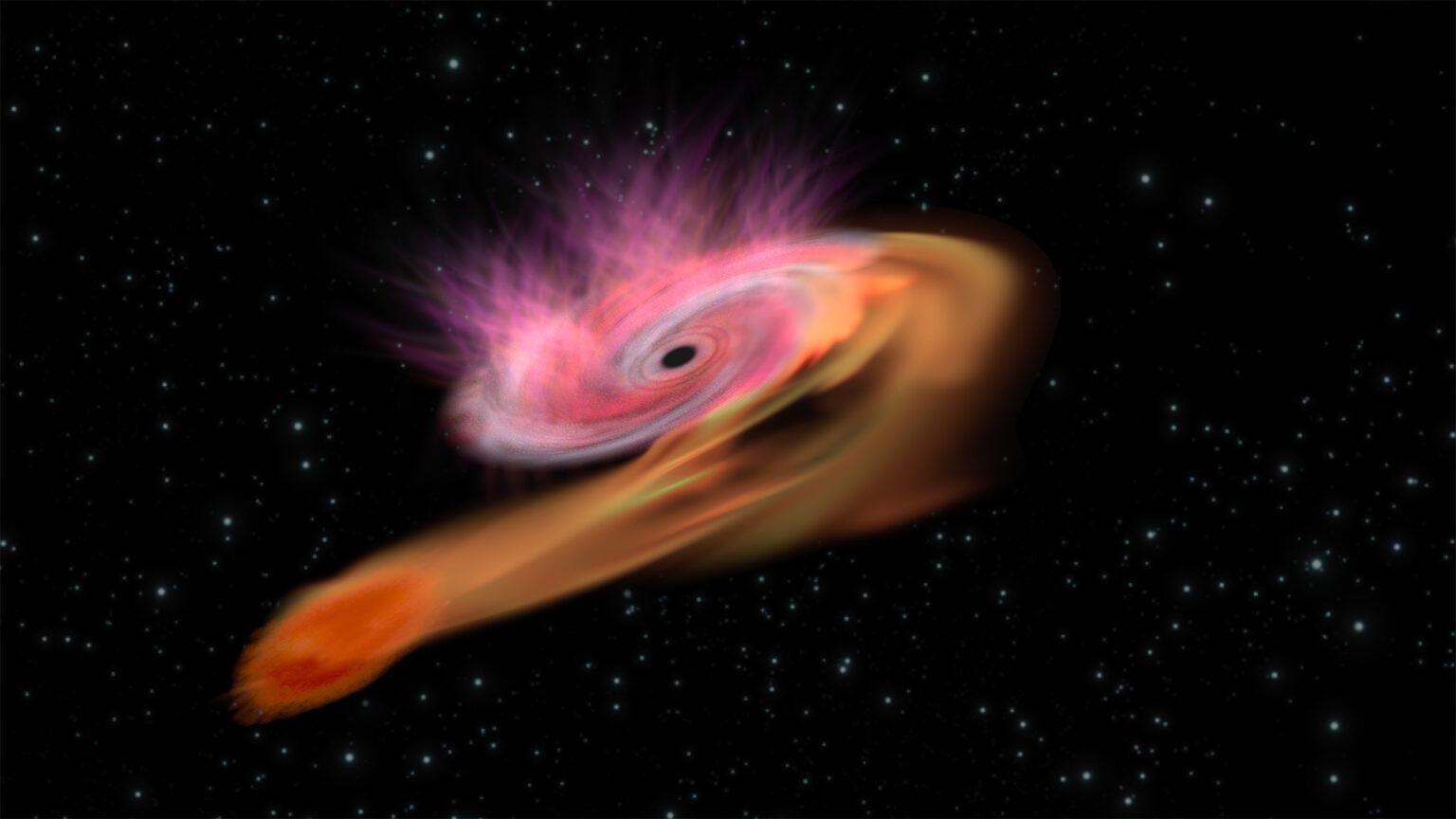
This off-center black hole, about 1 million times the mass of the sun, was hidden in the outskirts of the galaxy’s central bulge. It revealed itself through flashes of light caused by a star being torn apart in a tidal disruption event, or TDE. In a TDE, the black hole’s gravity stretches the star into a thin stream — a process known as spaghettification.
“The classic location where you expect massive black holes to be in a galaxy is in the center, like our Sag A* at the center of the Milky Way,” said Yuhan Yao, a Miller Postdoctoral Fellow at UC Berkeley who is lead author of a paper about the discovery recently published in The Astrophysical Journal Letters (ApJL). “That’s where people normally search for tidal disruption events. But this one, it’s not at the center. It’s actually about 2,600 light years away. That’s the first optically discovered off-nuclear TDE discovered.”
Meanwhile, the galaxy’s central black hole, roughly 100 million times the mass of the sun, is feeding on nearby gas that has ventured too close to escape.
Studying massive black holes in galaxy centers helps astronomers understand how galaxies evolve. Our own Milky Way contains one such black hole, called Sag A*, with a mass of 4 million suns. In contrast, the largest galaxies may have central black holes as massive as 100 billion suns, likely formed from mergers with smaller black holes.
Finding two massive black holes in one galaxy isn’t unexpected. Large galaxies often merge, bringing their central black holes together. These black holes may orbit each other quietly for long periods before eventually merging. Until then, they often remain hidden, only becoming visible during rare events like a TDE. On average, a massive black hole disrupts a star once every 30,000 years.
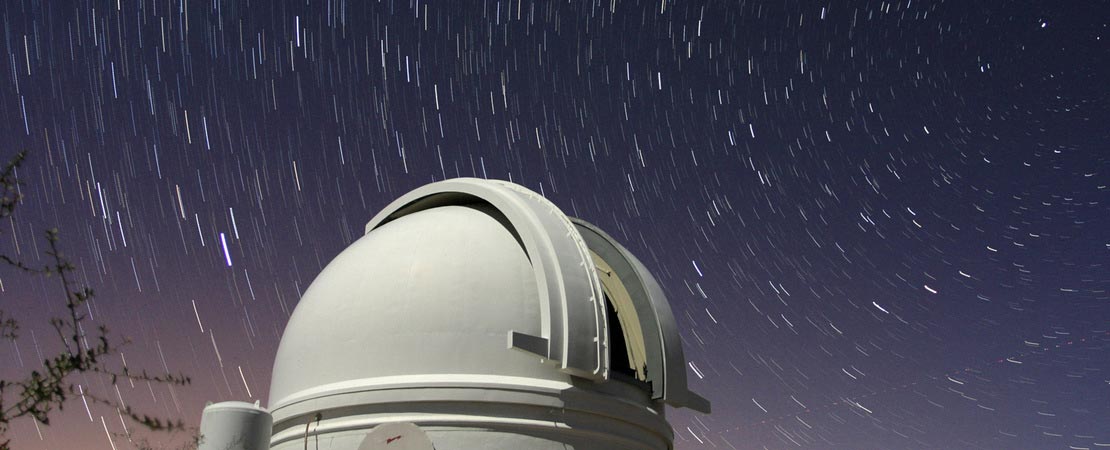
The new TDE, dubbed AT2024tvd, was detected by the Zwicky Transient Facility, an optical camera mounted on a telescope at Palomar Observatory near San Diego, and confirmed by observations with radio, X-ray and other optical telescopes, including NASA’s Hubble Space Telescope.
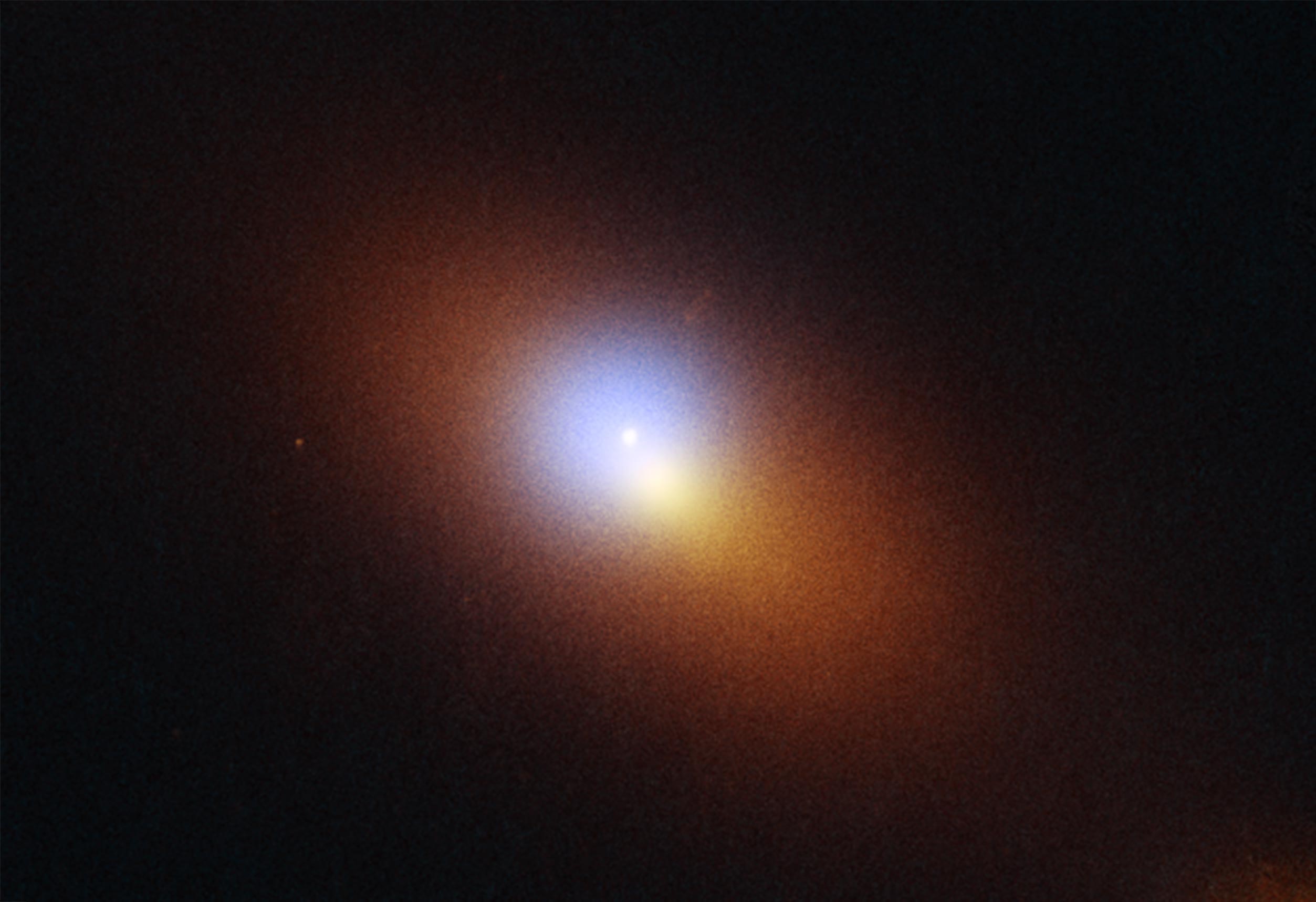
“Massive black holes are always at the centers of galaxies, but we know that galaxies merge — that is how galaxies grow. And when you have two galaxies that come together and become one, you have multiple black holes,” said co-author Ryan Chornock, a UC Berkeley associate adjunct professor of astronomy. “Now, what happens? We expect they eventually come together, but theorists have predicted that there should be a population of black holes that are roaming around inside galaxies.”
The discovery of one such roaming black hole shows that systematic searches for the signature of a TDE could turn up more rogue black holes. The find also validates plans for a space mission called LISA — the Laser Interferometer Space Antenna — that will look for gravitational waves from mergers of massive black holes like these.
“This is the first time that we actually see massive black holes being so close using TDEs,” said co-author Raffaella Margutti, a UC Berkeley associate professor of astronomy and of physics. “If these are a couple of supermassive black holes that are getting closer together — which is not necessarily true — but if they are, they might merge and emit gravitational waves that we’ll see in the future with LISA.”
LISA will complement ground-based gravitational wave detectors, such as LIGO and Virgo, which are sensitive to the merger of black holes or neutron stars weighing less than a few hundred times the mass of our sun, and telescopic studies of pulsar flashes, such as the Nanograv pulsar timing array experiment, which are sensitive to gravitational waves from the mergers of supermassive black holes weighing billions of solar masses. LISA’s sweet spot is black holes of several million solar masses. LISA is slated to be launched in the next decade.
Transient outbursts
Because black holes are invisible, scientists can only find them by detecting the light produced when they shred stars or gas clouds and create a bright, hot, rotating disk of material that gradually falls inward. TDEs are powerful probes of black hole accretion physics, Chornock said, revealing how close material can get to the black hole before being captured and the conditions necessary for black holes to launch powerful jets and winds.
The most productive search for TDEs has used data from the Zwicky Transient Facility, originally built to detect supernova explosions, but also sensitive to other flashes in the sky.
The ZTF has discovered nearly 100 TDEs since 2018, all within the cores of galaxies. X-ray satellites have also detected a few TDEs, including two in the outskirts of a galaxy that also has a central black hole. In those galaxies, however, the black holes are too far apart to ever merge. The newly discovered black hole is close enough to the core’s massive black hole to potentially fall toward it and merge, though not for billions of years.
Yao noted that two alternative scenarios could explain the presence of the wandering black hole in AT2024tvd. It could be from the core of a small galaxy that merged with the larger galaxy long ago and is either moving through the larger galaxy on its way out or has become bound to the galaxy in an orbit that may, eventually, bring it close enough to merge with the black hole at the core.
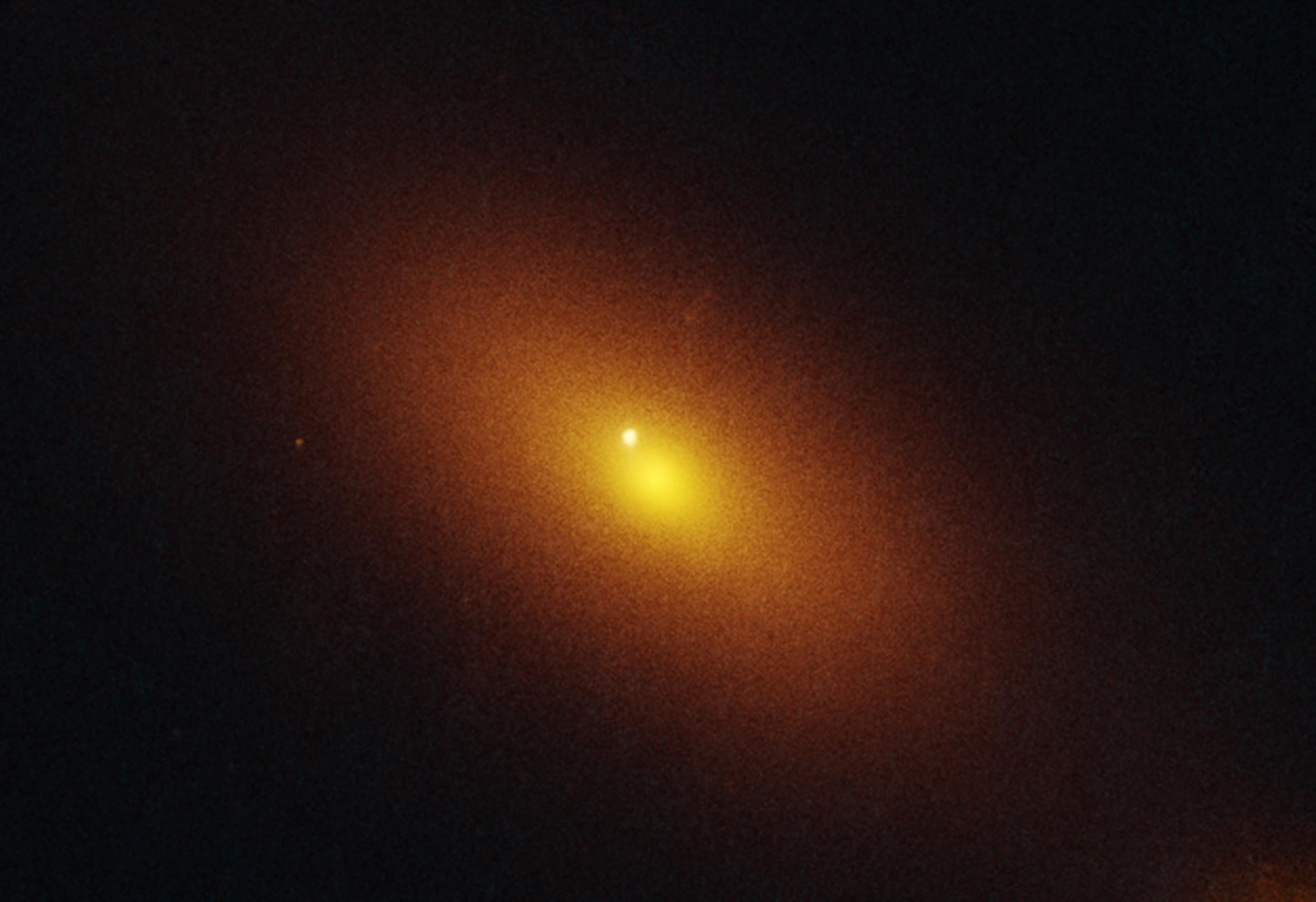
Erica Hammerstein, another UC Berkeley postdoctoral researcher, scrutinized the Hubble images as part of the study, but was unable to find evidence of a past galaxy merger.
AT2024tvd could also be a former member of a triplet of black holes that used to be at the galactic core. Because of the chaotic nature of three-body orbits, one would have been kicked out of the core to wander around the galaxy.
Searching galaxies for off-center black holes
Because the ZTF detects hundreds of flashes of light around the northern sky each year, TDE searches to date have focused on flashes discovered near the cores of galaxies, Yao said. She and Chornock created an algorithm to distinguish between the light produced by a supernova and a TDE, and employed it to search through the 10,000 or so detections by ZTF to date to find bursts of light in the galactic center that fit the characteristics of a TDE.
“Supernovae cool down after they peak, and their color becomes redder,” Yao said. “TDEs remain hot for months or years and have consistently blue colors throughout their evolution.”
TDEs also exhibit broad emission lines of hydrogen, helium, carbon, nitrogen, and silicon.
Last August, the Berkeley team discovered a burp of light that looked like a TDE, but its location seemed off-center, though within the resolution limits of the ZTF. The researchers suspected the black hole was indeed off center, and immediately requested time on several telescopes to pinpoint its location. These included NASA’s Chandra X-ray Observatory, the Very Large Array, and the Hubble Space Telescope. They all confirmed its off-nucleus location, with HST providing a distance of about 2,600 light years — about one-tenth the distance between our sun and Sag A*.
Though close to the central black hole, the off-nuclear black hole is not gravitationally bound to it. Because the black hole at the core spews out energy as it accretes infalling gas, it is categorized as an active galactic nucleus.
Yao and her team hope to find other roaming TDEs, which will give astronomers an idea of how often galaxies and their core black holes merge, and thus how long it takes to form some of the extreme, supermassive black holes.
“AT2024tvd is the first offset TDE captured by optical sky surveys, and it opens up the entire possibility of uncovering this elusive population of wandering black holes with future sky surveys,” Yao said. “Right now, theorists haven’t given much attention to offset TDEs. They primarily predict rates for TDEs occurring at the centers of galaxies. I think this discovery really motivates them to compute rates for offset TDEs, as well.”
Reference: “A Massive Black Hole 0.8 kpc from the Host Nucleus Revealed by the Offset Tidal Disruption Event AT2024tvd” by Yuhan Yao, Ryan Chornock, Charlotte Ward, Erica Hammerstein, Itai Sfaradi, Raffaella Margutti, Luke Zoltan Kelley, Wenbin Lu, Chang Liu, Jacob Wise, Jesper Sollerman, Kate D. Alexander, Eric C. Bellm, Andrew J. Drake, Christoffer Fremling, Marat Gilfanov, Matthew J. Graham, Steven L. Groom, K. R. Hinds, S. R. Kulkarni, Adam A. Miller, James C. A. Miller-Jones, Matt Nicholl, Daniel A. Perley, Josiah Purdum, Vikram Ravi, R. Michael Rich, Nabeel Rehemtulla, Reed Riddle, Roger Smith, Robert Stein, Rashid Sunyaev, Sjoert van Velzen and Avery Wold, 30 May 2025, The Astrophysical Journal Letters.
DOI: 10.3847/2041-8213/add7de
Funding: Support from the ZTF Partnership and the U.S. National Science Foundation
Never miss a breakthrough: Join the SciTechDaily newsletter.
Follow us on Google and Google News.
5 Comments
Nice! Presumably the Vera Rubin telescope will find more.
I just now mapped out the part of space didn’t find any activity can you guys specify in Astro unites events the precise location of these events
Why telescopes when we now have the capability to map out that space in 3d real time with tensor pinch fabric of space
3d real time with tensor pinch fabric of space
Amazing what one can do ACHIEVING INFINITE COHERENCE