
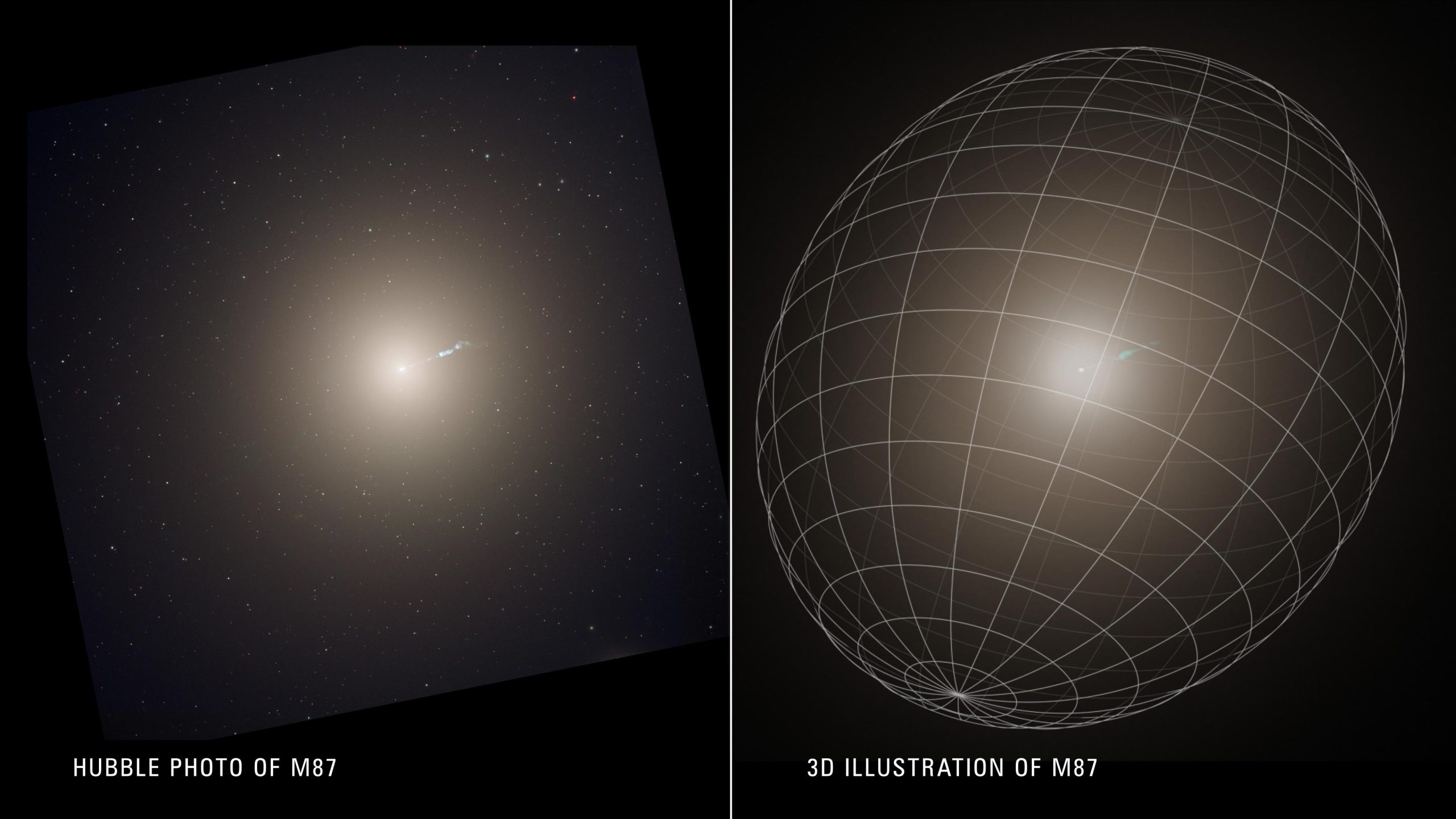
A Huge City of Myriad Stars Turns Out to be Potato-Shaped
Though it’s estimated that the universe contains 1 trillion galaxies, they come in just a few basic shapes. American astronomer Edwin Hubble realized this in the early 20th century when he used the most powerful telescope on Earth at the time to peer across the universe. Like a kid collecting rocks, he sorted them into shapes. Many were flattened spiral disks of stars. Others looked like cotton balls, which he called elliptical galaxies. Though the universe is three-dimensional, galaxies look flat on the sky. They are too far away for astronomers to employ stereoscopic vision. Now, a century later, astronomers at last have the tools to estimate the true shape of an elliptical galaxy. They picked one of the nearest elliptical galaxies to Earth, M87, located 55 million light-years away in the heart of the vast Virgo cluster of galaxies. By following the motion of stars around the center of M87, like bees around a hive, they’ve measured that the galaxy looks potato-shaped. It not only has a long and short axis, which defines an ellipse on a piece of graph paper, but they measured a third axis which helps define the three-dimensionality. The geometric term is: triaxial.
This animation begins with a Hubble Space Telescope photo of the huge elliptical galaxy M87. It then fades to a computer model of M87. A grid is overlaid to trace out its three-dimensional shape, made more evident by rotating the model and grid. This shape was gleaned from meticulous observations made with the Hubble and Keck telescopes. Because the galaxy is too far away for astronomers to employ stereoscopic vision, they instead followed the motion of stars around the center of M87, like bees around a hive. This created a three-dimensional view of how stars are distributed within the galaxy that informed the model.
Giant Galaxy Seen in 3D by NASA’s Hubble Space Telescope and Keck Observatory
Though we live in a vast three-dimensional universe, celestial objects seen through a telescope look flat because everything is so far away. Now for the first time, astronomers have measured the three-dimensional shape of one of the biggest and closest elliptical galaxies to us, M87. This galaxy turns out to be “triaxial,” or potato-shaped. This stereo vision was made possible by combining the power of NASA’s Hubble Space Telescope and the ground-based W. M. Keck Observatory on Maunakea, Hawaii.
In most cases, astronomers must use their intuition to figure out the true shapes of deep-space objects. For example, the whole class of huge galaxies called “ellipticals” look like blobs in pictures. Determining the true shape of giant elliptical galaxies will help astronomers understand better how large galaxies and their central large black holes form.
Scientists made the 3D plot by measuring the motions of stars that swarm around the galaxy’s supermassive central black hole. The stellar motion was used to provide new insights into the shape of the galaxy and its rotation, and it also yielded a new measurement of the black hole’s mass. Tracking the stellar speeds and position allowed researchers to build a three-dimensional view of the galaxy.
Astronomers at the University of California, Berkeley, were able to determine the mass of the black hole at the galaxy’s core to a high precision, estimating it at 5.4 billion times the mass of the Sun. Hubble observations in 1995 first measured the M87 black hole as being 2.4 billion solar masses, which astronomers deduced by clocking the speed of the gas swirling around the black hole. When the Event Horizon Telescope, an international collaboration of ground-based telescopes, released the first-ever image of the same black hole in 2019, the size of its pitch-black event horizon allowed researchers to calculate a mass of 6.5 billion solar masses using Einstein’s theory of general relativity.
The stereo model of M87 and the more precise mass of the central black hole could help astrophysicists learn the black hole’s spin rate. “Now that we know the direction of the net rotation of stars in M87 and have an updated mass of the black hole, we can combine this information with data from the Event Horizon Telescope to constrain the spin,” said Chung-Pei Ma, a UC Berkeley lead investigator on the research.
The Origins and Growth of M87
Over ten times the mass of the Milky Way, M87 probably grew from the merger of many other galaxies. That’s likely the reason M87’s central black hole is so large — it assimilated the central black holes of one or more galaxies it swallowed.
Ma, together with UC Berkeley graduate student Emily Liepold (lead author on the paper published in the Astrophysical Journal Letters) and Jonelle Walsh at Texas A&M University were able to determine the 3D shape of M87 thanks to a new precision instrument mounted on the Keck II Telescope. They pointed Keck at 62 adjacent locations of the galaxy, mapping out the spectra of stars over a region about 70,000 light-years across. This region spans the central 3,000 light-years where gravity is largely dominated by the supermassive black hole. Though the telescope cannot resolve individual stars because of M87’s great distance, the spectra can reveal the range of velocities to calculate mass of the object they’re orbiting.
“It’s sort of like looking at a swarm of 100 billion bees,” said Ma. “Though we are looking at them from a distance and can’t discern individual bees, we are getting very detailed information about their collective velocities.”
The researchers took the data between 2020 and 2022, as well as earlier star brightness measurements of M87 from Hubble, and compared them to computer model predictions of how stars move around the center of the triaxial-shaped galaxy. The best fit to this data allowed them to calculate the black hole’s mass. “Knowing the 3D shape of the ‘swarming bees’ enabled us to obtain a more robust dynamical measurement of the mass of the central black hole that is governing the bees’ orbiting velocities,” said Ma.
In the 1920s, astronomer Edwin Hubble first classified galaxies according to their shapes. Flat disk spiral galaxies could be viewed from various projection angles of the sky: face-on, oblique, or edge-on. But the “blobby-looking” galaxies were more problematic to characterize. Hubble came up with the term elliptical. They could only be sorted out by how great the ellipticity was. They didn’t have any apparent dust or gas inside of them to better distinguish between them. Now, a century later astronomers have a stereoscopic look at a prototypical elliptical galaxy.
Reference: “Keck Integral-field Spectroscopy of M87 Reveals an Intrinsically Triaxial Galaxy and a Revised Black Hole Mass” by Emily R. Liepold, Chung-Pei Ma and Jonelle L. Walsh, 15 March 2023, Astrophysical Journal Letters.
DOI: 10.3847/2041-8213/acbbcf
The Hubble Space Telescope is a project of international cooperation between NASA and ESA. NASA’s Goddard Space Flight Center in Greenbelt, Maryland, manages the telescope. The Space Telescope Science Institute (STScI) in Baltimore, Maryland, conducts Hubble and Webb science operations. STScI is operated for NASA by the Association of Universities for Research in Astronomy, in Washington, D.C.
Never miss a breakthrough: Join the SciTechDaily newsletter.
Follow us on Google and Google News.