
Close Menu
    Facebook X (Twitter) Instagram
    SciTechDaily
    • Biology
    • Chemistry
    • Earth
    • Health
    • Physics
    • Science
    • Space
    • Technology
    Facebook X (Twitter) Pinterest YouTube RSS
    SciTechDaily
    Home»Space»Hubble Captures Rarely Explored Galaxy Cluster, Filled With Cosmic Curiosities
    Space

    Hubble Captures Rarely Explored Galaxy Cluster, Filled With Cosmic Curiosities

    By ESA/HubbleApril 23, 20231 Comment2 Mins Read
    Facebook Twitter Pinterest Telegram LinkedIn WhatsApp Email Reddit
    Share
    Facebook Twitter LinkedIn Pinterest Telegram Email Reddit
    Galaxy Cluster ACO S520
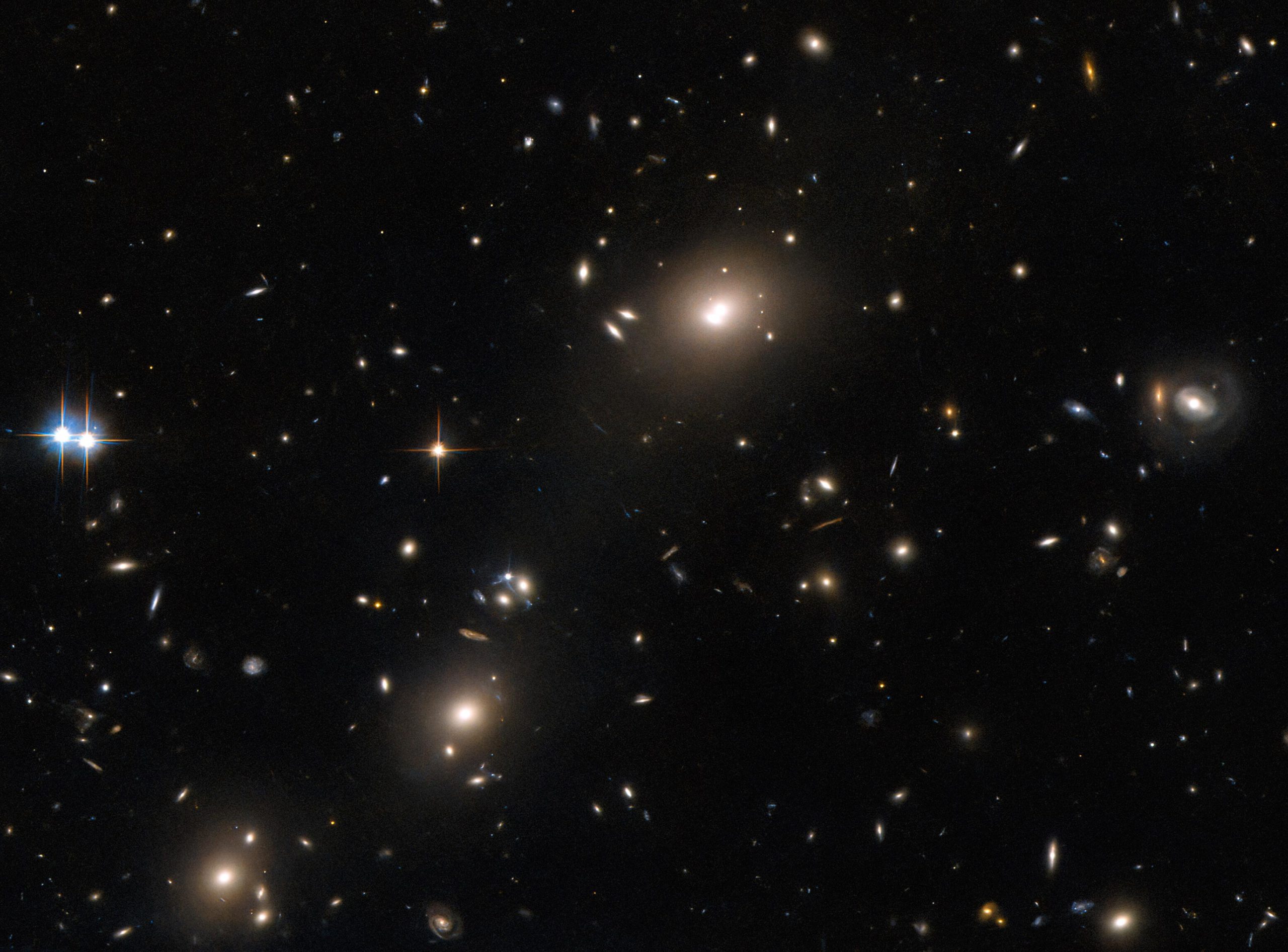
    This stunning image, captured by the Hubble Space Telescope, showcases the galaxy cluster ACO S520, located in the constellation Pictor. Alongside several large elliptical galaxies, the image reveals a ring-shaped galaxy and a pair of bright stars notable for their colorful crisscrossing diffraction spikes. The observations are part of a series searching for massive, luminous galaxy clusters that had not been previously explored, providing insights into the distribution of dark matter and offering a unique natural gravitational lens to study distant objects. Credit: ESA/Hubble & NASA, H. Ebeling

    The Hubble Space Telescope captured an image of the galaxy cluster ACO S520, containing several interesting astronomical finds, including a ring-shaped galaxy and a pair of bright stars. Astronomers hope to use these observations to further study the distribution of dark matter and discover distant objects using gravitational lenses.

    A menagerie of interesting astronomical finds fills this image from the NASA/ESA Hubble Space Telescope. As well as several large elliptical galaxies, a ring-shaped galaxy is lurking on the right of this image. A pair of bright stars are also visible at the left of this image, notable for their colorful crisscrossing diffraction spikes. This collection of astronomical curiosities is the galaxy cluster ACO S520 in the constellation Pictor, which was captured by Hubble’s Advanced Camera for Surveys.

    This is one of a series of Hubble observations searching for massive, luminous galaxy clusters that had not been captured by earlier surveys. Appropriately, the proposal for observing time was named “They almost got away”! Astronomers took advantage of occasional gaps in Hubble’s busy schedule to capture images of these barely-explored galaxy clusters, revealing a wealth of interesting targets for further study with Hubble and the NASA/ESA/CSA James Webb Space Telescope.

    Galaxy clusters are among the largest known objects in the Universe, and studying these objects can provide insights into the distribution of dark matter, which is responsible for most of the mass of a galaxy cluster. The vast masses of galaxy clusters are what cause many of them to act as gravitational lenses which distort and magnify light from even more distant objects. This can allow astronomers to use galaxy clusters as a kind of natural gravitational telescope to reveal distant objects that would usually be too faint to resolve — even for the crystal-clear vision of Hubble.

    Never miss a breakthrough: Join the SciTechDaily newsletter.
    Follow us on Google and Google News.

    Astronomy European Space Agency Hubble Space Telescope Popular
    Share. Facebook Twitter Pinterest LinkedIn Email Reddit

    Related Articles

    Hubble’s Newest Discovery Isn’t a Star, It’s a Window Into the Dark Universe

    Hubble Views Spiral Galaxy NGC 5793

    Hubble Captures the Best Ever Image of the Antennae Galaxies

    Hubble Captures Face-On Image of Messier 61

    Hubble Views an Ongoing Cosmic Collision

    Hubble Views Newborn Stars in Galaxy IC 5052

    New XDF Image, The Deepest-Ever View of the Universe

    Hubble Zooms in on the Center of M4

    Hubble Image of Peculiar Galaxy Pair Arp 116

    1 Comment

    1. Fixed gravity for you. on April 25, 2023 4:39 pm

      Nice ring galaxy. Although the ring is faint it looks exactly the size I would expect, relative to the barred region, as biased by the idea of allowing the effects expressed by gravity field vector carriers to roll-rotate together (like doing synchronized somersaults) thereby creating stationary gravity wave effects.

      Reply
    Leave A Reply Cancel Reply

    • Facebook
    • Twitter
    • Pinterest
    • YouTube

    Don't Miss a Discovery

    Subscribe for the Latest in Science & Tech!

    Trending News

    Scientists Discover 132-Million-Year-Old Dinosaur Tracks on South Africa’s Coast

    Scientists Uncover the Secret Ingredient Behind the Spark That May Have Started Life on Earth

    Physicists Observe Matter in Two Places at Once in Mind-Bending Quantum Experiment

    Stanford Scientists Discover Hidden Brain Circuit That Fuels Chronic Pain

    New Study Reveals Why Ozempic Works Better for Some People Than Others

    Climate Change Is Altering a Key Greenhouse Gas in a Way Scientists Didn’t Expect

    New Study Suggests Gravitational Waves May Have Created Dark Matter

    Scientists Discover Why the Brain Gets Stuck in Schizophrenia

    Follow SciTechDaily
    • Facebook
    • Twitter
    • YouTube
    • Pinterest
    • Newsletter
    • RSS
    SciTech News
    • Biology News
    • Chemistry News
    • Earth News
    • Health News
    • Physics News
    • Science News
    • Space News
    • Technology News
    Recent Posts
    • Researchers Discover Long-Lost Words of Ancient Greek Philosopher After 2,000 Years
    • New Study Warns: Asia’s Lifeline Water Source Is Rapidly Draining
    • 100 Times Worse? Thawing Permafrost May Be More Dangerous Than Previously Thought
    • “Pretty Close to Home”: The Hidden Earthquake Threat Beneath Seattle
    • The Surprising Reason You Might Want To Sleep Without a Pillow
    Copyright © 1998 - 2026 SciTechDaily. All Rights Reserved.
    • Science News
    • About
    • Contact
    • Editorial Board
    • Privacy Policy
    • Terms of Use

    Type above and press Enter to search. Press Esc to cancel.