
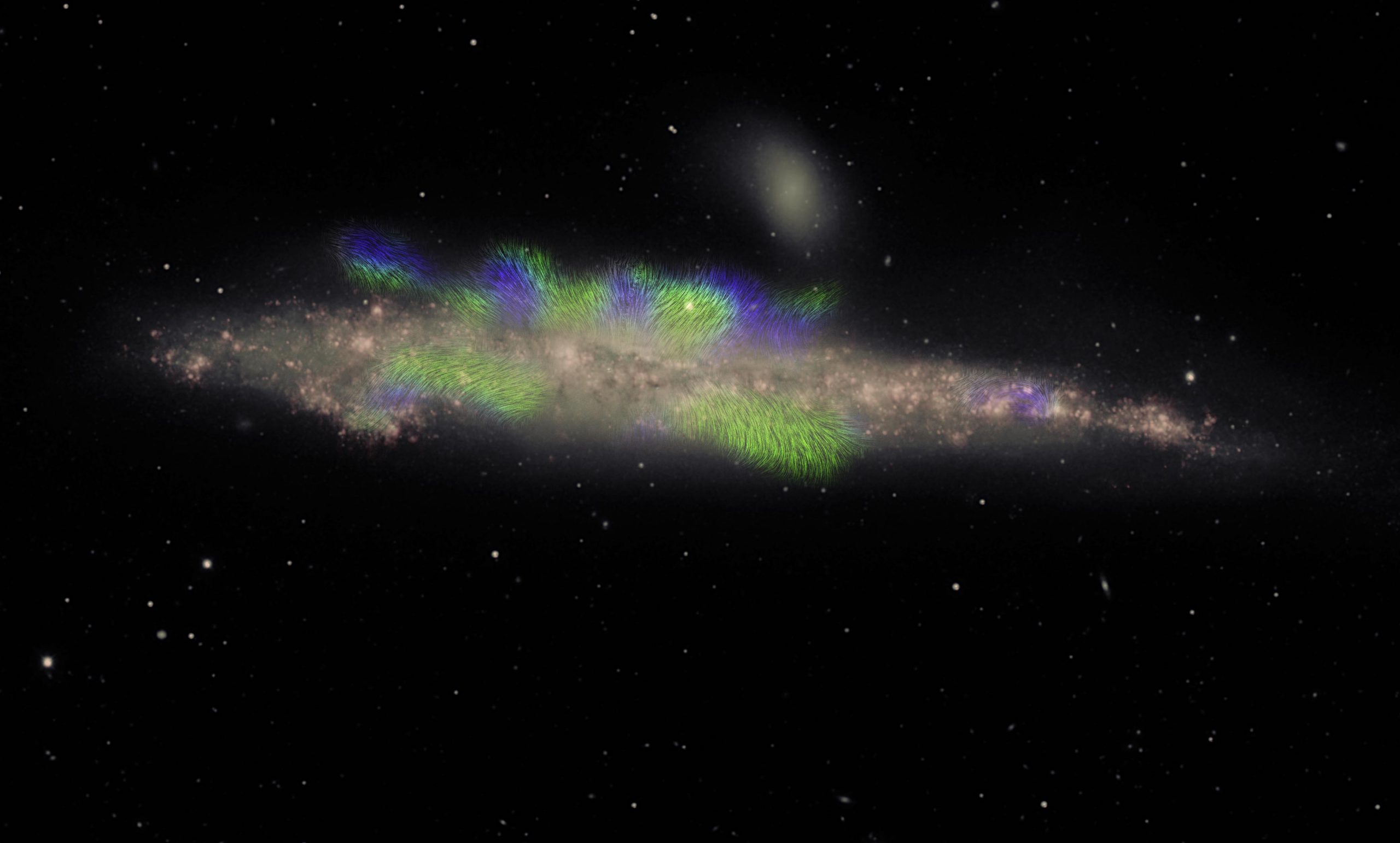
This image of the “Whale Galaxy” (NGC 4631), made with the National Science Foundation’s Karl G. Jansky Very Large Array (VLA), reveals hair-like filaments of the galaxy’s magnetic field protruding above and below the galaxy’s disk.
The spiral galaxy is seen edge-on, with its disk of stars shown in pink. The filaments, shown in green and blue, extend beyond the disk into the galaxy’s extended halo. Green indicates filaments with their magnetic field pointing roughly toward us and blue with the field pointing away. This phenomenon, with the field alternating in direction, has never before been seen in the halo of a galaxy.
“This is the first time that we have clearly detected what astronomers call large-scale, coherent, magnetic fields far in the halo of a spiral galaxy, with the field lines aligned in the same direction over distances of a thousand light-years. We even see a regular pattern of this organized field changing direction,” said Marita Krause, of the Max-Planck Institute for Radioastronomy in Bonn, Germany.
An international team of astronomers who are part of a project called the Continuum HAlos in Nearby Galaxies — an EVLA Survey (CHANG-ES), led by Judith Irwin of Queen’s University in Ontario, said the image indicates a large-scale, coherent magnetic field that is generated by dynamo action within the galaxy and spirals far outward in the form of giant magnetic ropes perpendicular to the disk.
“We are a little bit like the blind men and the elephant, since each time we look at the galaxy in a different way we reach a different conclusion about its nature! However, we seem to have one of those rare occasions where a classical theory, about magnetic generators called dynamos, predicted the observations of NGC 4631 quite well. Our dynamo model produces spiraling magnetic fields in the halo that are a continuation of the normal spiral arms in the galaxy’s disc,” said Richard Henriksen, of Queen’s University.
The scientists are continuing their work to further refine their understanding of the galaxy’s full magnetic structure.
The image was made by combining data from multiple observations with the VLA’s giant dish antennas arranged in different configurations to show both large structures and finer details within the galaxy. The naturally-emitted radio waves from the galaxy were analyzed to reveal the magnetic fields, including their directions.
The scientists said the techniques used to determine the direction of the magnetic field lines, illustrated by this image, now can be used on this and other galaxies to answer important questions about whether coherent magnetic fields are common in galactic halos and what their shapes are.
Building such a picture, they said, can answer important questions such as how galaxies acquire magnetic fields, and whether all such fields are produced by a dynamo effect. Can these galaxy halo fields illuminate the mysterious origin of the even larger intergalactic magnetic fields that have been observed?
NGC 4631, 25 million light-years from Earth in the constellation Canes Venatici, is about 80,000 light-years across, slightly smaller than our own Milky Way. It was discovered by the famous British astronomer Sir William Herschel in 1787. This image also shows a companion, NGC 4627, a small elliptical galaxy, just above NGC 4631.
The results were reported in the journal Astronomy & Astrophysics.
The theoretical models are described in Woodfinden et al. 2019 MNRAS, 487, 1498.
The National Radio Astronomy Observatory is a facility of the National Science Foundation, operated under cooperative agreement by Associated Universities, Inc.
References:
“CHANG-ES XV: Large-scale magnetic field reversals in the radio halo of NGC 4631” by Silvia Carolina Mora-Partiarroyo, Marita Krause, Aritra Basu, Rainer Beck, Theresa Wiegert, Judith Irwin, Richard Henriksen, Yelena Stein, Carlos J. Vargas, Volker Heesen, Rene A. M. Walterbos, Richard J. Rand, George Heald, Jiangtao Li, Patrick Kamieneski and Jayanne English, 26 November 2019, Astronomy & Astrophysics.
DOI: 10.1051/0004-6361/201935961
arXiv: 1910.07590
“Evolving Galactic Dynamos and Fits to the Reversing Rotation Measures in the Halo of NGC 4631” by Alex Woodfinden, Richard Henriksen, Judith Irwin and Silvia Carolina Mora-Partiarroyo, 17 May 2019, Monthly Notices of the Royal Astronomical Society.
DOI: 10.1093/mnras/stz1366
arXiv: 1905.13028
Never miss a breakthrough: Join the SciTechDaily newsletter.
Follow us on Google and Google News.
1 Comment
Check out the primerfields , this has been theorized to exist for several years by people who aren’t pre-occupied with more fanciful notions of how things work.