
Close Menu
    Facebook X (Twitter) Instagram
    SciTechDaily
    • Biology
    • Chemistry
    • Earth
    • Health
    • Physics
    • Science
    • Space
    • Technology
    Facebook X (Twitter) Pinterest YouTube RSS
    SciTechDaily
    Home»Space»Astronomers Find a Possible Stellar Survivor Associated with a Type Ia Supernova
    Space

    Astronomers Find a Possible Stellar Survivor Associated with a Type Ia Supernova

    By Space Telescope Science InstituteMarch 30, 2017No Comments2 Mins Read
    Facebook Twitter Pinterest Telegram LinkedIn WhatsApp Email Reddit
    Share
    Facebook Twitter LinkedIn Pinterest Telegram Email Reddit
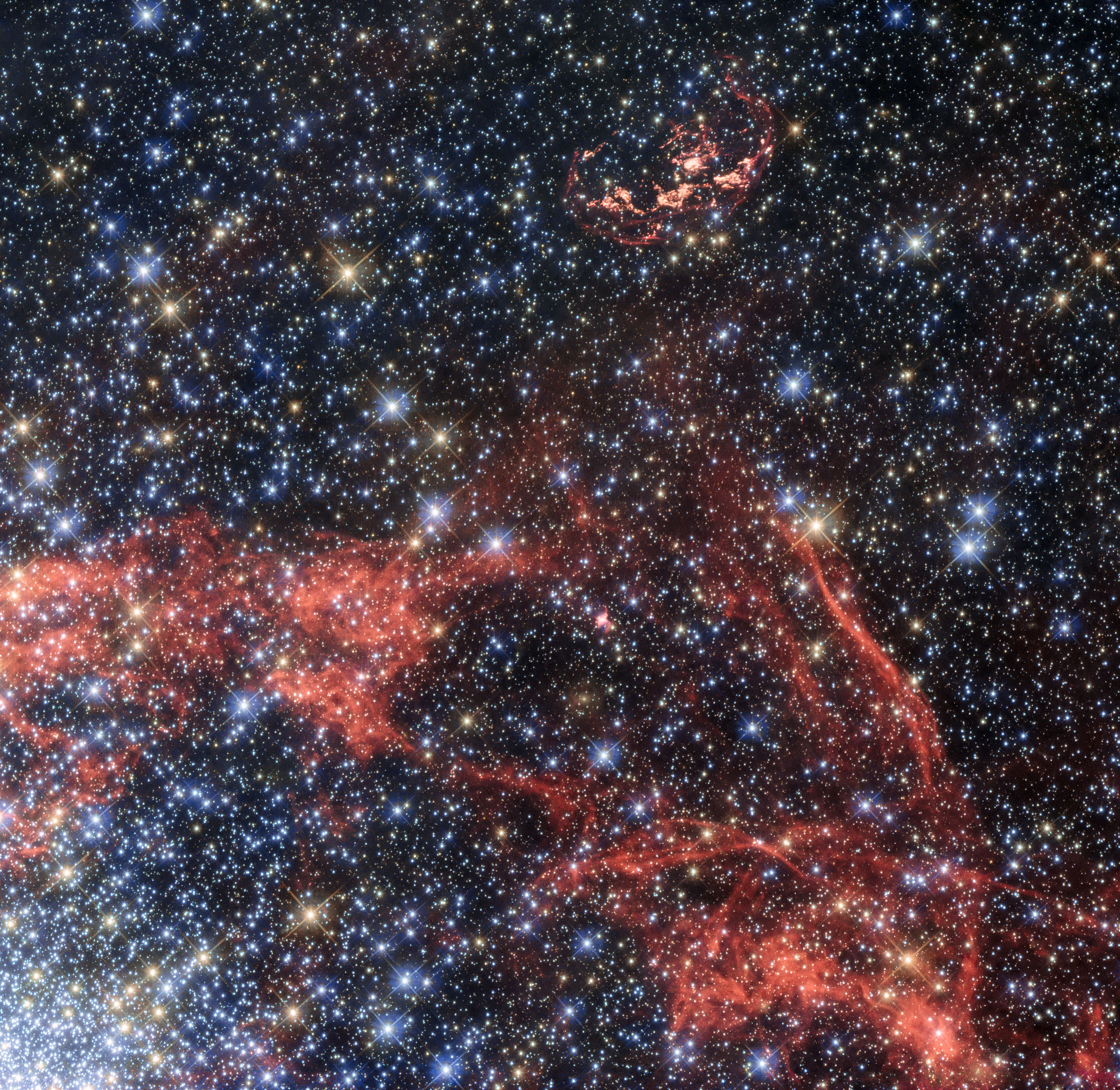
    Hubble Views Supernova Remnant SNR 0509-68.7
    Supernova remnant SNR 0509-68.7, also known as N103B, is the irregular shaped dust cloud, at the upper center of the image. The gas in the lower half of the image and the dense concentration of stars in the lower left are the outskirts of the star cluster NGC 1850. Credit: NASA, ESA and H.-Y. Chu (Academia Sinica, Taipei)

    Using the Hubble Space Telescope, astronomers searched the remains of a Type Ia supernova for a sun-like star that showed signs of being associated with the supernova.

    Of all the varieties of exploding stars, the ones called Type Ia are perhaps the most intriguing. Their predictable brightness lets astronomers measure the expansion of the universe, which led to the discovery of dark energy. Yet the cause of these supernovae remains a mystery. Do they happen when two white dwarf stars collide? Or does a single white dwarf gorge on gases stolen from a companion star until bursting?

    If the second theory is true, the normal star should survive. Astronomers used NASA’s Hubble Space Telescope to search the gauzy remains of a Type Ia supernova in a neighboring galaxy called the Large Magellanic Cloud. They found a sun-like star that showed signs of being associated with the supernova. Further investigations will be needed to learn if this star is truly the culprit behind a white dwarf’s fiery demise.

    This image, taken with NASA’s Hubble Space Telescope, shows the supernova remnant SNR 0509-68.7, also known as N103B. It is located 160,000 light-years from Earth in a neighboring galaxy called the Large Magellanic Cloud. N103B resulted from a Type Ia supernova, whose cause remains a mystery. One possibility would leave behind a stellar survivor, and astronomers have identified a possible candidate.

    The actual supernova remnant is the irregular shaped dust cloud, at the upper center of the image. The gas in the lower half of the image and the dense concentration of stars in the lower left are the outskirts of the star cluster NGC 1850.

    The Hubble image combines visible and near-infrared light taken by the Wide Field Camera 3 in June 2014.

    Reference: “Physical Structures of the Type Ia Supernova Remnant N103B” by Chuan-Jui Li (李傳睿), You-Hua Chu (朱有花), Robert A. Gruendl, Dan Weisz, Kuo-Chuan Pan (潘國全), Sean D. Points, Paul M. Ricker, R. Chris Smith and Frederick M. Walter, 10 February 2017, The Astrophysical Journal.
    DOI: 10.3847/1538-4357/836/1/85

    Never miss a breakthrough: Join the SciTechDaily newsletter.
    Follow us on Google and Google News.

    Astronomy Astrophysics Hubble Space Telescope Supernova
    Share. Facebook Twitter Pinterest LinkedIn Email Reddit

    Related Articles

    How Hubble Sees Through Cosmic Dust to Map Galaxies

    Astronomy & Astrophysics 101: Supernova

    Secrets of an Earlier Universe Revealed by Red-Supergiant Supernova

    Hubble Reveals Surviving Companion Star in Aftermath of Titanic Supernova Explosion

    Supernova Déjà-Vu: Astronomers Spot the Same Stellar Explosion Three Times – And Predict a Fourth Sighting in 16 Years

    Supernova Requiem: Rerun of Massive Blast From Exploding Star Expected To Appear in 2037

    Bizarre, Metallic Star Spotted Hurtling Out of the Milky Way at 2 Million Miles an Hour

    Hubble Views Supernova That Exploded Over 10 Billion Years Ago

    SN Primo Is Farthest Type Ia Supernova Discovered

    Leave A Reply Cancel Reply

    • Facebook
    • Twitter
    • Pinterest
    • YouTube

    Don't Miss a Discovery

    Subscribe for the Latest in Science & Tech!

    Trending News

    Scientists Warn That This Common Pet Fish Can Wreck Entire Ecosystems

    Scientists Make Breakthrough in Turning Plastic Trash Into Clean Fuel Using Sunlight

    This Popular Supplement May Interfere With Cancer Treatment, Scientists Warn

    Scientists Finally Solved One of Water’s Biggest Mysteries

    Could This New Weight-Loss Pill Disrupt the Entire Market? Here’s What You Should Know About Orforglipron

    Earth’s Crust Is Tearing Open in Africa, and It Could Form a New Ocean

    Breakthrough Bowel Cancer Trial Leaves Patients Cancer-Free for Nearly 3 Years

    Natural Compound Shows Powerful Potential Against Rheumatoid Arthritis

    Follow SciTechDaily
    • Facebook
    • Twitter
    • YouTube
    • Pinterest
    • Newsletter
    • RSS
    SciTech News
    • Biology News
    • Chemistry News
    • Earth News
    • Health News
    • Physics News
    • Science News
    • Space News
    • Technology News
    Recent Posts
    • The Most Effective Knee Arthritis Treatments Aren’t What You Expect
    • Scientists Develop Bioengineered Chewing Gum That Could Help Fight Oral Cancer
    • Popular Weight-Loss Drugs Found To Cut Heart Attack and Stroke Risk
    • After 37 Years, the World’s Longest-Running Soil Warming Experiment Uncovers a Startling Climate Secret
    • NASA Satellite Captures First-Ever High-Res View of Massive Pacific Tsunami
    Copyright © 1998 - 2026 SciTechDaily. All Rights Reserved.
    • Science News
    • About
    • Contact
    • Editorial Board
    • Privacy Policy
    • Terms of Use

    Type above and press Enter to search. Press Esc to cancel.