
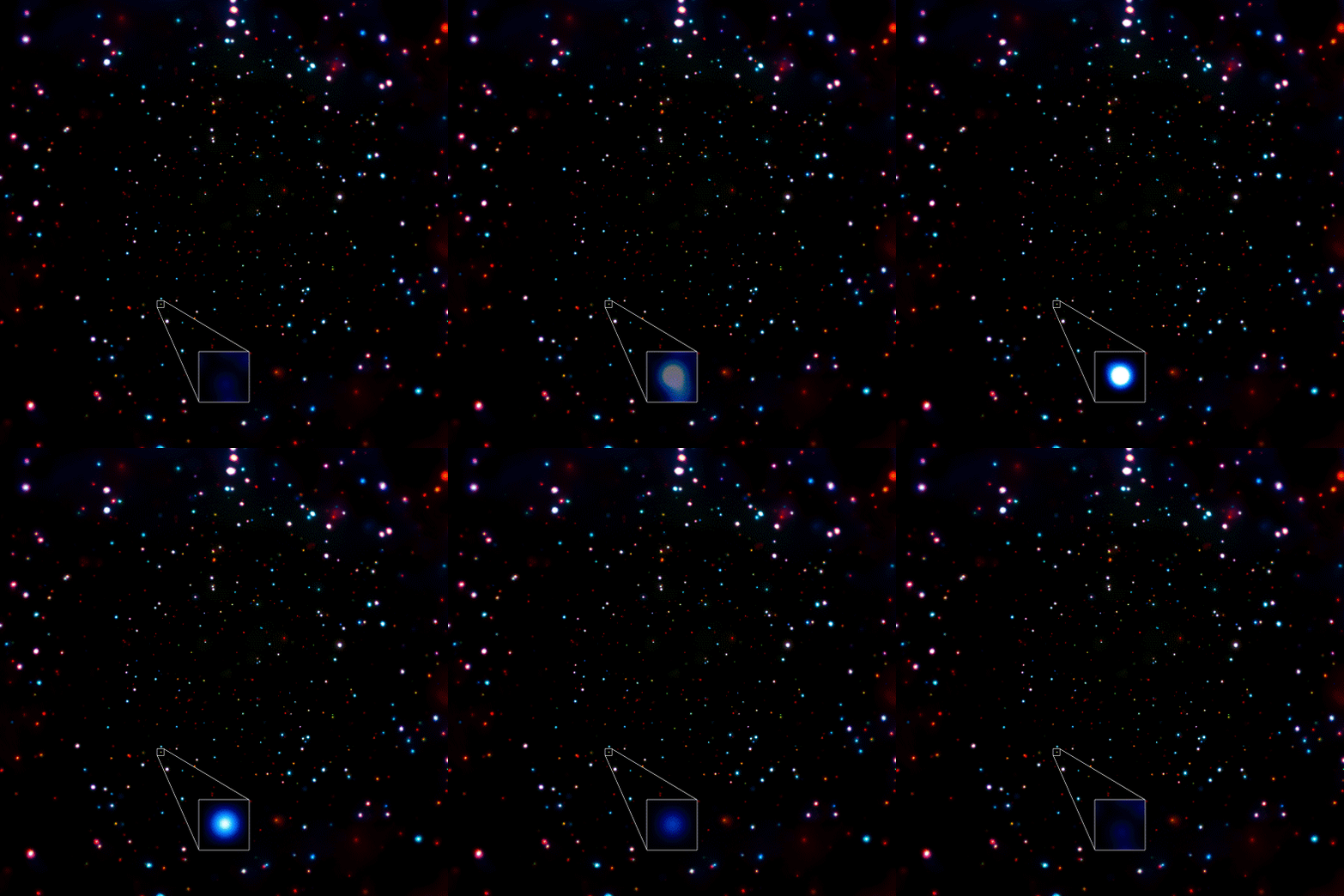
NASA’s Chandra X-ray Observatory has discovered a mysterious flash of X-rays in the Chandra Deep Field-South data. The mysterious X-ray source became 1,000 times brighter over a few hours before fading dramatically in about a day. Evidence points to this being some sort of destructive event but perhaps unlike any ever seen before.
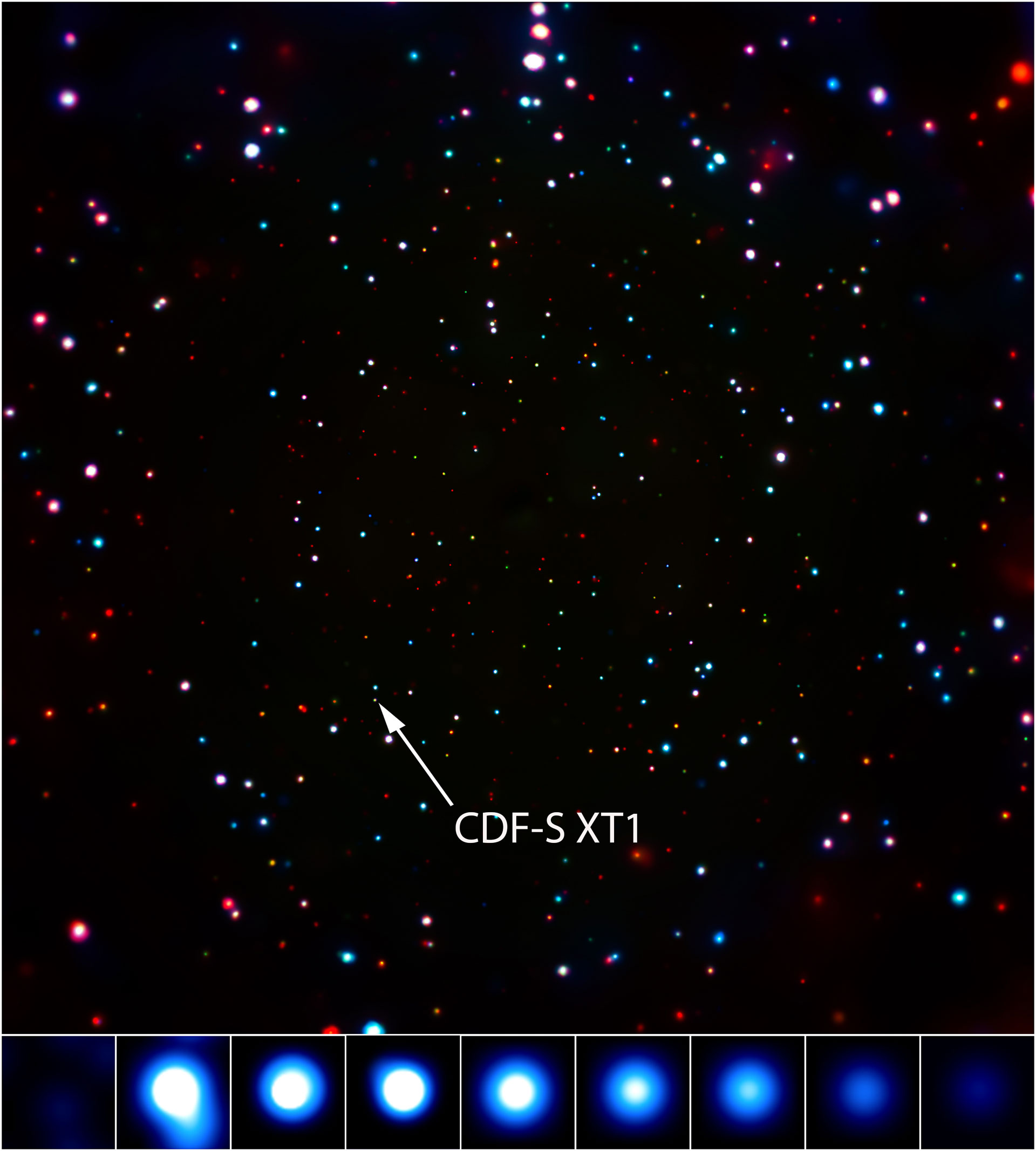
The X-ray source, located in a region of the sky known as the Chandra Deep Field-South (CDF-S), has remarkable properties. Prior to October 2014, this source was not detected in X-rays, but then it erupted and became at least a factor of 1,000 brighter in a few hours. After about a day, the source had faded completely below the sensitivity of Chandra.
Thousands of hours of legacy data from the Hubble and Spitzer Space Telescopes helped determine that the event likely came from a faint, small galaxy about 10.7 billion light-years from Earth. For a few minutes, the X-ray source produced a thousand times more energy than all the stars in this galaxy.
“Ever since discovering this source, we’ve been struggling to understand its origin,” said Franz Bauer of the Pontifical Catholic University of Chile in Santiago, Chile. “It’s like we have a jigsaw puzzle but we don’t have all of the pieces.”
Two of the three main possibilities to explain the X-ray source invoke gamma-ray burst (GRB) events. GRBs are jetted explosions triggered either by the collapse of a massive star or by the merger of a neutron star with another neutron star or a black hole. If the jet is pointing towards the Earth, a burst of gamma rays is detected. As the jet expands, it loses energy and produces weaker, more isotropic radiation at X-ray and other wavelengths.
Possible explanations for the CDF-S X-ray source, according to the researchers, are a GRB that is not pointed toward Earth, or a GRB that lies beyond the small galaxy. A third possibility is that a medium-sized black hole shredded a white dwarf star.
“None of these ideas fits the data perfectly,” said co-author Ezequiel Treister, also of the Pontifical Catholic University, “but then again, we’ve rarely if ever seen any of the proposed possibilities in actual data, so we don’t understand them well at all.”
The mysterious X-ray source was not seen at any other time during the two and a half months of exposure time Chandra has observed the CDF-S region, which has been spread out over the past 17 years. Moreover, no similar events have yet to be found in Chandra observations of other parts of the sky.
This X-ray source in the CDF-S has different properties from the as yet unexplained variable X-ray sources discovered in the elliptical galaxies NGC 5128 and NGC 4636 by Jimmy Irwin and collaborators. In particular, the CDF-S source is likely associated with the destruction of a neutron star, white dwarf, or massive star, and is roughly 100,000 times more luminous in X-rays. It is also located in a much smaller and younger host galaxy, and is only detected during a single, several-hour burst.
“We may have observed a completely new type of cataclysmic event,” said co-author Kevin Schawinski, of ETH Zurich in Switzerland. “Whatever it is, a lot more observations are needed to work out what we’re seeing.”
Additional highly targeted searches through the Chandra archive and those of ESA’s XMM-Newton and NASA’s Swift satellite may uncover more examples of this type of variable object that have until now gone unnoticed. Future X-ray observations by Chandra and other X-ray telescopes may also reveal the same phenomenon from other objects.
If the X-ray source was caused by a GRB triggered by the merger of a neutron star with a black hole or another neutron star, then gravitational waves would also have been produced. If such an event were to occur much closer to Earth, within a few hundred million light years, it may be detectable with the Laser Interferometer Gravitational-Wave Observatory (LIGO).
A paper describing this result appears in the June 2017 issue of the Monthly Notices of the Royal Astronomical Society.
Reference: “A New, Faint Population of X-ray Transients” by Franz E. Bauer, Ezequiel Treister, Kevin Schawinski, Steve Schulze, Bin Luo, David M. Alexander, William N. Brandt, Andrea Comastri, Francisco Forster, Roberto Gilli, David Alexander Kann, Keiichi Maeda, Ken’ichi Nomoto, Maurizio Paolillo, Piero Ranalli, Donald P. Schneider, Ohad Shemmer, Masaomi Tanaka, Alexey Tolstov, Nozomu Tominaga, Paolo Tozzi, Cristian Vignali, Junxian Wang, Yongquan Xue and Guang Yang, 20 February 2017, MNRAS.
DOI: 10.1093/mnras/stx417
arXiv
Never miss a breakthrough: Join the SciTechDaily newsletter.
Follow us on Google and Google News.