
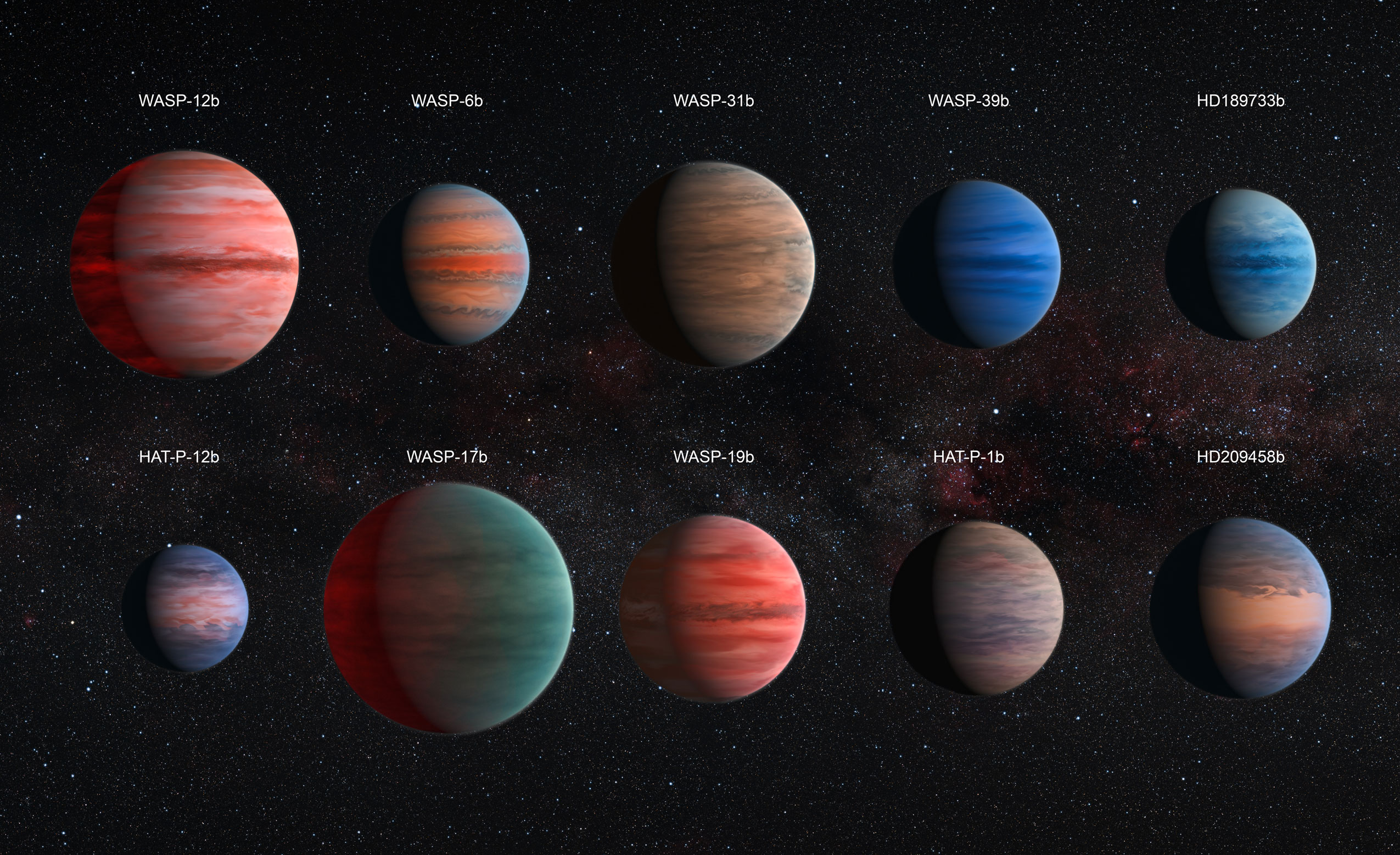
Using the Hubble Space Telescope and the Spitzer Space Telescope, a team of astronomers details the atmospheres of ten Jupiter-sized exoplanets and was able to discover why some of these worlds seem to have less water than expected — a long-standing mystery. The results are published in Nature.
To date, astronomers have discovered nearly 2000 planets orbiting other stars. Some of these planets are known as hot Jupiters — hot, gaseous planets with characteristics similar to those of Jupiter. They orbit very close to their stars, making their surface hot, and the planets tricky to study in detail without being overwhelmed by bright starlight.
Due to this difficulty, Hubble has only explored a handful of hot Jupiters in the past, across a limited wavelength range. These initial studies have found several planets to hold less water than expected.
This video shows an artist’s impression of the ten hot Jupiter exoplanets studied by David Sing and his colleagues. From top left to lower left these planets are WASP-12b, WASP-6b, WASP-31b, WASP-39b, HD 189733b, HAT-P-12b, WASP-17b, WASP-19b, HAT-P-1b and HD 209458b.
Now, an international team of astronomers has tackled the problem by making the largest ever study of hot Jupiters, exploring and comparing ten such planets in a bid to understand their atmospheres. Only three of these planetary atmospheres had previously been studied in detail; this new sample forms the largest ever spectroscopic catalog of exoplanet atmospheres.
The team used multiple observations from both the NASA/ESA Hubble Space Telescope and NASA’s Spitzer Space Telescope. Using the power of both telescopes allowed the team to study the planets, which are of various masses, sizes, and temperatures, across an unprecedented range of wavelengths.
“I’m really excited to finally ‘see’ this wide group of planets together, as this is the first time we’ve had sufficient wavelength coverage to be able to compare multiple features from one planet to another,” says David Sing of the University of Exeter, UK, lead author of the new paper. “We found the planetary atmospheres to be much more diverse than we expected.”
All of the planets have a favorable orbit that brings them between their parent star and Earth. As the exoplanet passes in front of its host star, as seen from Earth, some of this starlight travels through the planet’s outer atmosphere. “The atmosphere leaves its unique fingerprint on the starlight, which we can study when the light reaches us,” explains co-author Hannah Wakeford, now at NASA Goddard Space Flight Center, USA.
These fingerprints allowed the team to extract the signatures from various elements and molecules — including water — and to distinguish between cloudy and cloud-free exoplanets, a property that could explain the missing water mystery.
The team’s models revealed that, while apparently cloud-free exoplanets showed strong signs of water, the atmospheres of those hot Jupiters with faint water signals also contained clouds and haze — both of which are known to hide water from view. Mystery solved!
“The alternative to this is that planets form in an environment deprived of water — but this would require us to completely rethink our current theories of how planets are born,” explained co-author Jonathan Fortney of the University of California, Santa Cruz, USA. “Our results have ruled out the dry scenario, and strongly suggest that it’s simply clouds hiding the water from prying eyes.”
The study of exoplanetary atmospheres is currently in its infancy, with only a handful of observations taken so far. Hubble’s successor, the James Webb Space Telescope, will open a new infrared window on the study of exoplanets and their atmospheres.
Reference: “A continuum from clear to cloudy hot-Jupiter exoplanets without primordial water depletion” by David K. Sing, Jonathan J. Fortney, Nikolay Nikolov, Hannah R. Wakeford, Tiffany Kataria, Thomas M. Evans, Suzanne Aigrain, Gilda E. Ballester, Adam S. Burrows, Drake Deming, Jean-Michel Désert, Neale P. Gibson, Gregory W. Henry, Catherine M. Huitson, Heather A. Knutson, Alain Lecavelier des Etangs, Frederic Pont, Adam P. Showman, Alfred Vidal-Madjar, Michael H. Williamson and Paul A. Wilson, 14 December 2015, Nature.
DOI: 10.1038/nature16068
Never miss a breakthrough: Join the SciTechDaily newsletter.
Follow us on Google and Google News.