
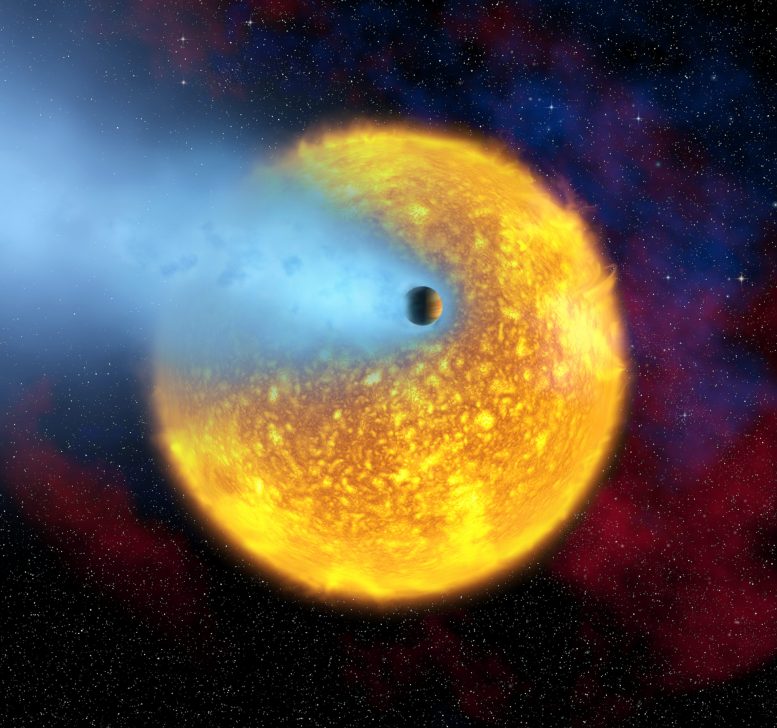
A team of scientists has developed a new method that allows them to estimate the magnetic field of a distant exoplanets. Using this method they managed to estimate the value of the magnetic moment of the planet HD 209458b.
In the two decades which passed since the discovery of the first planet outside the Solar system, astronomers have made great progress in the study of these objects. While 20 years ago a big event was even the discovery of a new planet, nowadays astronomers are able to consider their moons, atmosphere and climate, and other characteristics similar to the ones of the planets in the Solar system. One of the important properties of both solid and gaseous planets is their possible magnetic field and its magnitude. On Earth, it protects all living creatures from dangerous cosmic rays and helps animals to navigate in space.
Kristina Kislyakova of the Space Research Institute of the Austrian Academy of Sciences in Graz together with an international group of physicists for the first time ever was able to estimate the value of the magnetic moment and the shape of the magnetosphere of the exoplanet HD 209458b. Maxim Khodachenko, a researcher at the Department of Radiation and computational methods of the Skobeltsyn Institute of Nuclear Physics of the Lomonosov Moscow State University, is also one of the authors of the article. He also works at the Space Research Institute of the Austrian Academy of Sciences.
Planet HD 209458b (Osiris) is a hot Jupiter, approximately one-third larger and lighter than Jupiter. It is a hot gaseous giant orbiting very close to the host star HD 209458. HD 209458b accomplishes one revolution around the host star for only 3.5 Earth days. It has been known to astronomers for a long time and is relatively well studied. In particular, it is the first planet where the atmosphere was detected. Therefore, for many scientists, it has become a model object for the development of their hypotheses.
Scientists used the observations of the Hubble Space Telescope of the HD 209458b in the hydrogen Lyman-alpha line at the time of transit, when the planet crosses the stellar disc as seen from the Earth. At first, the scientists studied the absorption of the star’s radiation by the atmosphere of the planet. Afterward, they were able to estimate the shape of the gas cloud surrounding the hot Jupiter, and, based on these results, the size and the configuration of the magnetosphere.
“We modeled the formation of the cloud of hot hydrogen around the planet and showed that only one configuration, which corresponds to specific values of the magnetic moment and the parameters of the stellar wind, allowed us to reproduce the observations,” explained Kristina Kislyakova.
To make the model more accurate, scientists accounted for many factors that define the interaction between the stellar wind and the atmosphere of the planet: so-called charge exchange between the stellar wind and the neutral atmospheric particles and their ionization, gravitational effects, pressure, radiation acceleration, and the spectral line broadening.
At present, scientists believe that the size of the atomic hydrogen envelope is defined by the interaction between the gas outflows from the planet and the incoming stellar wind protons. Similarly to the Earth, the interaction of the atmosphere with the stellar wind occurs above the magnetosphere. By knowing the parameters of an atomic hydrogen cloud, one can estimate the size of the magnetosphere by means of a specific model.
Since direct measurements of the magnetic field of exoplanets are currently impossible, indirect methods are broadly used, for example, using radio observations. There exist a number of attempts to detect the radio emission from the planet HD 209458b. However, because of the large distances, attempts to detect the radio emission from exoplanets have yet been unsuccessful.
“The planet’s magnetosphere was relatively small being only 2.9 planetary radii corresponding to a magnetic moment of only 10% of the magnetic moment of Jupiter” — explained Kislyakova, a graduate of the Lobachevsky State University of Nizhny Novgorod. According to her, it is consistent with the estimates of the effectiveness of the planetary dynamo for this planet.
“This method can be used for every planet, including Earth-like planets, if there exists an extended high energetic hydrogen envelope around them” – summarized Maxim Khodachenko.
Reference: “Magnetic moment and plasma environment of HD 209458b as determined from Lyα observations” by Ping Wang, Dirk Scherler, Jing Liu-Zeng, Jürgen Mey, Jean-Philippe Avouac, Yunda Zhang and Dingguo Shi, 21 November 2014, Science.
DOI: 10.1126/science.1257829
Never miss a breakthrough: Join the SciTechDaily newsletter.
Follow us on Google and Google News.
2 Comments
Have to start looking at it in another way. Hydrogen creation layer. Particles ions and sub-particles from the sun are being combined in the various magneto shell accelerators. MMS mission should expose these mechanisms.
Magnetic moments are common for all the spherical heavenly bodies , whether it is Jupiter, Saturn, Moon, Mars or any exo-planet. You cant find a magnetic moment on PHobos and Deimos , the cranked pieces of satelites of Mars or even on Comets. It is an intrinsic part of terrestrial planets inner core compositioin. Hydrogen being the largest element on the Universe, any star should spew it on their nearby planets. Thus this indirect method of measuring the magnetic intensity of the exo planet outside its magnetosphere is a good idea to confirm the same. Thank You.