
Close Menu
    Facebook X (Twitter) Instagram
    SciTechDaily
    • Biology
    • Chemistry
    • Earth
    • Health
    • Physics
    • Science
    • Space
    • Technology
    Facebook X (Twitter) Pinterest YouTube RSS
    SciTechDaily
    Home»Space»Astronomers Gain a Better Understanding of Spica
    Space

    Astronomers Gain a Better Understanding of Spica

    By Harvard-Smithsonian Center for AstrophysicsApril 26, 2016No Comments3 Mins Read
    Facebook Twitter Pinterest Telegram LinkedIn WhatsApp Email Reddit
    Share
    Facebook Twitter LinkedIn Pinterest Telegram Email Reddit
    Stellar Modelling of Spica
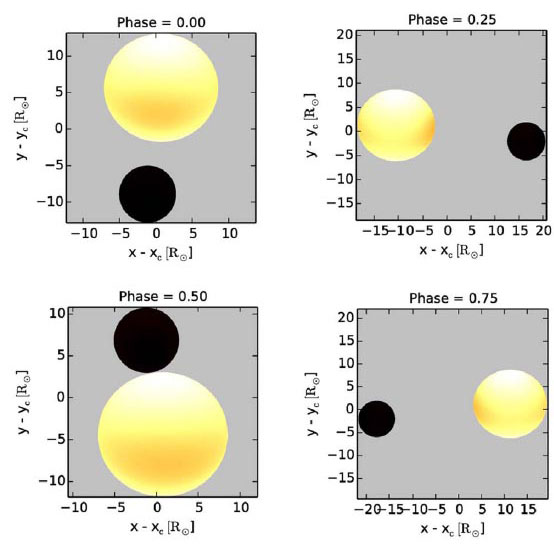
    A schematic of the binary stars in Spica, showing four stages of an orbital period. Massive binary stars often have a “mass discrepancy problem,” meaning that the masses derived from orbital and evolutionary methods disagree.

    A newly published study details Spica, an eccentric double-lined spectroscopic binary system with a β Cep type variable primary component.

    The familiar star Spica (Alpha Virginis) is the fifteenth brightest star in the night sky, in part because it is relatively nearby, only about 250 light-years away. It is easy to find by following the arc of the Big Dipper’s handle and using the mnemonic, “Arc to Arcturus (Alpha Bootes) and then spike to Spica.” In fact Spica is a “spectroscopic” binary, two stars orbiting each other and too close together to separate visually. They were revealed as being a binary pair in 1890 when spectroscopic observations discovered that the stellar lines were doubled due to each star having a slightly different velocity and corresponding Doppler shift. The stars in Spica are, moreover, an unusual pair: They are very close, separated by about twenty-eight solar-radii, and orbit each other in only 4.01 days. This puts them so close together that their mutual gravity tidally distorts their atmospheres, with the result that the stars are not spherical. Oh, and the more massive star pulses in size and luminosity.

    Binary stars play a critical role for astronomers studying stars. Because mass and gravity determine the dynamics of orbital behavior, in a binary system it is possible to get at the stars’ masses by studying the orbital motions, something that nominally can be done with great accuracy. In contrast, for a single star the mass must be inferred from a much more complicated set of stellar properties and evolutionary models, although even so these models are thought to be excellent and reliable. Sometimes, however, the mass determined from spectroscopy (kinematics) differs from that determined from evolutionary modeling. In the case of massive binary stars (and Spica’s two stars are both massive, at 11.4 and 7.2 solar-masses, respectively) this is known as the “mass discrepancy problem.”

    Enter CfA astronomer Dimitar Sasselov who is part of a team trying to resolve the mass discrepancy problem. In previous work on massive binaries, the team found that the single-star evolutionary models were slightly in error, in particular for the smaller partner. For their analysis of Spica, the astronomers obtained 1731 high-quality spectra and broadband measurements over the course of nearly twenty-three days. They were able to refine all of the system parameters, and realized that the pulsations in the larger star are actually tidally induced, the first such case found for a massive binary. They also found, somewhat surprisingly, that there was no mass discrepancy problem for Spica – the stellar masses derived in both ways are actually consistent, although there are large uncertainties introduced by the complex nature of the Spica system. The research program continues, and the astronomers plan to observe and analyze another few dozen systems in a consistent way, to improve their insights into the nature of the mass discrepancy problem for massive stars.

    Reference: “Stellar modeling of Spica, a high-mass spectroscopic binary with a β Cep variable primary component” 2 February 2016, MNRAS.
    DOI: 10.1093/mnras/stw255

    Never miss a breakthrough: Join the SciTechDaily newsletter.
    Follow us on Google and Google News.

    Astronomy Astrophysics Cosmology Harvard-Smithsonian Center for Astrophysics Stars
    Share. Facebook Twitter Pinterest LinkedIn Email Reddit

    Related Articles

    Astronomers Explore Cosmic Ray Influences on Star Formation in Galaxies

    Astronomers Observe a New Type of Binary Star – “Exciting, Missing Evolutionary Link”

    Astronomers Have Discovered a Gigantic Sphere-Shaped Cavity in Space

    Mystery Solved: Astronomers Unravel the Puzzle of Betelgeuse’s “Great Dimming”

    Mega-Flares From Stars: 10 Million Times More Energetic Than the Most Powerful Flare Ever Observed on the Sun

    The Give and Take of Stellar Mega-Flares: By Studying Thousands of Young Stars, New Information Has Emerged

    Growing up Stardust: Astronomers Discover That Stars and Planets May Be Siblings

    Massive Rotating Stars in the Pleiades Cluster

    Chandra Studies Extraordinary Magnetar: Fastest Spinning and Possibly the Youngest Magnetar Known

    Leave A Reply Cancel Reply

    • Facebook
    • Twitter
    • Pinterest
    • YouTube

    Don't Miss a Discovery

    Subscribe for the Latest in Science & Tech!

    Trending News

    Largest-Ever Study Finds Medicinal Cannabis Ineffective for Anxiety, Depression, PTSD

    250-Million-Year-Old Egg Solves One of Evolution’s Biggest Mysteries

    Living With Roommates Might Be Changing Your Gut Microbiome Without You Knowing

    Century-Old Cleaning Chemical Linked to 500% Increased Risk of Parkinson’s Disease

    What if Your Memories Never Happened? Physicists Take a New Look at the Boltzmann Brain Paradox

    One of the Universe’s Largest Stars May Be Getting Ready To Explode

    Scientists Discover Enzyme That Could Supercharge Ozempic-Like Weight Loss Drugs

    Popular Sweetener Linked to DNA Damage – “It’s Something You Should Not Be Eating”

    Follow SciTechDaily
    • Facebook
    • Twitter
    • YouTube
    • Pinterest
    • Newsletter
    • RSS
    SciTech News
    • Biology News
    • Chemistry News
    • Earth News
    • Health News
    • Physics News
    • Science News
    • Space News
    • Technology News
    Recent Posts
    • The Most Elusive Number in Physics Just Got Even More Mysterious
    • Scientists Uncover Hidden Trigger Behind Stem Cell Aging
    • Scientists Discover Coral Reefs Are Teeming With Previously Unknown Life
    • Scientists Find Way to Reverse Fatty Liver Disease Without Changing Diet
    • Could Humans Regrow Limbs? New Study Reveals Promising Genetic Pathway
    Copyright © 1998 - 2026 SciTechDaily. All Rights Reserved.
    • Science News
    • About
    • Contact
    • Editorial Board
    • Privacy Policy
    • Terms of Use

    Type above and press Enter to search. Press Esc to cancel.