
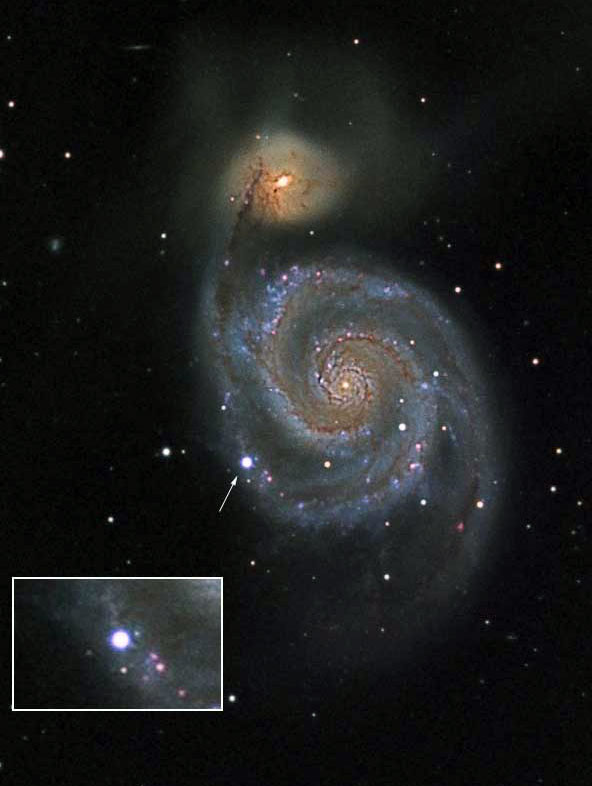
Using precise radio imaging techniques, astronomers from the Harvard-Smithsonian Center for Astrophysics have determined the size of the shock around supernova SN 2011dh and estimated its outward velocity.
Supernovae, the explosive deaths of massive stars, are among the most momentous events in the cosmos because they disburse into space all of the chemical elements that were produced inside their progenitor stars, including the elements essential for making planets and life. Their bright emission also enables them to be used as probes of the very distant universe. Not least, supernovae are astrophysical laboratories for the study of very high-velocity shocks and the physics of particles under extreme conditions.
On May 31, 2011, an amateur astronomer spotted a supernova in the relatively nearby Whirlpool Galaxy (Messier 51), about 257 million light-years away. An analysis of the spectrum of SN2011dh showed that the precursor object was a massive supergiant star, about thirteen times bigger than the Sun (there is also some evidence for the presence of a binary companion star). The explosion set off a shock wave whose bright optical emission comes primarily from the inner dense, slow-moving ejecta. In addition, astronomers see a fast-moving component to the shock that is bright at radio wavelengths. The size and expansion velocity of the shock are thought to be basic distinguishing characteristics of different kinds of supernova (for example, having different mass progenitors or different stellar properties). Astronomers have therefore been at work trying to study these shocks. Unfortunately, supernovae are relatively rare, and so far only five supernovae have gone off in galaxies close enough to us, and recently enough, to have had their detailed shock properties studied.
CfA astronomers Atish Kamble and Alicia Soderberg and their colleagues have now measured a sixth. They have been following SN2011dh in the radio since the explosion took place using a variety of radio telescope facilities, including very long baseline techniques, to obtain very high spatial resolution images of the shock. Observations they took 453 days after the event have now been combined with more recent measurements, enabling the scientists to determine the basic geometry of the shock: It has swept out a nearly spherical shell of hot material about 120 times larger in radius than the average distance Pluto is from the Sun.
Since the scientists know how long the shock has been propagating, about 453 days, they can estimate its velocity as about 19,000 kilometers per second (over forty-two million miles per hour). Combined with other observations of its radio brightness, the result implies that for nearly all of that time the expansion proceeded without being slowed down significantly by intervening material in space. Only about one-thousandth of a solar mass of material has been swept up. These measurements are key tests of the robustness of theoretical predictions about supernovae and the underlying assumptions, and the results provide confidence in supernova shock theories. The research is part of an ongoing, cradle-to-grave study of this supernova.
Reference: “Imaging the Expanding Shell of SN 2011dh” A. de Witt, M. F. Bietenholz, A. Kamble, A. M. Soderberg, A. Brunthaler, B. Zauderer, N. Bartel and M. P. Rupen, 1 January 2016, MNRAS.
DOI: 10.1093/mnras/stv2306
Never miss a breakthrough: Join the SciTechDaily newsletter.
Follow us on Google and Google News.
2 Comments
That amateur astronomer who discovered this supernova was my friend Tom Reiland. He is a terrific observer who has given so much to astronomy. I did not want him to remain nameless in this article.
Too bad the space gravitational wave telescope (elISA) isn’t up and running.