
Close Menu
    Facebook X (Twitter) Instagram
    SciTechDaily
    • Biology
    • Chemistry
    • Earth
    • Health
    • Physics
    • Science
    • Space
    • Technology
    Facebook X (Twitter) Pinterest YouTube RSS
    SciTechDaily
    Home»Space»Astronomers Measure Accreting Regions Around Supermassive Black Holes
    Space

    Astronomers Measure Accreting Regions Around Supermassive Black Holes

    By Harvard-Smithsonian Center For AstrophysicsDecember 29, 2017No Comments3 Mins Read
    Facebook Twitter Pinterest Telegram LinkedIn WhatsApp Email Reddit
    Share
    Facebook Twitter LinkedIn Pinterest Telegram Email Reddit
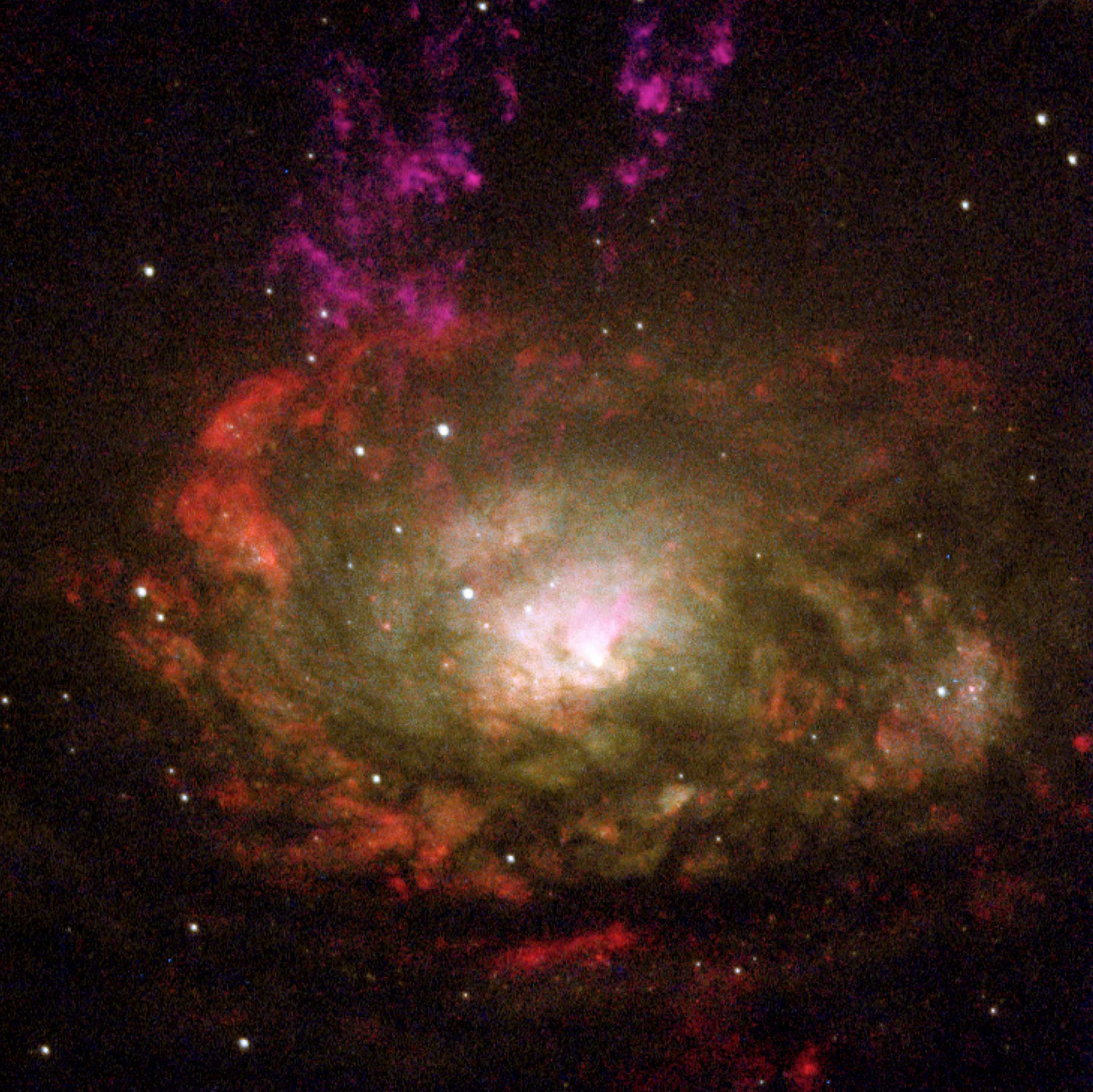
    Geometry of Nuclear Black Hole Accretion Disks
    A Hubble image of the Circinus galaxy with its active galactic nucleus (AGN). NASA, Andrew S. Wilson U.Maryland; Patrick L. Shopbell CIT; Chris Simpson Subaru; Thaisa Storchi-Bergmann and F. K. B. Barbosa, UFRGS, Brazil; and Martin J. Ward, U. Leicester

    Astronomers from the Harvard-Smithsonian Center For Astrophysics have measured the sizes of the accreting regions around the supermassive black holes in four distant AGN using techniques of reverberation mapping.

    Supermassive black holes with millions or even billions of solar-masses of material are found at the nuclei of most galaxies, including our Milky Way. A torus of dust and gas orbits around the black hole (at least according to most theories) and radiates in ultraviolet light when material falling toward the black hole heats the disk to millions of degrees. The accretion process can also power the ejection of jets of rapidly moving charged particles. Such actively accreting supermassive black holes in galaxies are called active galactic nuclei (AGN).

    Astronomers who model the physical processes in one of these huge dynamos start with the gas motions and geometry of the region. The gas motions can be measured straightforwardly from emission lines in the gas, typically optical lines of hydrogen that are excited by the uv radiation. As for geometry, simple calculations estimate that the radius of line-emitting gas should be a few thousand astronomical units (one AU is the average distance of the Earth from the Sun). Because most AGN are too far away to be able to measure dimensions this small, astronomers have come to rely on the technique of “reverberation mapping.” Radiation from the accretion disk is highly variable. Since it takes time for the uv to travel from the accretion disk near the black hole out to the line-emitting gas, there is a delay between an event seen in the continuum and then in the hydrogen lines

    CfA astronomer Anna Pancoast and a team of her colleagues analyzed reverberation mapping data of four AGN to study their geometries and, in particular, the volume of hot gas known for its rapid motions, the so-called broad line region because the spectral lines have widths corresponding to as much as three thousand kilometers per second. The scientists find the geometry of this gas, at least in these four AGN, is well-described as coming from thick disks seen nearly face-on, with median radii from about 1600 AU to 4000 AU, and each with a black hole whose mass is about seventy million solar-masses (with an estimated precision for each one of about 50%). The new work was successful in modeling the observations and nearly doubles the size of the AGN sample modeled with this technique. The sample is still small, however, and more observations are being planned.

    Reference: “The Structure of the Broad-line Region in Active Galactic Nuclei. II. Dynamical Modeling of Data From the AGN10 Reverberation Mapping Campaign” by C. J. Grier, A. Pancoast1, A. J. Barth, M. M. Fausnaugh, B. J. Brewer, T. Treu and B. M. Peterson, 9 November 2017, The Astrophysical Journal.
    DOI: 10.3847/1538-4357/aa901b

    Never miss a breakthrough: Join the SciTechDaily newsletter.
    Follow us on Google and Google News.

    Astronomy Astrophysics Black Hole Cosmology Harvard-Smithsonian Center for Astrophysics
    Share. Facebook Twitter Pinterest LinkedIn Email Reddit

    Related Articles

    Invisible Storm Lights Up Galaxy Cluster With Record-Breaking Radio Glow

    Radio Weak Blazars Challenge the Basic Explanation of Blazars

    Astronomers Discover a Cosmic Particle Accelerator in Abell 3411 and 3412

    NASA’s Chandra Views a Stellar Circle of Life, Cygnus X-3

    Astrophysicists Show Milky Way Had a Blowout Bash 6 Million Years Ago

    Astronomers Discover Evidence of a ‘Direct-Collapse Black Hole’

    New Research Shows LIGO’s Twin Black Holes Might Have Been Born Inside a Single Star

    Astronomers Use G1 and G2 to Probe the Accretion Flow Feeding Sgr A*

    A Significant Step Towards Explaining the Cosmic Origins of the Seeds of Galaxies

    Leave A Reply Cancel Reply

    • Facebook
    • Twitter
    • Pinterest
    • YouTube

    Don't Miss a Discovery

    Subscribe for the Latest in Science & Tech!

    Trending News

    Wasp Colonies Explode Into Violence After Losing Their Queen

    Scientists Create “Living Plastic” That Self-Destructs in Just Six Days

    Your Blood May Carry a 700-Million-Year-Old Secret

    Scientists Discover Some “Zombie Cells” May Actually Help You Live Longer

    Earth May Be Seeding Venus With Life, According to New Research

    What Scientists Found Inside a 117-Year-Old Woman Reveals New Clues to Long Life

    Scientists Discover Mysterious Creature Living in the Great Salt Lake – and It Exists Nowhere Else on Earth

    It’s Alive? Surprising Discovery Changes What We Know About Fog

    Follow SciTechDaily
    • Facebook
    • Twitter
    • YouTube
    • Pinterest
    • Newsletter
    • RSS
    SciTech News
    • Biology News
    • Chemistry News
    • Earth News
    • Health News
    • Physics News
    • Science News
    • Space News
    • Technology News
    Recent Posts
    • Doctors May Need To Rethink Calcium and Vitamin D Recommendations After Major Review
    • Researchers Suspected Brain Inflammation in Long COVID but Found Something Else
    • Goodbye CPAP? New Pill Shows Major Promise for Sleep Apnea
    • Largest Known Wild Chimpanzee Community Breaks Apart After Decades of Unity
    • Scientists Turn Mice Transparent to Uncover Obesity’s Secret Effects on Nerves
    Copyright © 1998 - 2026 SciTechDaily. All Rights Reserved.
    • Science News
    • About
    • Contact
    • Editorial Board
    • Privacy Policy
    • Terms of Use

    Type above and press Enter to search. Press Esc to cancel.