
Close Menu
    Facebook X (Twitter) Instagram
    SciTechDaily
    • Biology
    • Chemistry
    • Earth
    • Health
    • Physics
    • Science
    • Space
    • Technology
    Facebook X (Twitter) Pinterest YouTube RSS
    SciTechDaily
    Home»Space»Astronomers Measure Remarkable Flares from the Galactic Center
    Space

    Astronomers Measure Remarkable Flares from the Galactic Center

    By Megan Watzke, Harvard-Smithsonian Center for AstrophysicsOctober 5, 2018No Comments3 Mins Read
    Facebook Twitter Pinterest Telegram LinkedIn WhatsApp Email Reddit
    Share
    Facebook Twitter LinkedIn Pinterest Telegram Email Reddit
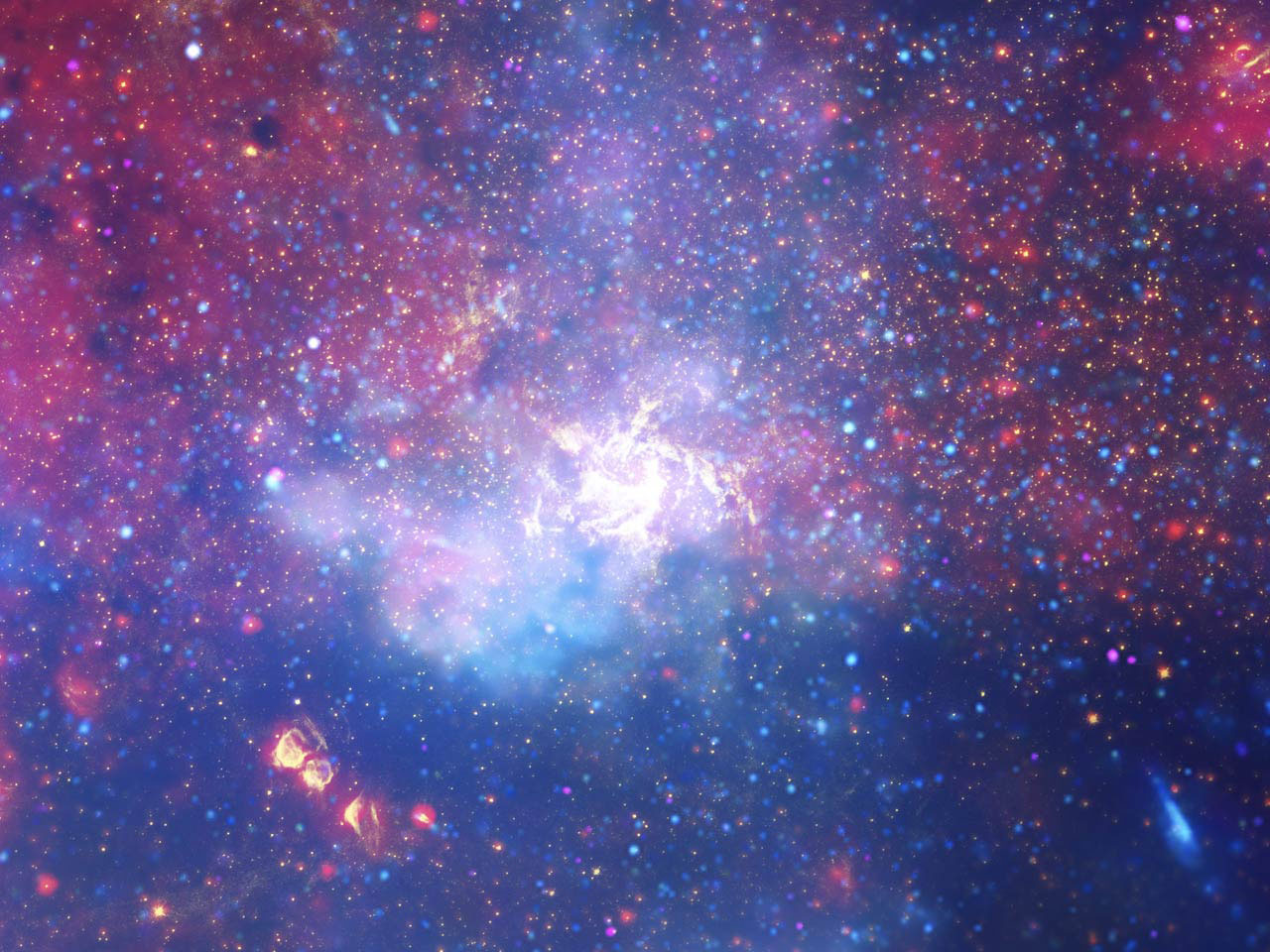
    Remarkable Flares from the Galactic Center
    A multiwavelength view of the field around the Milky Way’s galactic center seen from the X-ray (blue) through the infrared (red). Astronomers have measured flaring events at multiple wavelengths coming from the supermassive black hole at the very center. X-ray: NASA/CXC/UMass/D. Wang et al.; Optical: NASA/ESA/STScI/D.Wang et al.; IR: NASA/JPL-Caltech/SSC/S.Stolovy

    Sagittarius A* (Sgr A*), the supermassive black hole at the center of our Milky Way Galaxy, is 100 times closer to us than any other SMBH and therefore a prime candidate for studies of how matter radiates as it accretes onto black holes. SgrA* has been observed for decades and rapid fluctuations reported from X-ray to the near-infrared wavelengths (intervening dust reduces optical light signals by a factor of over a trillion) and at submillimeter and radio wavelengths. Modeling the mechanisms of light variability is a direct challenge to our understanding of accretion onto SMBHs, but it is thought that correlations between flare timing at different wavelengths could reveal information about the spatial structure, for example, if hotter material is located in a smaller zone closer to the black hole. One of the chief barriers to progress is the paucity of simultaneous multi-wavelength observations.

    CfA astronomers Giovanni Fazio, Joe Hora, Steve Willner, Matt Ashby, Mark Gurwell, and Howard Smith and a team of colleagues carried out a series of multiwavelength monitoring campaigns that included the IRAC camera onboard the Spitzer Space Telescope and the Chandra X-ray Observatory as well as the ground-based Keck telescope and the Submillimeter Array. Spitzer was able to monitor the black hole fluctuations continuously for 23.4 hours during each session, something that no ground-based observatory is capable of doing, and something that reliably enables scientists to spot slow trends (as distinct from short bursts).

    Computational modeling of the emission from the vicinity of a black hole is a complex undertaking that among other things requires simulating how the material accretes, how it is heated and radiates, and (since all this happens close to a possibly rotating black hole) how general relativity predicts the radiation will appear to distant observers. Theorists suspect that shorter wavelength emission arises closer in and cooler emission farther out, with the former produced first and the latter subsequently. A time delay therefore might reflect the distance between these zones, and indeed previous sets of observations, some by this same team, did find evidence that hot, near-infrared flaring preceded the submillimeter flares seen by the SMA. In their new paper, the scientists report on two flares that apparently violate these and other previous patterns: the first event occurred simultaneously at all wavelengths; in the second event the X-ray, near-infrared, and submillimeter flares all turned on within one hour of each other, not quite simultaneous but still unexpectedly close. The new observations will be extended with future simultaneous campaigns, and will help theorists refine their still quite speculative set of choices.

    Publication: “Multiwavelength Light Curves of Two Remarkable Sagittarius A* Flares” by G. G. Fazio, J. L. Hora, G. Witzel, S. P. Willner, M. L. N. Ashby, F. Baganoff, E. Becklin, S. Carey, D. Haggard, C. Gammie, A. Ghez, M. A. Gurwell, J. Ingalls, D. Marrone, M. R. Morris and H. A. Smith, 30 August 2018, The Astrophysical Journal.
    DOI: 10.3847/1538-4357/aad4a2

    Never miss a breakthrough: Join the SciTechDaily newsletter.
    Follow us on Google and Google News.

    Astronomy Cosmology Harvard-Smithsonian Center for Astrophysics
    Share. Facebook Twitter Pinterest LinkedIn Email Reddit

    Related Articles

    Astronomers Just Reconstructed a Galaxy’s 12-Billion-Year History

    Webb’s Mysterious “Little Red Dots” May Be the Cradle of the First Black Holes

    Mysterious Radio Signals Reveal What’s Hiding Between Galaxies

    Cosmic Mystery Solved: Astronomers Have Discovered the Universe’s “Missing” Matter

    Invisible Storm Lights Up Galaxy Cluster With Record-Breaking Radio Glow

    Herschel Observations Help Identify the Physical Processes Underway in Cold, Dense Clouds

    CfA Scientists Measure the Rate of Expansion of the Universe

    New Study Challenges Planck Results

    Calculations Show the Ideal Time to Study the Cosmos

    Leave A Reply Cancel Reply

    • Facebook
    • Twitter
    • Pinterest
    • YouTube

    Don't Miss a Discovery

    Subscribe for the Latest in Science & Tech!

    Trending News

    One of the Universe’s Largest Stars May Be Getting Ready To Explode

    Scientists Discover Enzyme That Could Supercharge Ozempic-Like Weight Loss Drugs

    Popular Sweetener Linked to DNA Damage – “It’s Something You Should Not Be Eating”

    Ancient “Rock” Microbes May Reveal How Complex Life Began

    Researchers Capture Quantum Interference in One of Nature’s Rarest Atoms

    “A Plague Is Upon Us”: The Mass Death That Changed an Ancient City Forever

    Scientists Discover Game-Changing New Way To Treat High Cholesterol

    This Small Change to Your Exercise Routine Could Be the Secret to Living Longer

    Follow SciTechDaily
    • Facebook
    • Twitter
    • YouTube
    • Pinterest
    • Newsletter
    • RSS
    SciTech News
    • Biology News
    • Chemistry News
    • Earth News
    • Health News
    • Physics News
    • Science News
    • Space News
    • Technology News
    Recent Posts
    • Scientists Prove There Are Just Six Degrees of Separation in a Social Network
    • Bee Bacteria Could Fix a Major Flaw in Plant-Based Milk
    • Scientists Discover a Surprising Way To Make Bread Healthier and More Nutritious
    • Natural Compounds Boost Bone Implant Success While Killing Bacteria and Cancer Cells
    • After 60 Years, Scientists Uncover Unexpected Brain Effects of Popular Diabetes Drug Metformin
    Copyright © 1998 - 2026 SciTechDaily. All Rights Reserved.
    • Science News
    • About
    • Contact
    • Editorial Board
    • Privacy Policy
    • Terms of Use

    Type above and press Enter to search. Press Esc to cancel.