
Close Menu
    Facebook X (Twitter) Instagram
    SciTechDaily
    • Biology
    • Chemistry
    • Earth
    • Health
    • Physics
    • Science
    • Space
    • Technology
    Facebook X (Twitter) Pinterest YouTube RSS
    SciTechDaily
    Home»Space»NASA Voyager 2 Nearing Interstellar Space, Measures Increase in Cosmic Rays
    Space

    NASA Voyager 2 Nearing Interstellar Space, Measures Increase in Cosmic Rays

    By Calla Cofield / Jia-Rui Cook, Jet Propulsion LaboratoryOctober 6, 20182 Comments3 Mins Read
    Facebook Twitter Pinterest Telegram LinkedIn WhatsApp Email Reddit
    Share
    Facebook Twitter LinkedIn Pinterest Telegram Email Reddit
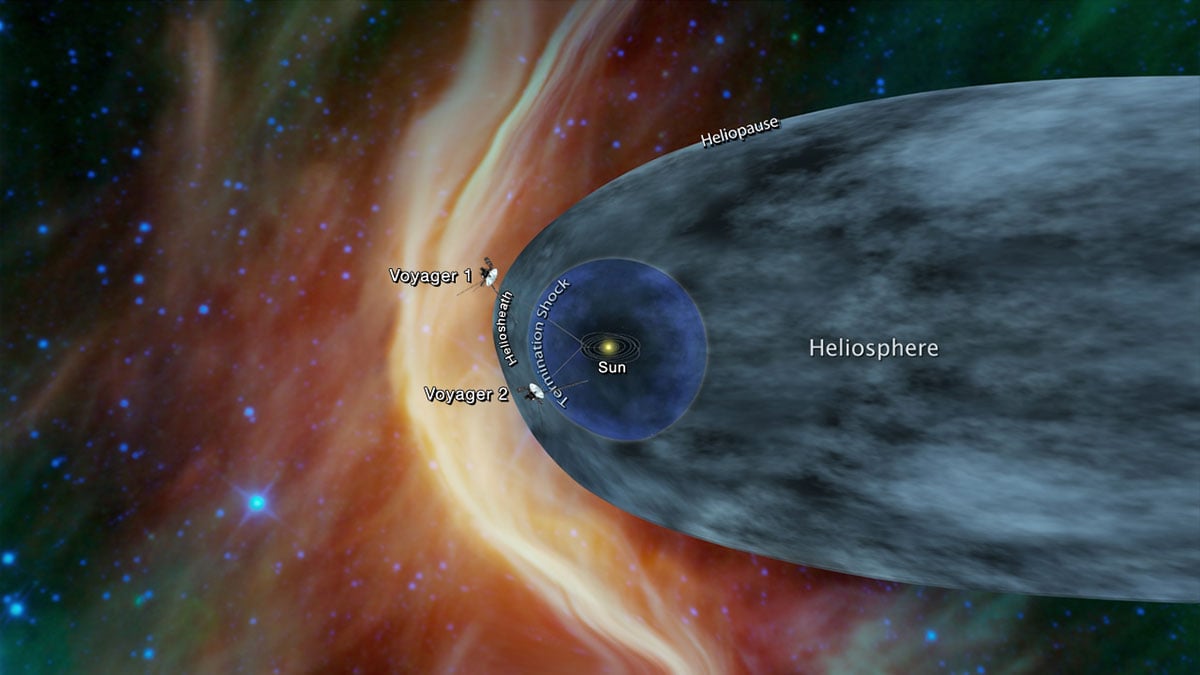
    Voyager 2 Nearing Interstellar Space
    This graphic shows the position of the Voyager 1 and Voyager 2 probes relative to the heliosphere, a protective bubble created by the Sun that extends well past the orbit of Pluto. Voyager 1 crossed the heliopause, or the edge of the heliosphere, in 2012. Voyager 2 is still in the heliosheath, or the outermost part of the heliosphere. Credit: NASA/JPL-Caltech

    NASA’s Voyager 2 probe, currently on a journey toward interstellar space, has detected an increase in cosmic rays that originate outside our solar system. Launched in 1977, Voyager 2 is a little less than 11 billion miles (about 17.7 billion kilometers) from Earth, or more than 118 times the distance from Earth to the Sun.

    Since 2007 the probe has been traveling through the outermost layer of the heliosphere — the vast bubble around the Sun and the planets dominated by solar material and magnetic fields. Voyager scientists have been watching for the spacecraft to reach the outer boundary of the heliosphere, known as the heliopause. Once Voyager 2 exits the heliosphere, it will become the second human-made object, after Voyager 1, to enter interstellar space.

    Since late August, the Cosmic Ray Subsystem instrument on Voyager 2 has measured about a 5 percent increase in the rate of cosmic rays hitting the spacecraft compared to early August. The probe’s Low-Energy Charged Particle instrument has detected a similar increase in higher-energy cosmic rays.

    Cosmic rays are fast-moving particles that originate outside the solar system. Some of these cosmic rays are blocked by the heliosphere, so mission planners expect that Voyager 2 will measure an increase in the rate of cosmic rays as it approaches and crosses the boundary of the heliosphere.

    In May 2012, Voyager 1 experienced an increase in the rate of cosmic rays similar to what Voyager 2 is now detecting. That was about three months before Voyager 1 crossed the heliopause and entered interstellar space.

    However, Voyager team members note that the increase in cosmic rays is not a definitive sign that the probe is about to cross the heliopause. Voyager 2 is in a different location in the heliosheath — the outer region of the heliosphere — than Voyager 1 had been, and possible differences in these locations means Voyager 2 may experience a different exit timeline than Voyager 1.

    The fact that Voyager 2 may be approaching the heliopause six years after Voyager 1 is also relevant, because the heliopause moves inward and outward during the Sun’s 11-year activity cycle. Solar activity refers to emissions from the Sun, including solar flares and eruptions of material called coronal mass ejections. During the 11-year solar cycle, the Sun reaches both a maximum and a minimum level of activity.

    “We’re seeing a change in the environment around Voyager 2, there’s no doubt about that,” said Voyager Project Scientist Ed Stone, based at Caltech in Pasadena. “We’re going to learn a lot in the coming months, but we still don’t know when we’ll reach the heliopause. We’re not there yet — that’s one thing I can say with confidence.”

    The Voyager spacecraft were built by NASA’s Jet Propulsion Laboratory in Pasadena, California, which continues to operate both. JPL is a division of Caltech. The Voyager missions are a part of the NASA Heliophysics System Observatory, managed by the Heliophysics Division of the Science Mission Directorate in Washington.

    Never miss a breakthrough: Join the SciTechDaily newsletter.
    Follow us on Google and Google News.

    Astronomy Popular Space Exploration Voyager
    Share. Facebook Twitter Pinterest LinkedIn Email Reddit

    Related Articles

    “We Need To Go Back” – Uranus’ Moon May Have Harbored a Colossal 100-Mile Deep Ocean

    NASA Detects New Interstellar Visitor to Our Solar System: Could It Be an Alien Probe?

    From 15 Billion Miles Away: NASA’s Voyager 1 Springs Back to Life

    NASA’s Longest-Lived Mission: Voyager Probes Log 45 Years in Space

    NASA’s Voyager 1 Spacecraft Mystery: Engineers Investigating Telemetry Data

    In the Emptiness of Space 14 Billion Miles Away, Voyager I Detects “Hum” From Plasma Waves

    Synchrotron Emission Will Allow Astronomers to Find Stars That No One Has Seen Before

    Voyager 1 Presents the “Sounds” of Interstellar Space

    Has Voyager 1 Reached Interstellar Space? Study Provides Details of Drastic Changes in Radiation Levels

    2 Comments

    1. Fakeorama on October 8, 2018 10:53 am

      FAKE FAKE FAKE‼️

      Reply
    2. Dr.S on November 1, 2018 2:58 pm

      Hi Donald, what else is fake? Perhaps you?

      Reply
    Leave A Reply Cancel Reply

    • Facebook
    • Twitter
    • Pinterest
    • YouTube

    Don't Miss a Discovery

    Subscribe for the Latest in Science & Tech!

    Trending News

    Scientists Warn That This Common Pet Fish Can Wreck Entire Ecosystems

    Scientists Make Breakthrough in Turning Plastic Trash Into Clean Fuel Using Sunlight

    This Popular Supplement May Interfere With Cancer Treatment, Scientists Warn

    Scientists Finally Solved One of Water’s Biggest Mysteries

    Could This New Weight-Loss Pill Disrupt the Entire Market? Here’s What You Should Know About Orforglipron

    Earth’s Crust Is Tearing Open in Africa, and It Could Form a New Ocean

    Breakthrough Bowel Cancer Trial Leaves Patients Cancer-Free for Nearly 3 Years

    Natural Compound Shows Powerful Potential Against Rheumatoid Arthritis

    Follow SciTechDaily
    • Facebook
    • Twitter
    • YouTube
    • Pinterest
    • Newsletter
    • RSS
    SciTech News
    • Biology News
    • Chemistry News
    • Earth News
    • Health News
    • Physics News
    • Science News
    • Space News
    • Technology News
    Recent Posts
    • Kratom Use Explodes in the US, With Life-Changing Consequences
    • Scientists Uncover Fatal Weakness in “Zombie Cells” Linked to Cancer
    • World-First Study Reveals Human Hearts Can Regenerate After a Heart Attack
    • Why Your Dreams Feel So Real Sometimes and So Strange Other Times
    • Scientists Debunk 100-Year-Old Belief About Brain Cells, Rewriting Textbooks
    Copyright © 1998 - 2026 SciTechDaily. All Rights Reserved.
    • Science News
    • About
    • Contact
    • Editorial Board
    • Privacy Policy
    • Terms of Use

    Type above and press Enter to search. Press Esc to cancel.