
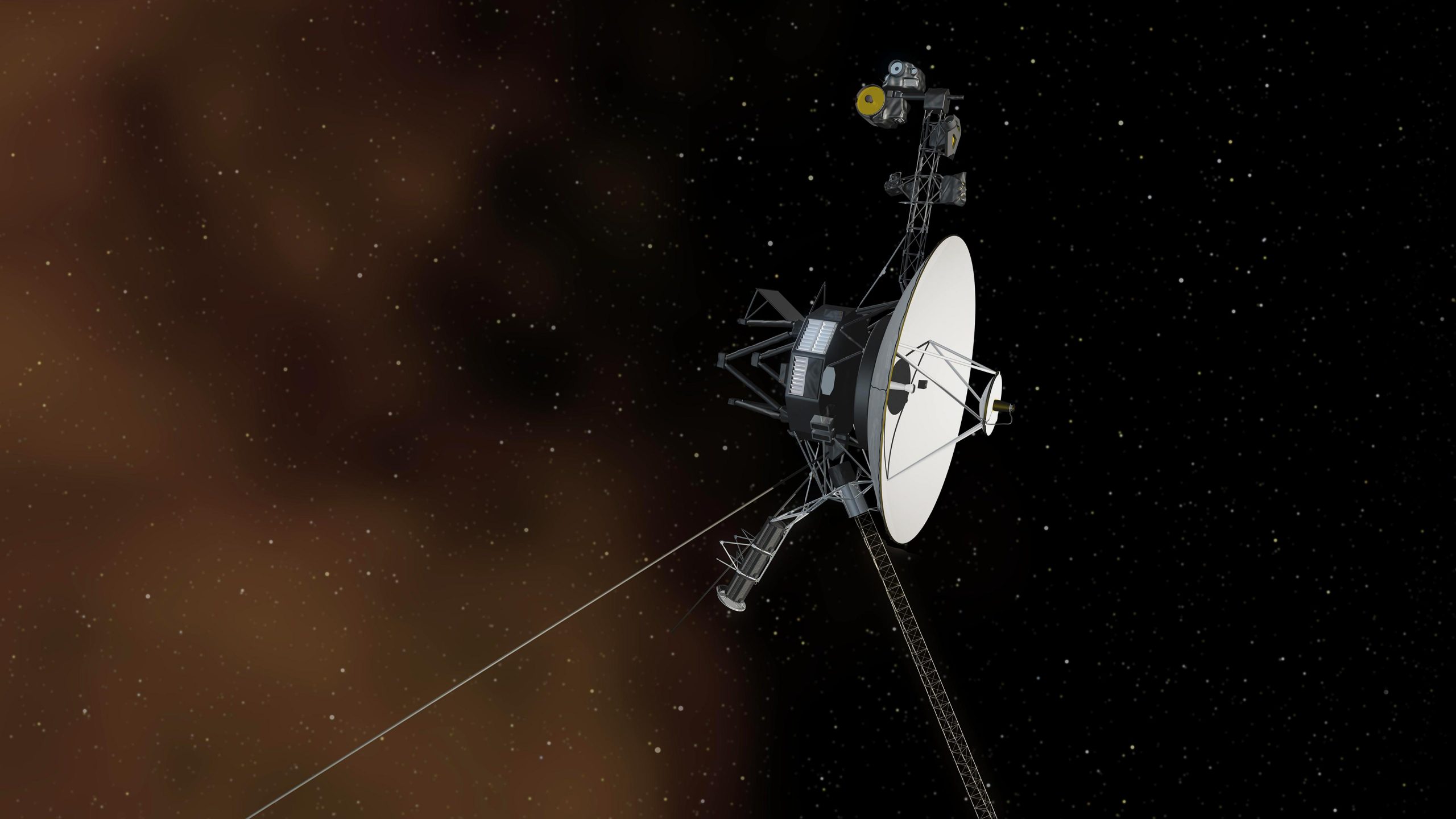
Voyager 1 has detected a steady interstellar plasma hum, providing fresh insights into the space beyond the solar system.
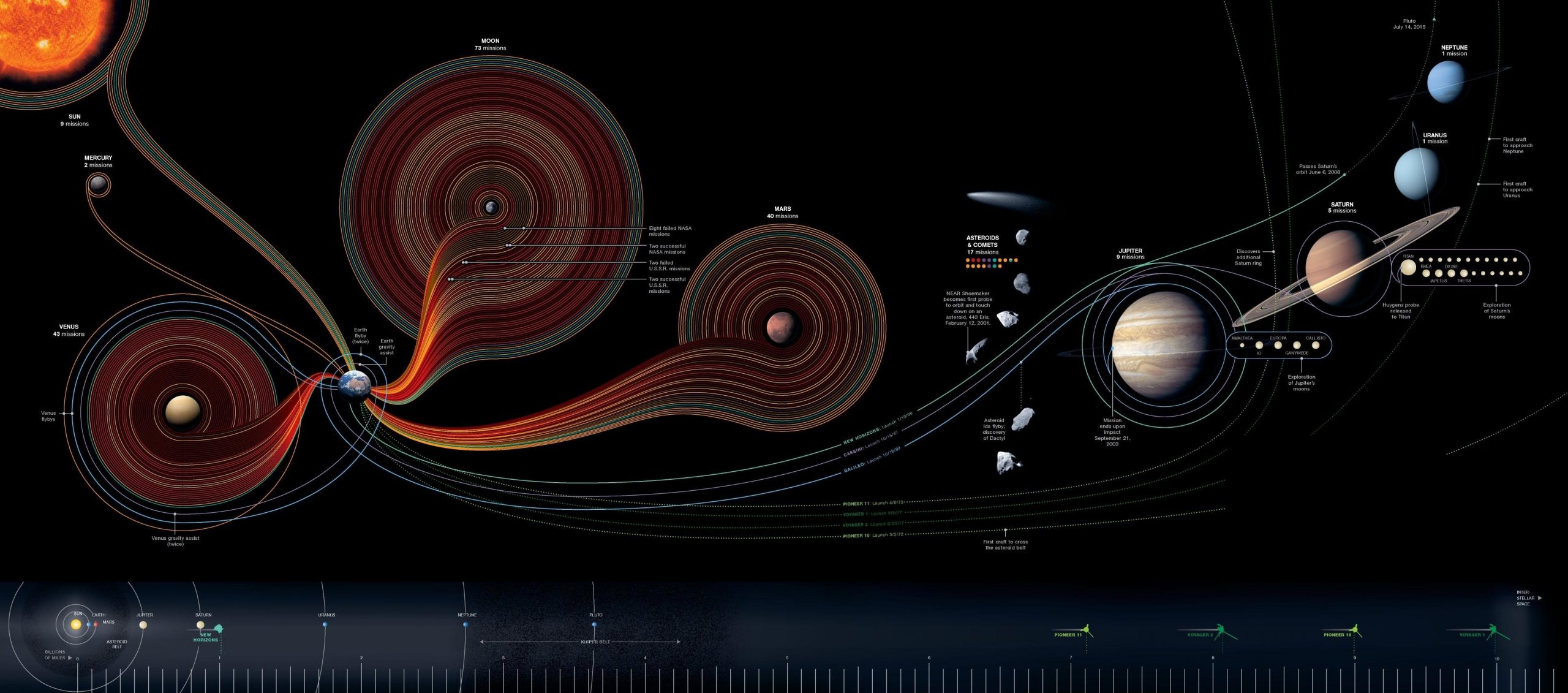
Voyager 1 — one of two sibling NASA spacecraft launched 44 years ago and now the most distant human-made object in space — still works and zooms toward infinity.
The craft has long since zipped past the edge of the solar system through the heliopause — the solar system’s border with interstellar space — into the interstellar medium. Now, its instruments have detected the constant drone of interstellar gas (plasma waves), according to Cornell University-led research published in Nature Astronomy.
Examining data slowly sent back from more than 14 billion miles away, Stella Koch Ocker, a Cornell doctoral student in astronomy, has uncovered the emission. “It’s very faint and monotone, because it is in a narrow frequency bandwidth,” Ocker said. “We’re detecting the faint, persistent hum of interstellar gas.”
This work allows scientists to understand how the interstellar medium interacts with the solar wind, Ocker said, and how the protective bubble of the solar system’s heliosphere is shaped and modified by the interstellar environment.

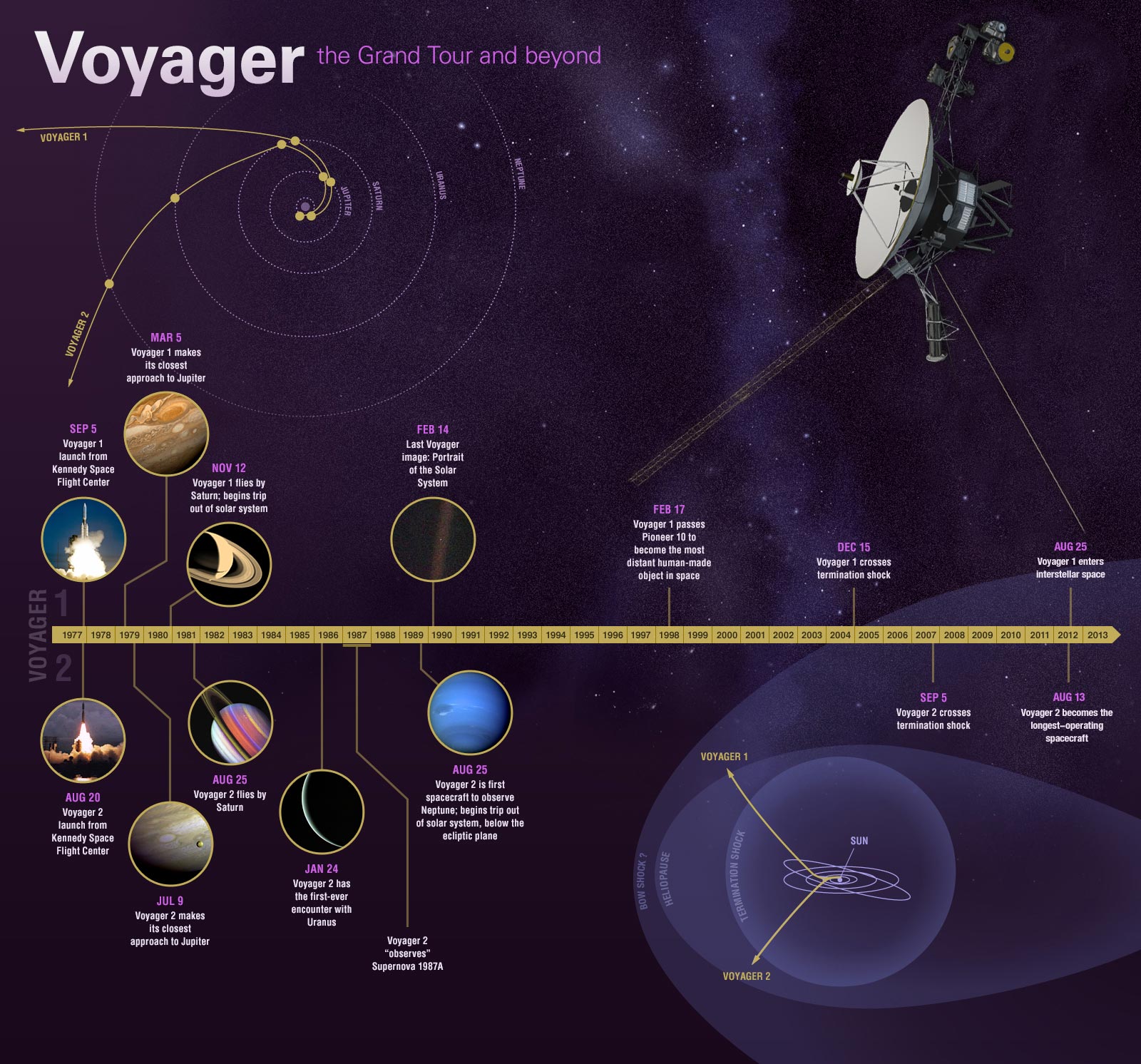
Launched in September 1977, the Voyager 1 spacecraft flew by Jupiter in 1979 and then Saturn in late 1980. Traveling at about 38,000 mph, Voyager 1 crossed the heliopause in August 2012.
After entering interstellar space, the spacecraft’s Plasma Wave System detected perturbations in the gas. But, in between those eruptions — caused by our own roiling sun — researchers have uncovered a steady, persistent signature produced by the tenuous near-vacuum of space.
A Gentle Rain of Space Plasma
“The interstellar medium is like a quiet or gentle rain,” said senior author James Cordes, the George Feldstein Professor of Astronomy. “In the case of a solar outburst, it’s like detecting a lightning burst in a thunderstorm and then it’s back to a gentle rain.”
New Insights Into Low-Level Space Activity
Ocker believes there is more low-level activity in the interstellar gas than scientists had previously thought, which allows researchers to track the spatial distribution of plasma — that is, when it’s not being perturbed by solar flares.
Cornell research scientist Shami Chatterjee explained how continuous tracking of the density of interstellar space is important. “We’ve never had a chance to evaluate it. Now we know we don’t need a fortuitous event related to the sun to measure interstellar plasma,” Chatterjee said. “Regardless of what the sun is doing, Voyager is sending back detail. The craft is saying, ‘Here’s the density I’m swimming through right now. And here it is now. And here it is now. And here it is now.’ Voyager is quite distant and will be doing this continuously.”
Voyager 1 left Earth carrying a Golden Record created by a committee chaired by the late Cornell professor Carl Sagan, as well as mid-1970s technology. To send a signal to Earth, it took 22 watts, according to NASA’s Jet Propulsion Laboratory. The craft has almost 70 kilobytes of computer memory and — at the beginning of the mission — a data rate of 21 kilobits per second.
Due to the 14-billion-mile distance, the communication rate has since slowed to 160-bits-per-second, or about half a 300-baud rate.
Reference: “Persistent plasma waves in interstellar space detected by Voyager 1” by Stella Koch Ocker, James M. Cordes, Shami Chatterjee, Donald A. Gurnett, William S. Kurth and Steven R. Spangler, 10 May 2021, Nature Astronomy.
DOI: 10.1038/s41550-021-01363-7
NASA, the Jet Propulsion Laboratory and the National Science Foundation supported the work. Cordes, Chatterjee and Ockler are members of Cornell’s Carl Sagan Institute.
Never miss a breakthrough: Join the SciTechDaily newsletter.
Follow us on Google and Google News.
9 Comments
mao
mowy like
So where’s the audio???/
humming you say ….. probably a capacitor going south…
Tats why in India they chant the word power aum. Which is called as primodial sound. Pranava. Sound of celestial breath
Wanted a more detail abt it
HUGE waste of taxpayer funds ever dreamed up. No redeeming social value whatsoever.
I have read some comments on the post showing that there is no social value…. And perhaps your are correct that there is no immediate value to this but every small bit of information no matter what how minor is accumulated for reason and purpose of our future. Not for us but the generations to come most people don’t understand that…..
#THEORY #ASTROLOGY #SOUND #MAGNET
I JUST DISCOVERED SOMETHING NEW; SOUND WAVE CAN ONLY TRAVEL THROUGH #MAGNETICS FIELDS OR TO BE TRANSFER. IT SEEM THAT EVERY PLANET HAS A MAGNETIC POLE, WHETHER IT IS STRONG OR VERY LOW FORCE WISE. SIMILAR TO A STUDIO MICROPHONE & HEADPHONES, THE HIGH PITCH SOUND IS RECEIVE FROM A AUDIO WAVE SIGNAL; CAUSING POSSIBLY POSITIVE & NEGATIVE INTERFERENCE LIKE MAGNET MEETS END COUNTER REACTS. TO SEND #MESSENGI TO #LIFE OF OTHER #ALIEN PLANETS; THE KINDS HAS TO CONTAIN AUDIO INSIDE CONTAINER THAT CAN SOMEHOW REACH ANOTHER, BY ANY MEANS NECESSARY DISTANCE.