
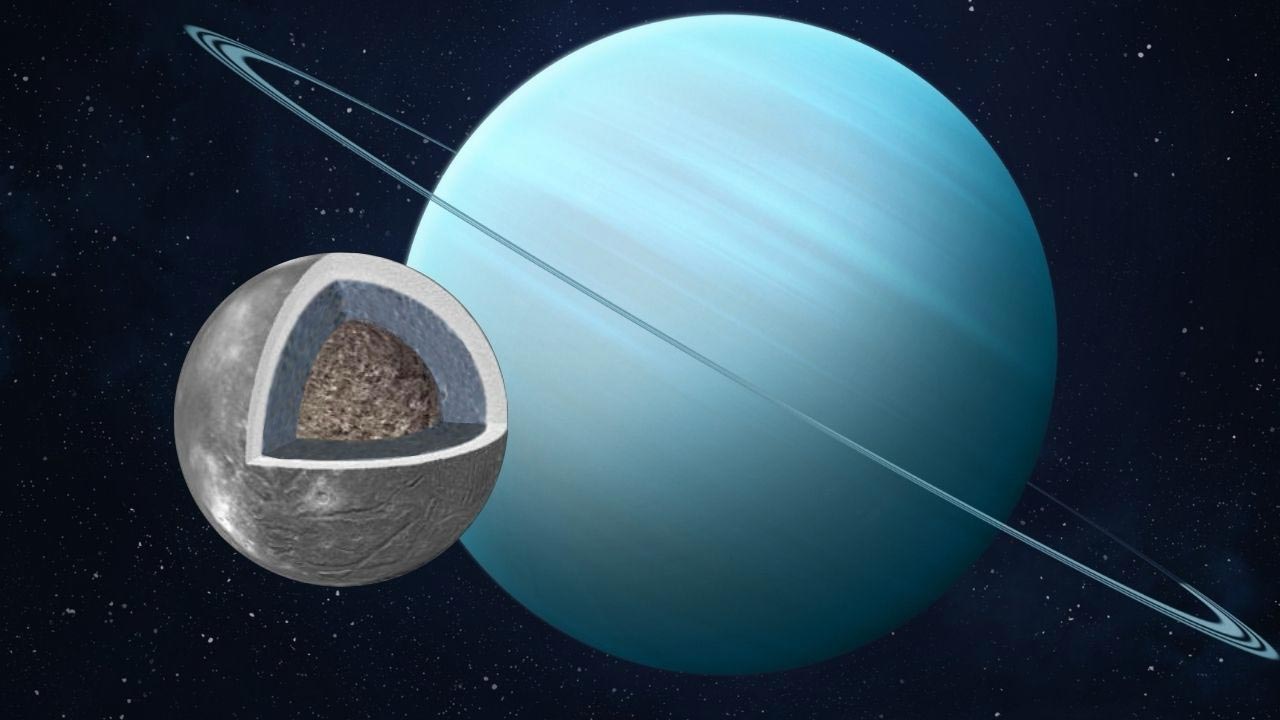
Evidence points to a long-lost ocean beneath Ariel’s icy crust. Tides and orbit shifts may have cracked its surface billions of years ago.
Growing evidence indicates that a deep ocean may lie hidden beneath the icy exterior of Uranus’ moon Ariel. A new study published in Icarus examined how this subsurface ocean might have formed and evolved, revealing that it could once have reached depths of more than 100 miles (170 kilometers).
For comparison, Earth’s Pacific Ocean averages only about 2.5 miles (4 kilometers) deep.
Ariel’s surface and its mysteries
“Ariel is pretty unique in terms of icy moons,” said paper co-author Alex Patthoff, a Planetary Science Institute senior scientist.
Ariel, Uranus’ brightest and second-closest moon, measures roughly 720 miles (1,159 km) across (about the distance from PSI in Tucson to Salt Lake City, Utah). It is the fourth-largest moon in the Uranian system and displays a striking mix of ancient and youthful features. According to first author Caleb Strom, a recent graduate of the University of North Dakota, Ariel’s surface combines heavily cratered areas with smooth plains likely formed by cryovolcanism. The moon’s landscape also contains large fractures, ridges, and grabens—sections of crust that have sunk below surrounding terrain—on scales greater than nearly anywhere else in the Solar System.
This complex terrain led scientists to investigate Ariel’s internal and orbital history. The team aimed to determine how its inner structure and orbital eccentricity, or the degree to which its orbit deviates from a perfect circle, could have produced the patterns seen today. Both factors affect the stress placed on the moon’s crust, which can fracture as Ariel is pulled and stretched by Uranus’ gravity.
“First, we mapped out the larger structures that we see on the surface, then we used a computer program to model the tidal stresses on the surface, which result from distortion of Ariel from soccer ball-shaped to slight football-shaped and back as it moves closer and farther from Uranus during its orbit,” Patthoff said. “By combining the model with what we see on the surface, we can make inferences about Ariel’s past eccentricity and how thick the ocean might have been.”
The power of tidal stress
The researchers determined that Ariel once had an orbital eccentricity of roughly 0.04, about 40 times greater than it is today. Although this number may appear small, even slight increases in eccentricity can significantly intensify tidal stress. At that level, Ariel’s orbit would have been four times more elongated than Jupiter’s moon Europa, whose surface is continuously fractured by powerful tidal forces. Despite this, Ariel’s path around Uranus would still have looked nearly circular to the eye.
“In order to create those fractures, you have to have either a really thin ice on a really big ocean, or a higher eccentricity and a smaller ocean,” Patthoff said. “But either way, we need an ocean to be able to create the fractures that we are seeing on Ariel’s surface.”
Connecting Ariel to its sister moons
What’s more, this is the second in a series of papers investigating the past subsurface of Uranus’ moons. Last year, this same team published a paper on Miranda with similar results.
“We are finding evidence that the Uranus system may harbor twin ocean worlds,” said co-author Tom Nordheim of Johns Hopkins University Applied Physics Laboratory and principal investigator of the NASA Solar System Workings grant that funded the Miranda and Ariel studies. “Unfortunately, we’ve only seen the southern hemispheres of Ariel and Miranda. But our results can give us predictions of what a future spacecraft might see on the moons’ unimaged northern hemispheres, such as the location of fractures and ridges there. Ultimately, we just need to go back to the Uranus system and see for ourselves.”
Researchers still aren’t sure exactly how long ago this deep ocean might have existed; however, this work will provide an important input for future research that investigates the behavior of outer Solar System oceans over time.
Reference: “Constraining ocean and ice shell thickness on Ariel from surface geologic structures and stress mapping” by Caleb Strom, Tom A. Nordheim, D. Alex Patthoff and Sherry K. Fieber-Beyer, 22 September 2025, Icarus.
DOI: 10.1016/j.icarus.2025.116822
This research was also funded by the North Dakota Space Grant Consortium.
Never miss a breakthrough: Join the SciTechDaily newsletter.
Follow us on Google and Google News.
3 Comments
I don’t wanna go back to Uranus. It was a very dark place.
So you were surprised? You shouldn’t have went the first time! 🌚💩
What’s the point of this, it may have had massive oceans at one time.
What good does it do us .A lot of this is guesswork.
Are we going to land on it because landing on our own moon is difficult enough and that’s nearby.