
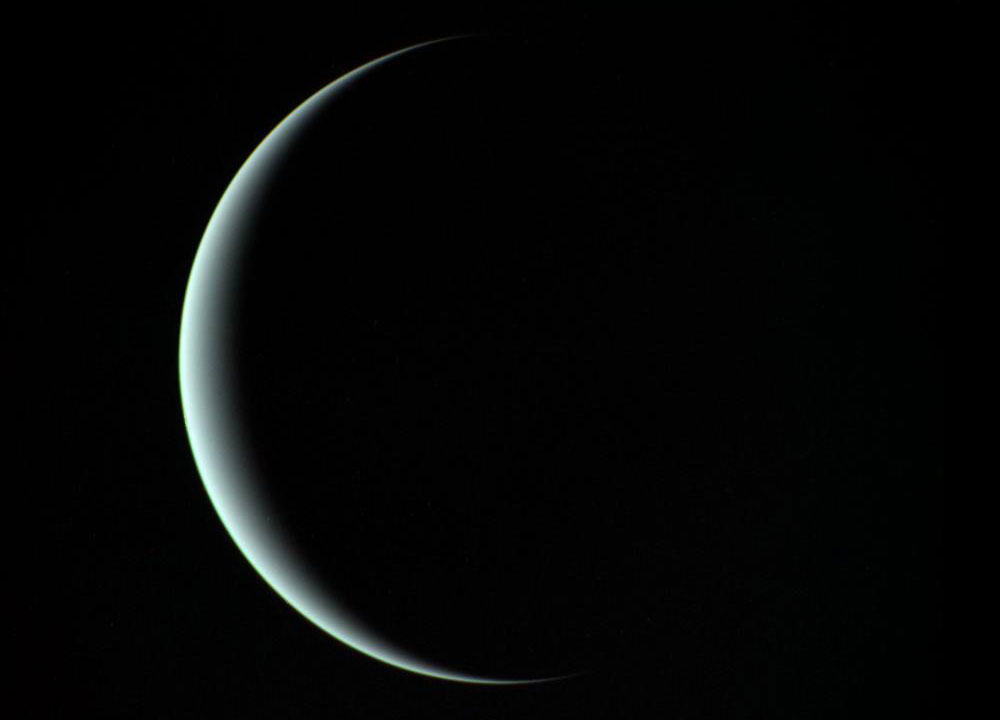
Hydrogen sulfide, the gas that gives rotten eggs their distinctive odor, permeates the upper atmosphere of the planet Uranus – as has been long debated, but never definitively proven. Based on sensitive spectroscopic observations with the Gemini North telescope, astronomers uncovered the noxious gas swirling high in the giant planet’s cloud tops. This result resolves a stubborn, long-standing mystery of one of our neighbors in space.
Even after decades of observations, and a visit by the Voyager 2 spacecraft, Uranus held on to one critical secret, the composition of its clouds. Now, one of the key components of the planet’s clouds has finally been verified.
Patrick Irwin from the University of Oxford, UK and global collaborators spectroscopically dissected the infrared light from Uranus captured by the 8-meter Gemini North telescope on Hawaii’s Maunakea. They found hydrogen sulfide, the odiferous gas that most people avoid, in Uranus’s cloud tops. The long-sought evidence is published in the April 23rd issue of the journal Nature Astronomy.
The Gemini data, obtained with the Near-Infrared Integral Field Spectrometer (NIFS), sampled reflected sunlight from a region immediately above the main visible cloud layer in Uranus’s atmosphere. “While the lines we were trying to detect were just barely there, we were able to detect them unambiguously thanks to the sensitivity of NIFS on Gemini, combined with the exquisite conditions on Maunakea,” said Irwin. “Although we knew these lines would be at the edge of detection, I decided to have a crack at looking for them in the Gemini data we had acquired.”
“This work is a strikingly innovative use of an instrument originally designed to study the explosive environments around huge black holes at the centers of distant galaxies,” said Chris Davis of the United State’s National Science Foundation, a leading funder of the Gemini telescope. “To use NIFS to solve a longstanding mystery in our own Solar System is a powerful extension of its use,” Davis adds.
Astronomers have long debated the composition of Uranus’s clouds and whether hydrogen sulfide or ammonia dominates the cloud deck, but lacked definitive evidence either way. “Now, thanks to improved hydrogen sulfide absorption-line data and the wonderful Gemini spectra, we have the fingerprint which caught the culprit,” says Irwin. The spectroscopic absorption lines (where the gas absorbs some of the infrared light from reflected sunlight) are especially weak and challenging to detect according to Irwin.
The detection of hydrogen sulfide high in Uranus’s cloud deck (and presumably Neptune’s) contrasts sharply with the inner gas giant planets, Jupiter and Saturn, where no hydrogen sulfide is seen above the clouds, but instead, ammonia is observed. The bulk of Jupiter and Saturn’s upper clouds are comprised of ammonia ice, but it seems this is not the case for Uranus. These differences in atmospheric composition shed light on questions about the planets’ formation and history.
Leigh Fletcher, a member of the research team from the University of Leicester in the UK, adds that the differences between the cloud decks of the gas giants (Jupiter and Saturn), and the ice giants (Uranus and Neptune), were likely imprinted way back during the birth of these worlds. “During our Solar System’s formation the balance between nitrogen and sulphur (and hence ammonia and Uranus’s newly-detected hydrogen sulfide) was determined by the temperature and location of planet’s formation.”
Another factor in the early formation of Uranus is the strong evidence that our Solar System’s giant planets likely migrated from where they initially formed. Therefore, confirming this composition information is invaluable in understanding Uranus’ birthplace, evolution and refining models of planetary migrations.
According to Fletcher, when a cloud deck forms by condensation, it locks away the cloud-forming gas in a deep internal reservoir, hidden away beneath the levels that we can usually see with our telescopes. “Only a tiny amount remains above the clouds as a saturated vapor,” said Fletcher. “And this is why it is so challenging to capture the signatures of ammonia and hydrogen sulfide above cloud decks of Uranus. The superior capabilities of Gemini finally gave us that lucky break,” concludes Fletcher.
Glenn Orton, of NASA’s Jet Propulsion Laboratory, and another member of the research team notes, “We’ve strongly suspected that hydrogen sulfide gas was influencing the millimeter and radio spectrum of Uranus for some time, but we were unable to attribute the absorption needed to identify it positively. Now, that part of the puzzle is falling into place as well.”
While the results set a lower limit to the amount of hydrogen sulfide around Uranus, it is interesting to speculate what the effects would be on humans even at these concentrations. “If an unfortunate human were ever to descend through Uranus’s clouds, they would be met with very unpleasant and odiferous conditions.” But the foul stench wouldn’t be the worst of it according to Irwin. “Suffocation and exposure in the negative 200 degrees Celsius (negative 330 degrees Fahrenheit) atmosphere made of mostly hydrogen, helium, and methane would take its toll long before the smell,” concludes Irwin.
The new findings indicate that although the atmosphere might be unpleasant for humans, this far-flung world is fertile ground for probing the early history of our Solar System and perhaps understanding the physical conditions on other large, icy worlds orbiting the stars beyond our Sun.
Reference: “Detection of hydrogen sulfide above the clouds in Uranus’s atmosphere” by Patrick G. J. Irwin, Daniel Toledo, Ryan Garland, Nicholas A. Teanby, Leigh N. Fletcher, Glenn A. Orton and Bruno Bézard, 23 April 2018, Nature Astronomy.
DOI: 10.1038/s41550-018-0432-1
Never miss a breakthrough: Join the SciTechDaily newsletter.
Follow us on Google and Google News.