
Close Menu
    Facebook X (Twitter) Instagram
    SciTechDaily
    • Biology
    • Chemistry
    • Earth
    • Health
    • Physics
    • Science
    • Space
    • Technology
    Facebook X (Twitter) Pinterest YouTube RSS
    SciTechDaily
    Home»Space»Astronomers Observed Evolved Star Being Devoured
    Space

    Astronomers Observed Evolved Star Being Devoured

    By Harvard-Smithsonian Center for AstrophysicsMay 4, 2012No Comments3 Mins Read
    Facebook Twitter Pinterest Telegram LinkedIn WhatsApp Email Reddit
    Share
    Facebook Twitter LinkedIn Pinterest Telegram Email Reddit
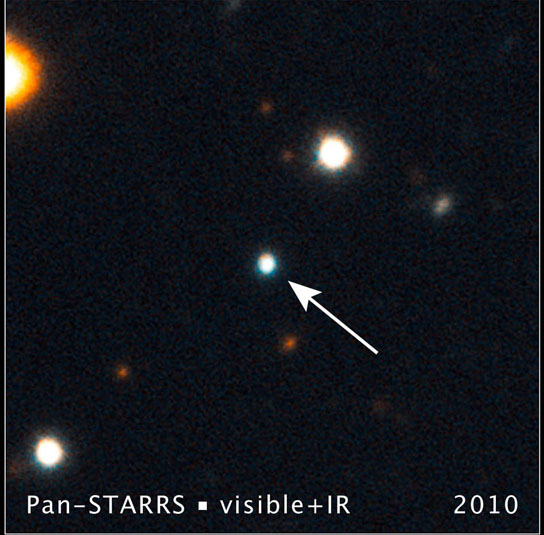
    supermassive black hole shredded and absorbed a star
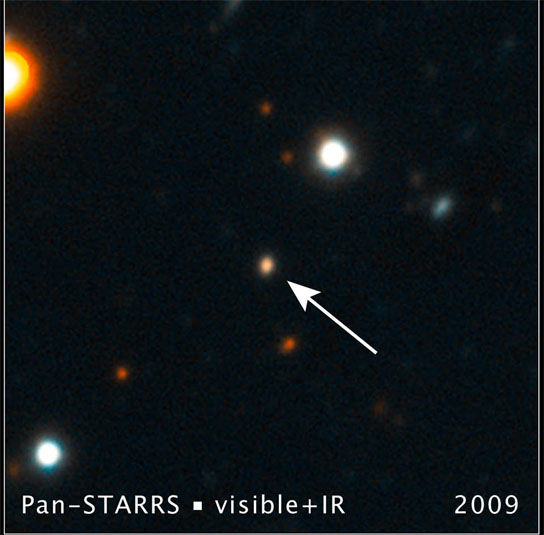
    An optical-IR image showing a galaxy that suddenly brightened when the supermassive black hole at its center shredded and absorbed a star that wandered too close. Credit: NASA; Gezari, Rest, and Chornock

    A team of CfA astronomers is reporting that the object they observed using the Pan-STARRS telescope was a supermassive black hole, roughly two million solar masses in size, devouring what was probably a 5 billion-year-old star.
    Black Hole Flare

    Black holes can come in a wide range of masses. Some, with only about one solar mass, result from the supernova death of a massive star, while those at the center of galaxies (called supermassive black holes) have millions or even billions of solar masses. Supermassive black holes are relatively famous because they are responsible for the powerful jets and other dramatic phenomena seen in some galaxies. The center of our Milky Way galaxy contains a modest-sized supermassive black hole, with about four million solar masses, and (fortunately for us) it is inactive — it lacks the extreme phenomena seen elsewhere.

    Black holes are so dense that nothing, not even light, can escape from their gravitational clutches. Still, black holes can be detected because matter that falls into them heats up, and emits bright radiation. A short-lived flare, for example, can result when a body (perhaps a cloud of gas or a star) wanders too close to a black hole and is eaten. Astronomers are particularly interested in measuring the way the brightness of the flare increases, versus its decline, because the shape of the rising emission holds clues to the actual infall process. Observing such events is difficult, though, because the flaring activity may only last for a few months — by the time it is spotted in the sky the most diagnostic phases of flare activity may have passed. Moreover, flares from smaller supermassive black holes (like the one in the center of the Milly Way) may be correspondingly weaker.

    Pan-STARRS (Panoramic Survey Telescope & Rapid Response System) is a telescope with a small mirror (1.8 meters) but a very large field of view, and large digital cameras (1.4 billion pixels) developed especially to look for transient events. It can observe the entire available sky several times a month. In May of 2010 it spotted what appeared to be a flare from a previously inactive, Milky-Way-sized supermassive black hole in a galaxy about two billion light-years away. A team including CfA astronomers Ryan Chornock, Edo Berger, Peter Challis, Gautham Narayan, Ryan Foley, George Marion, Laura Chomiuk, Alicia Soderberg, Bob Kirshner, and Chris Stubbs, then led an aggressive follow-up campaign of observations to see what was going on.

    The team reports on their discovery in this week’s Nature. They began observing the flare about 40 days after it went off and about 40 days before it peaked, providing excellent data over most of the event. Detailed modeling of the light led the team to conclude that the black hole is less massive than previously thought, only about two million solar masses, and that the object it devoured was probably an evolved star (about 5 billion years old) whose mass was about 0.2 solar masses. These new results provide a particularly impressive, detailed view of what goes on in these exotic cosmic flares, and offer support for the overall model of these flaring events.

    Never miss a breakthrough: Join the SciTechDaily newsletter.
    Follow us on Google and Google News.

    Astrophysics Black Hole Harvard-Smithsonian Center for Astrophysics
    Share. Facebook Twitter Pinterest LinkedIn Email Reddit

    Related Articles

    Researchers Model the Workings of an X-ray Binary Star

    Researchers Study Mysterious Gamma Ray Source with No Known Counterpart

    Researchers Trace the Evolution of Galaxies that Host Massive Black Holes

    Distinguishing Black Holes from Naked Singularities

    A Link Between Black Hole Accretion Rate and Star Formation Rate

    Astronomers Measure a Black Hole’s “Point of No Return”

    Cloud of Hydrogen and Helium Plunging Toward the Galactic Center

    Study Challenges Prevailing Ideas About How Supermassive Black Holes Grow

    Gamma-Ray Beams Suggest Milky Way’s Central Black Hole Had Active Past

    Leave A Reply Cancel Reply

    • Facebook
    • Twitter
    • Pinterest
    • YouTube

    Don't Miss a Discovery

    Subscribe for the Latest in Science & Tech!

    Trending News

    Scientists Call for a Complete Rethink of Alzheimer’s Treatment

    Scientists Identify Molecular Switch That Lets Exercise Reverse Muscle Aging

    Why Your Most Vivid Dreams Might Be the Key to Deep, Restful Sleep

    A Bright Star Hid a Massive Secret for 50 Years: Mystery of Gamma Cassiopeiae Finally Solved

    Scientists Identify Protein That Slows Key Effects of Aging

    Revolutionary Submarine Mysteriously Disappears Without a Trace – Scientists Are Now Preparing for a Bold Return

    Why Drinking More Water Isn’t Enough To Stop Kidney Stones

    New Study Reveals Surprising Effect of Drinking Coffee at Night

    Follow SciTechDaily
    • Facebook
    • Twitter
    • YouTube
    • Pinterest
    • Newsletter
    • RSS
    SciTech News
    • Biology News
    • Chemistry News
    • Earth News
    • Health News
    • Physics News
    • Science News
    • Space News
    • Technology News
    Recent Posts
    • Your BMI Might Be Wrong: Study Finds Millions Are Misclassified
    • More Than Half of U.S. College Students Are Lonely, Major Study Reveals
    • Scientists Reveal Biological Signal Behind Mysterious Alzheimer’s Drug Side Effect
    • A Simple Blood Test Could Predict Dementia Risk 25 Years Early
    • Scientists Uncover Unexpected Behavior Deep Inside Earth’s Mantle
    Copyright © 1998 - 2026 SciTechDaily. All Rights Reserved.
    • Science News
    • About
    • Contact
    • Editorial Board
    • Privacy Policy
    • Terms of Use

    Type above and press Enter to search. Press Esc to cancel.