
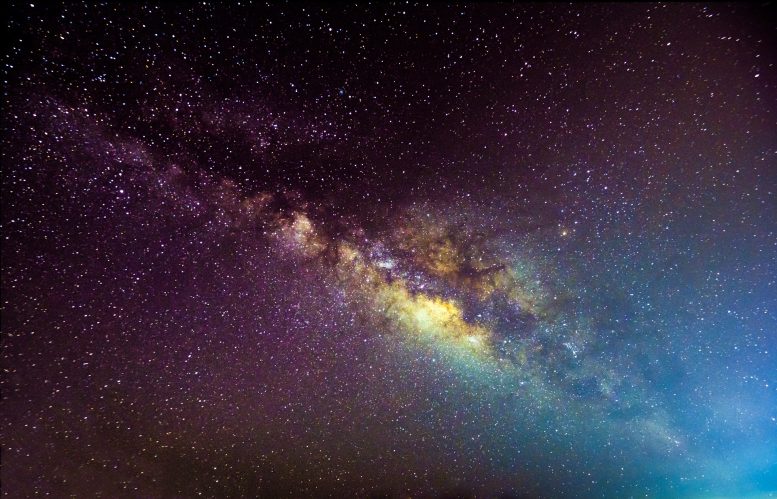
An international team of researchers has produced new maps of the material located between the stars in the Milky Way, moving astronomers closer to solving a stubborn interstellar mystery.
An international team of sky scholars, including a key researcher from Johns Hopkins, has produced new maps of the material located between the stars in the Milky Way. The results should move astronomers closer to cracking a stardust puzzle that has vexed them for nearly a century.
The maps and an accompanying journal article appear in the August 15 issue of the journal Science. The researchers say their work demonstrates a new way of uncovering the location and eventually the composition of the interstellar medium—the material found in the vast expanse between star systems within a galaxy.
This material includes dust and gas composed of atoms and molecules that are left behind when a star dies. The material also supplies the building blocks for new stars and planets.
“There’s an old saying that ‘We are all stardust,’ since all chemical elements heavier than helium are produced in stars,” says Rosemary Wyse, a Johns Hopkins professor of physics and astronomy who played a prominent role in the research and helped shape the Science paper. “But we still don’t know why stars form where they do. This study is giving us new clues about the interstellar medium out of which the stars form.”
In particular, the researchers focused on a mysterious feature in the light from stars, a peculiarity called diffuse interstellar bands, or “DIBs.” A graduate student who photographed the light from distant stars discovered these dark bands in 1922.
Analyzing rainbow-colored bands of starlight that have passed through space gives astronomers important information about the makeup of the space materials that the light has encountered. But in 1922, the grad student’s photographs yielded some dark lines indicating that some starlight was “missing” and that something in the interstellar medium between Earth and the star was absorbing the light.
Since then, scientists have identified more than 400 of these diffuse interstellar bands, but the materials that cause the bands to appear and their precise location have remained a mystery.
Researchers have speculated that the absorption of starlight that creates these dark bands points to the presence of unusually large, complex molecules, but proof of this has remained elusive. The nature of this puzzling material is important to astronomers because it could provide clues about the physical conditions and chemistry of these regions between stars. Such details serve as critical components in theories about how stars and galaxies are formed.
Wyse said more concrete clues should emerge from the new pseudo-3D maps of the DIB-material within our Milky Way Galaxy, maps that were produced by the 23 scientists who contributed to the Science article.
The maps were assembled from data collected over a 10-year period by the Radial Velocity Experiment, also known as RAVE. This project used the UK Schmidt Telescope in Australia to collect spectroscopic information from the light of as many as 150 stars at once. The maps are described as “pseudo-3D” because a specific mathematical form was assumed for the distribution in the vertical dimension that provides the distances from the plane of the Milky Way, with the maps presented in the remaining two dimensions.
Wyse, who is on the executive board of the RAVE project, said the survey supplied the mapmakers with data related to 500,000 stars. The vast size of the sample enabled the mapmakers to determine the distances of the material that causes the DIBs and thus how the material is distributed throughout the Milky Way Galaxy. The resulting maps showed the intriguing result that the complex molecules thought to be responsible for the DIBs are distributed differently than another known component of the interstellar medium—the solid particles known as dust—also traced by the RAVE survey.
Future studies can use the techniques outlined in the new paper to assemble other maps that should further solve the mysteries surrounding where DIBs are located and what materials cause them.
“To figure out what something is, you first have to figure out where it is, and that’s what this paper does,” Wyse says. “Larger surveys will provide more details in the future. This paper has demonstrated how to do that.”
Janez Kos and Tomaz Zwitter of the University of Ljubljana in Slovenia led the astronomy team that produced this paper. Wyse was the third author listed on the paper.
RAVE is a multinational project with the participation of scientists from Australia, Germany, France, the U.K., Italy, Canada, the Netherlands, Slovenia, and the U.S., coordinated by the Leibniz Institute for Astrophysics Potsdam in Germany. Funding of RAVE, which guarantees extensive data, telescope, and instrument access is provided by the participating institutions and the national research foundations.
Reference: “Pseudo–three-dimensional maps of the diffuse interstellar band at 862 nm” by Janez Kos, Tomaž Zwitter, Rosemary Wyse, Olivier Bienaymé, James Binney, Joss Bland-Hawthorn, Kenneth Freeman, Brad K. Gibson, Gerry Gilmore, Eva K. Grebel, Amina Helmi, Georges Kordopatis, Ulisse Munari, Julio Navarro, Quentin Parker, Warren A. Reid, George Seabroke, Sanjib Sharma, Arnaud Siebert, Alessandro Siviero, Matthias Steinmetz, Fred G. Watson and Mary E. K. Williams, 15 August 2014, Science.
DOI: 10.1126/science.1253171
Never miss a breakthrough: Join the SciTechDaily newsletter.
Follow us on Google and Google News.