
Close Menu
    Facebook X (Twitter) Instagram
    SciTechDaily
    • Biology
    • Chemistry
    • Earth
    • Health
    • Physics
    • Science
    • Space
    • Technology
    Facebook X (Twitter) Pinterest YouTube RSS
    SciTechDaily
    Home»Space»Astronomers Reveal Colliding Galaxy Clusters
    Space

    Astronomers Reveal Colliding Galaxy Clusters

    By Harvard-Smithsonian Center for AstrophysicsDecember 2, 2016No Comments3 Mins Read
    Facebook Twitter Pinterest Telegram LinkedIn WhatsApp Email Reddit
    Share
    Facebook Twitter LinkedIn Pinterest Telegram Email Reddit
    Galaxy 3C438
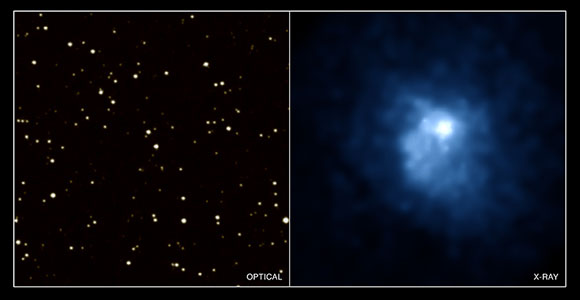
    The galaxy 3C438 and its cluster of galaxies as seen in the optical (left) and in X-rays by the Chandra X-ray Observatory (right).

    A team of astronomers from the Harvard-Smithsonian Center for Astrophysics have concluded that the hot gas in the cluster around galaxy 3C438 is the result of a collision between two clusters of galaxies.

    Galaxy clusters contain a few to thousands of galaxies and are the largest bound structures in the Universe. Most galaxies are members of a cluster. Our Milky Way, for example, is a member of the “Local Group,” a set of about fifty galaxies whose other large member is the Andromeda galaxy. The closest large cluster of galaxies to us, about fifty million light-years away, is the Virgo Cluster, with about 2000 members.

    Clusters are believed to grow as the result of mergers between smaller galaxy groups and from the accretion of gas and dark matter. The energy released in these mergers is largely dissipated in the hot gas within the cluster, where X-ray observations can spot evidence for shocks and high temperatures. Mergers between two equally massive galaxy clusters provide particularly important diagnostics since these energetic collisions have the most dramatic and long-lasting effects. These major mergers are relatively rare events, however. The Bullet Cluster is one recently analyzed example, and because it also happens to act as a gravitational lens for background galaxies, it became famous for showing the distribution of its dark matter.

    CfA astronomers Deanna Emery, Akos Bogdan, Ralph Kraft, Filipe Andrade-Santos, Bill Forman, Christine Jones, and another colleague studied another major merger in the cluster around the galaxy 3C438. Members of the team used the Chandra X-ray Observatory to examine the hot cluster gas. Previous observations had concluded that activity was due either to a supermassive black hole or from a massive merger, but the two could not be distinguished. Using additional Chandra observations and new calibration procedures, the scientists re-reduced all the data. They found that the hot cluster gas extends over a distance of about 2.5 million light-years and has brightness features apparently caused by a merger bow shock. They are even able to calculate the estimated relative velocity of the merger as about 2600 kilometers per second. Since few observations of bow shocks in clusters have been made, this detection makes an important contribution to the study of the dynamics of cluster mergers and how massive clusters may have formed.

    Reference: “A Spectacular Bow Shock in the 11 keV Galaxy Cluster Around 3C 438” by Deanna L. Emery, Akos Bogdan, Ralph P. Kraft, Felipe Andrade-Santos, William R. Forman, Martin J. Hardcastle and Christine Jones, 11 January 2017, The Astrophysical Journal.
    DOI: 10.3847/1538-4357/834/2/159
    arXiv: 1611.03489

    Never miss a breakthrough: Join the SciTechDaily newsletter.
    Follow us on Google and Google News.

    Astronomy Astrophysics Cosmology Harvard-Smithsonian Center for Astrophysics
    Share. Facebook Twitter Pinterest LinkedIn Email Reddit

    Related Articles

    Webb’s Mysterious “Little Red Dots” May Be the Cradle of the First Black Holes

    Mysterious Radio Signals Reveal What’s Hiding Between Galaxies

    Cosmic Mystery Solved: Astronomers Have Discovered the Universe’s “Missing” Matter

    Invisible Storm Lights Up Galaxy Cluster With Record-Breaking Radio Glow

    Astronomers Search for Trigger of Nearby Supernova

    Herschel Observations Help Identify the Physical Processes Underway in Cold, Dense Clouds

    CfA Scientists Measure the Rate of Expansion of the Universe

    New Study Challenges Planck Results

    Calculations Show the Ideal Time to Study the Cosmos

    Leave A Reply Cancel Reply

    • Facebook
    • Twitter
    • Pinterest
    • YouTube

    Don't Miss a Discovery

    Subscribe for the Latest in Science & Tech!

    Trending News

    Scientists Uncover Promising New Strategy To Stop Parkinson’s in Its Tracks

    Experts Reveal the Surprising Cancer Link Behind a Common Vitamin

    This Strange “Golden Orb” Found 2 Miles Deep Stumped Scientists for Years

    Giant “Last Titan” Dinosaur Discovered in Thailand Was Bigger Than 9 Elephants

    This “Longevity Gene” May Protect the Brain From Aging and Dementia

    Common Cleaning Chemical Could Triple Your Risk of a Dangerous Liver Disease

    Scientists Discover Bizarre 100-Million-Year-Old Insect With Giant Claws

    Scientists Discover “Good” Gut Microbes That Could Protect Against Autism and ADHD

    Follow SciTechDaily
    • Facebook
    • Twitter
    • YouTube
    • Pinterest
    • Newsletter
    • RSS
    SciTech News
    • Biology News
    • Chemistry News
    • Earth News
    • Health News
    • Physics News
    • Science News
    • Space News
    • Technology News
    Recent Posts
    • Tea or Coffee? Your Daily Choice Could Affect Osteoporosis Risk
    • Scientists Discover Brain Pathway That May Slow Parkinson’s Disease – but Only in Women
    • Vitamin C May Fight Cancer in a Surprising Way
    • Light-Matter Particles Could Revolutionize AI Computing
    • Scientists Warn Many Insects May Not Survive a Warming World
    Copyright © 1998 - 2026 SciTechDaily. All Rights Reserved.
    • Science News
    • About
    • Contact
    • Editorial Board
    • Privacy Policy
    • Terms of Use

    Type above and press Enter to search. Press Esc to cancel.