
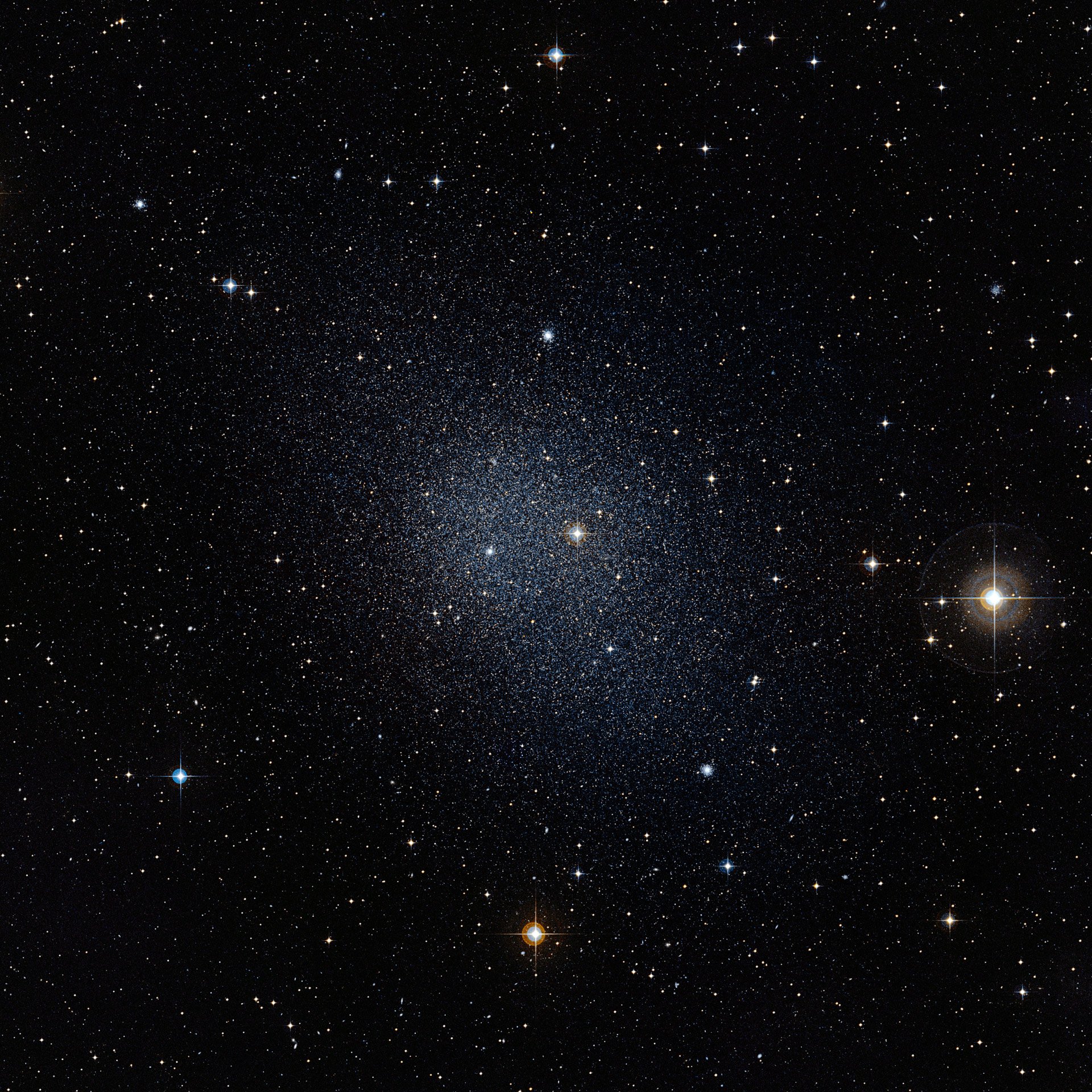
A newly published study details how astronomers used both data from telescopes and newly developed computer modeling to solve a 20-year debate over how dark matter is distributed in small galaxies.
Austin — Astronomers at The University of Texas at Austin believe they have discovered the answer to a 20-year debate over how the mysterious cosmic “dark matter” is distributed in small galaxies. Graduate student John Jardel and his advisor Karl Gebhardt found that the distribution, on average, follows a simple law of decreasing density from the galaxy’s center, although the exact distribution often varies from galaxy to galaxy. The findings are published today in The Astrophysical Journal Letters.
Dark matter is matter that gives off no light, but that astronomers detect by seeing its gravitational tug on other objects (like stars). Theories abound on what dark matter might be made of — unseen particles, dead stars, and more — but nobody knows for sure. Though mysterious, understanding the nature of dark matter is important, because it makes up most of the matter in the universe. The only way to understand how the cosmos evolved to its present state is to decode dark matter’s role.
For that reason, astronomers study the distribution of dark matter within galaxies and on even larger scales. Dwarf galaxies, in particular, make great laboratories to study dark matter, Jardel says, because they contain up to 1,000 times more dark matter than normal matter. Normal galaxies like the Milky Way, on the other hand, contain only 10 times more dark matter than normal matter.
For the past 20 years, observational astronomers and theorists have debated how dark matter is distributed in galaxies. Observational astronomers, through their studies of telescope data, have argued that galaxies have a fairly uniform distribution of dark matter throughout. Theorists, backed by computer simulations from the 1990s, have argued that dark matter density decreases steadily from a galaxy’s core to its hinterlands. The disagreement is known as the “core/cusp debate.”

Jardel’s work set out to study the question using both data from telescopes and newly developed computer modeling. The project started out “not assuming core or cusp theory is right,” he says, “but just asking ‘what is it?.’ These new models allowed us to take this approach.”
Jardel used telescope observations of several of the satellite galaxies orbiting the Milky Way, including the Carina, Draco, Fornax, Sculptor, and Sextans dwarf galaxies. The work involved running many supercomputer models for each galaxy to determine the distribution of dark matter within it, using the university’s Texas Advanced Computing Center (TACC).
He found that in some of the galaxies, the dark matter density decreased steadily from the center. In others, the density held constant. And some galaxies fell in between. However, when all the galaxies’ distributions were analyzed together, the results showed that on average, the theorists were right.
“When you look at individual galaxies,” Jardel says, “some of them look wildly different from expectations. However, when you average several galaxies together, these differences tend to cancel each other out.” This seems to suggest that the theory behind dark matter in galaxies is correct on the whole, but that “each galaxy develops slightly differently.”
The results do “pose more questions — questions about dark matter itself, and how normal matter interacted with dark matter” to form the types of galaxies seen today, Jardel says.
Possible next steps in this research include getting more telescope observations of these galaxies, both their centers and their extreme outlying regions, to understand the distribution of dark matter within them even better. More theory is also needed to explain the details of why certain galaxies’ dark matter halos deviate from the norm.
This work was partially funded by a grant from the National Science Foundation.
Reference: “Variations in a Universal Dark Matter Profile for Dwarf Spheroidals” by John R. Jardel and Karl Gebhardt, 10 September 2013, The Astrophysical Journal Letters.
DOI: 10.1088/2041-8205/775/1/L30
Never miss a breakthrough: Join the SciTechDaily newsletter.
Follow us on Google and Google News.
12 Comments
Could gamma ray bursts be strong enough to destroy a black hole? If so might dark matter be the remnants of dead black holes? It has a strong gravitational pull, and emits nor reflects light. In larger concentrations I assume it would still exhibit many features of a black hole such as light distortion, and space time flux, but if it were spread thin over great expanses would it not exhibit characteristics of dark matter?
Wow… Another example of how The Universal Mind works… Just a few weeks back I too voiced a theory of how Dark matter is the remnants of black holes that have reached critical mass and expel a blast of neutral mass we call Dark Matter across the sphere of the universe… The Universe relating through Humankind…
What if the black hole is a gate to another “universe”, something out of this universe. The dark matter is the matter consisting in this other universe. That would mean that in the other strange universe our matter is called the dark/strange matter.
..carbon, solar energy, frozen matter is the miracle of evolution… waiting in a godless space.
“He found that in some of the galaxies, the dark matter density decreased steadily from the center. In others, the density held constant. And some galaxies fell in between. However, when all the galaxies’ distributions were analyzed together, the results showed that on average, the theorists were right.”– the statement shows that the Dark Matter distribution in the Universe is dynamic and galaxy specific. You know that universal galactic concentration should have been uniform if gravitational forces alone comes into play. There is an additional force coming to shape the galaxies in addition. This should be the Dark Matter around. “Galactic lensing” should be observed in each and every galaxy and stars too to varying effect by the cause of the intervening Dark Matter. The centre of our Milky way Galaxy too should have a core of Dark Matter near “Antares” star of ‘Scorpio’ constellation. The Black Holes too could have a Dark Matter embedded in its core to keep the shape from collapsing to a point. The Sun too could have a Dark Matter in its core to keep its shape and can also wield on other planets to go around it. Dark Matter is the enormous butter greased in between the solid ‘breads of stars’ and by itself is invisible indeed. You can but taste the butter eventhough it disappears to be seen. Thank You.
DARK MATTER is the quantum expansion of the power law ,take another look at the FORNAX GALAXY AND VIEW THE DARK LINES OF FORCE AND THE QUANTUM EGG FORMATION-CREATION
See also comments on potential dark matter 20 year dark matter mystery
That should have read, see also comments on hubble small galaxy 13 billion light years away
TO VIEW DARK MATTER CONCENTRATE ON THE DARK AND NOT THE LIGHT, THE PICTURE IS HOLOGRAPHIC AND AN OPTICAL-ILLUSION, YOU AS THE OBSERVER ARE VIEWING EXSPANDED SPACE THAT IS 4-DIMENSIONAL, YOU ARE A 3-DIMENSIONAL HUMAN BEING THAT HAS A 4-DIMENSIONAL MIND AND A 3-DIMENSIONAL BRAIN, USE YOUR 4D MIND
But we are 4d beings…if not 5d considering space as a seperate dimension and time..eg space time is a factor ie [13 geo loc] § [time relative/reference].
Eg a statue remains at the same space (relatively speaking) throughout a defined subset of a timeline (cartographers, surveyors, and GPS systems reference the space element but not time (even tho geo loc is communicated in time measurements lol)
You’re out of your 2D mind.
OK, so they really didn’t solve the dark matter hypothesis even though the clikyBateish headline alluded that they did.
Got it.