
New research reveals a never-before-seen behavior in a repeating Fast Radio Burst, offering fresh insights into these mysterious cosmic phenomena.
Astronomers continue to unravel the mystery of deep space signals after discovering a never-before-seen quirk in a newly detected Fast Radio Burst (FRB).
FRBs are millisecond-long, extremely bright flashes of radio light that generally come from outside our Milky Way galaxy. Most happen only once, but some “repeaters” send out follow-up signals, adding to the intrigue surrounding their origin.
A new study published in the Monthly Notices of the Royal Astronomical Society has now shed new light on them, after spotting a “highly active” repeating FRB signal that is behaving differently than anything ever detected before.
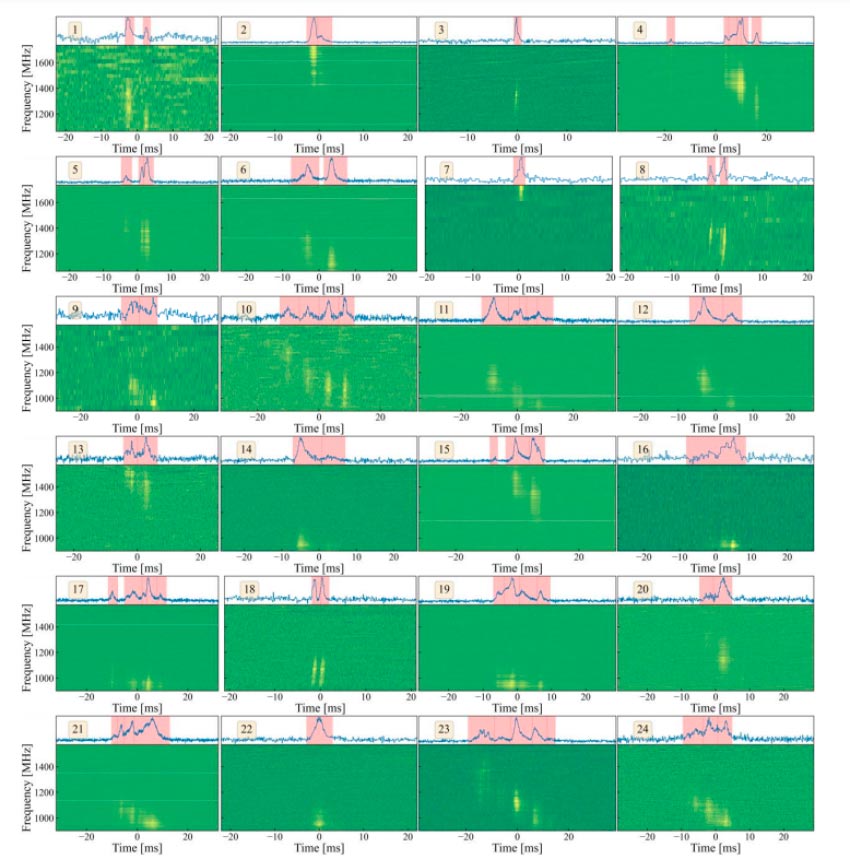
Scientists at the SETI Institute in California recorded 35 FRBs from one source, FRB 20220912A, over a period of two months and found that a fascinating pattern emerged.
Like most repeating FRBs, each burst drifted from higher to lower frequencies over time.
But with FRB 20220912A, there was also a never-before-seen drop in the center frequency of the bursts, revealing what sounds like a cosmic slide-whistle when converted into a sonification using notes on a xylophone.
In it, most of the highest notes can be heard in the first few seconds, and the majority of the lowest ones in the final seconds, as if the xylophone player is repeatedly hitting the lowest available bar on the instrument.
Theories and Discoveries: A Step Closer to Understanding FRBs
Astronomers think that at least some FRBs are generated by a type of neutron star known as a magnetar – the highly magnetized cores of dead stars – while other theories point the finger at colliding neutron star binaries or merging white dwarfs.
“This work is exciting because it provides both confirmation of known FRB properties and the discovery of some new ones,” said lead author Dr. Sofia Sheikh, of the SETI Institute.
“We’re narrowing down the source of FRBs, for example, to extreme objects such as magnetars, but no existing model can explain all of the properties that have been observed so far.”
This sound bite is a data sonification of the 101 sub-bursts observed with the ATA and analyzed in this work. The center frequency of each sub-burst is mapped to a xylophone note [in a one-octave A Lydian scale]. There is a lot of scatter in the notes, but most of the highest notes appear in the first few seconds, and most of the lowest notes appear in the last few seconds, as if the xylophone player is hitting the lowest available bar on the instrument repeatedly. We use statistical methods to verify that this trend from high to low is significant, and would likely continue if the ATA could observe at even lower frequency ranges (equivalent to ‘adding more notes’ at the bottom of the xylophone).
The researchers made their discovery after carrying out 541 hours of observations using the SETI Institute’s Allen Telescope Array (ATA).
They also tried to identify a pattern in the timings between the bursts, but none was found, further illustrating the unpredictable and mystifying nature of these intense blasts of radio waves.
Nevertheless, the latest research is another step forward in the quest to unlock the secrets of FRBs, which generate as much energy in a thousandth of a second as our Sun does in an entire year.
“It has been wonderful to be part of the first FRB study done with the Allen Telescope Array (ATA) – this work proves that new telescopes with unique capabilities, like the ATA, can provide a new angle on outstanding mysteries in FRB science,” Dr. Sheikh added.
For more on this research, see Unlocking the Strange Puzzle of Fast Radio Bursts.
Reference: “Characterization of the Repeating FRB 20220912A with the Allen Telescope Array” by Sofia Z. Sheikh, Wael Farah, Alexander W. Pollak, Andrew, P. V., Siemion, Mohammed A. Chamma, Luigi F. Cruz, Roy H. Davis, David R. DeBoer, Vishal Gajjar, Phil Karn, Jamar Kittling, Wenbin Lu, Mark Masters, Pranav Premnath, Sarah Schoultz, Carol Shumaker, Gurmehar Singh and Michael Snodgrass, Accepted, Monthly Notices of the Royal Astronomical Society.
arXiv:2312.07756
Never miss a breakthrough: Join the SciTechDaily newsletter.
Follow us on Google and Google News.
3 Comments
It has been said that if you dropped a marsh mellow onto the surface of a Neutron star, the marsh mellow will be traveling at near the speed of light when it hits the surface, with the force of several Hydrogen bombs. What would a 20Lb rock do? Maybe we are detecting the impacts of small rocks, and the FRB they emit is what happens when normal mater is converted to nuclear pasta?
Hello to Astronomy student Homer, I have to say that I read your comment dear friend, you are right, when we put matter on a neutron star, it is possible that the particles will be thrown out with a speed close to the speed of light, but this is your issue.What are the uses you raised and how can we make use of the issue you raised and how can you Mr. Homer Azir prove such an experiment.I suggest that you concentrate your thoughts on knowing the relationship between the names of the continents, countries, seas, and cities, what is the relationship between the names and the shape of the continents, seas, etc. This is what my humble servant means.What is the reasonable relationship between these two that I mentioned, if you look for the relationship of this issue that I mentioned, then you will look at the nature and thinking of the people who lived in the past, a hundred million years ago, nowa little more than a hundred million or less than After a hundred million years, you will find out the relationship between yourself and the relationship of those names with the forms I mentioned and with the people on the earth, what was the story in the historyand fate of the earthlings, that is, what was the story of the people before us and what was the fate of them.
You should know that I did not say that the mass of the star that hit the planet Jupiter from the big arm of the galaxy was hundreds of times that of the sun.If it was hundreds of times that of the sun, the earth would have burned up and life would not have existed after a hundred million years.I said that the sun of the solar system is hundreds of times that star.It is twice as big and that star’s mass and volume is hundreds of times smaller than the sun, but in Google, the words were changed during the translation, that’s why I checked before sending the message and I noticed the issue.I informed you so that you know how the translation work is set And what is wrong with it???