
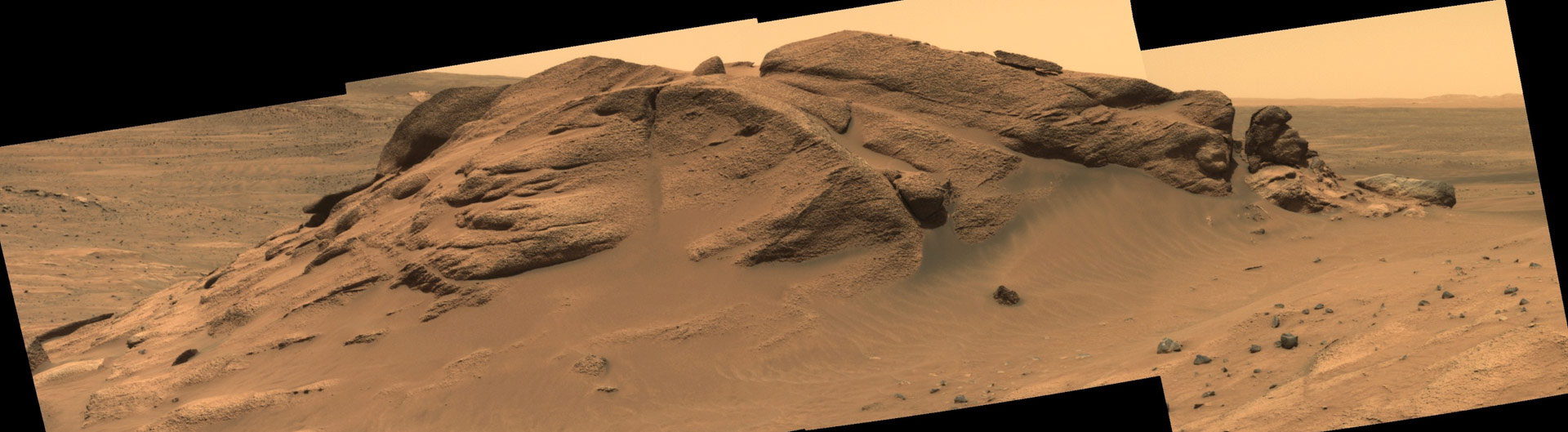
New research from Arizona State University shows evidence that the Gusev Crater on Mars once held a lake.
If desert mirages occur on Mars, “Lake Gusev” belongs among them. This come-and-go body of ancient water has come and gone more than once, at least in the eyes of Mars scientists.
Now, however, it’s finally shifting into sharper focus, thanks to a new analysis of old data by a team led by Steve Ruff, associate research professor at Arizona State University’s Mars Space Flight Facility in the School of Earth and Space Exploration. The team’s report was just published in the April 2014 issue of the journal Geology.
The story begins in early 2004, when NASA landed Spirit, one of its two Mars Exploration Rovers, inside the 100-mile-wide Gusev Crater. Why Gusev? Because from orbit, Gusev, with its southern rim breached by a meandering river channel, looked as if it once held a lake – and water-deposited rocks were the rover mission’s focus. Yet, when Spirit began to explore, scientists found Gusev’s floor was paved not with lakebed sediments, but volcanic rocks.
Less than two miles away, however, stood the Columbia Hills, 300 feet high. When Spirit drove up into them, it indeed discovered ancient rocks that had been altered by water. But to scientists’ chagrin, no lake sediments were among them. Instead, scientists discovered evidence of hydrothermal activity – essentially hot springs like those in Yellowstone National Park.
But there’s hope yet for Lake Gusev, thanks to a Columbia Hills rock outcrop, dubbed Comanche. This outcrop is unusually rich in magnesium-iron carbonate minerals, a discovery made in 2010 that Ruff played a major role in. While Comanche’s carbonate minerals were originally attributed to hydrothermal activity, the team’s new analysis points to a different origin.
Cool waters
Says Ruff, “We looked more closely at the composition and geologic setting of Comanche and nearby outcrops. There’s good evidence that low temperature surface waters introduced the carbonates into Comanche rather than hot water rising from deep down.”
Comanche started out as a volcanic ash deposit known as tephra that originally covered the Columbia Hills and adjacent plains. This material, Ruff explains, came from explosive eruptions somewhere within or around Gusev.
Then floodwaters entered the crater through the huge valley that breaches Gusev’s southern rim. These floods appear to have ponded long enough to alter the tephra, producing briny solutions. When the brines evaporated, they left behind residues of carbonate minerals. As the lake filled and dried, perhaps many times in succession, it loaded Comanche and its neighbor rocks with carbonates.
“The lake didn’t have to be big,” Ruff explains. “The Columbia Hills stand 300 feet high, but they’re in the lowest part of Gusev. So a deep, crater-spanning lake wasn’t needed.”
Today, the Columbia Hills rise as an island of older terrain surrounded by younger lava flows, Ruff says. “Comanche and a neighbor outcrop called Algonquin are remnants of the older and much more widespread tephra deposit. The wind has eroded most of that deposit, also carrying away much of the evidence for an ancient lake.”
Return to Gusev?
Mars rover Spirit fell silent on a winter night in March 2010, and it has never been heard from since. Spirit left most of the Columbia Hills and other Gusev targets unexplored. Ruff says that as NASA evaluates landing sites for its new sample-collecting rover in 2020, Gusev Crater deserves serious consideration.
“Going back to Gusev would give us an opportunity for a second field season there, which any terrestrial geologist would understand,” argues Ruff. “After the first field season with Spirit, we now have a bunch more questions and new hypotheses that can be addressed by going back.”
Because the Mars 2020 rover mission will collect and cache samples for potential return to Earth, that makes going to an already visited site more important, says Ruff.
“Scientifically and operationally it makes sense to go to a place which we know has geologically diverse – and astrobiologically interesting – materials to sample,” Ruff argues.
“And we know exactly where to find them.”
Reference: “Evidence for a Noachian-aged ephemeral lake in Gusev crater, Mars” by Steven W. Ruff, Paul B. Niles, Fabrizio Alfano and Amanda B. Clarke, 1 April 2014, Geology.
DOI: 10.1130/G35508.1
Never miss a breakthrough: Join the SciTechDaily newsletter.
Follow us on Google and Google News.