
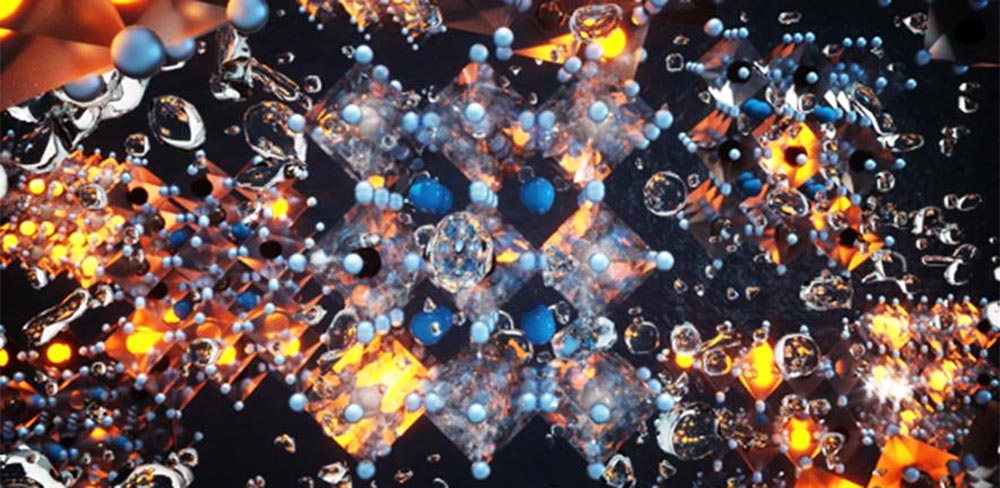
An international group of researchers has developed a new technique that could be used to make more efficient low-cost light-emitting materials that are flexible and can be printed using ink-jet techniques.
The researchers, led by the University of Cambridge and the Technical University of Munich, found that by swapping one out of every 1,000 atoms of one material for another, they were able to triple the luminescence of a new material class of light emitters known as halide perovskites.
This ‘atom swapping’, or doping, causes the charge carriers to get stuck in a specific part of the material’s crystal structure, where they recombine and emit light. The results, reported in the Journal of the American Chemical Society, could be useful for low-cost printable and flexible LED lighting, displays for smartphones or cheap lasers.
Many everyday applications now use light-emitting devices (LEDs), such as domestic and commercial lighting, TV screens, smartphones and laptops. The main advantage of LEDs is they consume far less energy than older technologies.
Ultimately, also the entirety of our worldwide communication via the internet is driven by optical signals from very bright light sources that within optical fibers carry information at the speed of light across the globe.
Quantum Dots: A Revolution in Brightness
The team studied a new class of semiconductors called halide perovskites in the form of nanocrystals which measure only about a ten-thousandth of the thickness of a human hair. These ‘quantum dots’ are highly luminescent materials: the first high-brilliance QLED TVs incorporating quantum dots recently came onto the market.
The Cambridge researchers, working with Daniel Congreve’s group at Harvard, who are experts in the fabrication of quantum dots, have now greatly improved the light emission from these nanocrystals. They substituted one out of every one thousand atoms with another – swapping lead for manganese ions – and found the luminescence of the quantum dots tripled.
A detailed investigation using laser spectroscopy revealed the origin of this observation. “We found that the charges collect together in the regions of the crystals that we doped,” said Sascha Feldmann from Cambridge’s Cavendish Laboratory, the study’s first author. “Once localized, those energetic charges can meet each other and recombine to emit light in a very efficient manner.”
A Path to Brighter, Cheaper LEDs and Displays
“We hope this fascinating discovery: that even smallest changes to the chemical composition can greatly enhance the material properties, will pave the way to cheap and ultrabright LED displays and lasers in the near future,” said senior author Felix Deschler, who is jointly affiliated at the Cavendish and the Walter Schottky Institute at the Technical University of Munich.
In the future, the researchers hope to identify even more efficient dopants which will help make these advanced light technologies accessible to every part of the world.
Reference: “Charge Carrier Localization in Doped Perovskite Nanocrystals Enhances Radiative Recombination” by Sascha Feldmann, Mahesh K. Gangishetty, Ivona Bravić, Timo Neumann, Bo Peng, Thomas Winkler, Richard H. Friend, Bartomeu Monserrat, Daniel N. Congreve and Felix Deschler, 16 May 2021, Journal of the American Chemical Society.
DOI: 10.1021/jacs.1c01567
Never miss a breakthrough: Join the SciTechDaily newsletter.
Follow us on Google and Google News.
2 Comments
For those of us in the SFBay Area this is unwelcome news. The beauty of the night sky over the Bay has been compromised by extraordinarily bright LED advertising billboards along the causeway entrance to the Bay Bridge. Twenty Fours a day and night. What is wrong with people?
This blog is very nice and very informative also. Thank you.