
Close Menu
    Facebook X (Twitter) Instagram
    SciTechDaily
    • Biology
    • Chemistry
    • Earth
    • Health
    • Physics
    • Science
    • Space
    • Technology
    Facebook X (Twitter) Pinterest YouTube RSS
    SciTechDaily
    Home»Biology»Barbed Porcupine Quills Could Help Enhance Various Biomedical Devices
    Biology

    Barbed Porcupine Quills Could Help Enhance Various Biomedical Devices

    By SciTechDailyDecember 12, 2012No Comments3 Mins Read
    Facebook Twitter Pinterest Telegram LinkedIn WhatsApp Email Reddit
    Share
    Facebook Twitter LinkedIn Pinterest Telegram Email Reddit
    porcupine-quill-efficiency
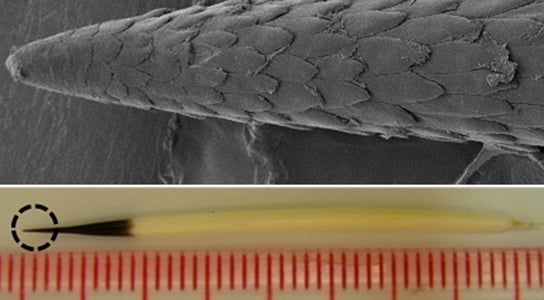
    The tiny barbs (top) coating the tips of the quills from North American porcupines (bottom) make it more difficult to extract a quill from flesh, but they also help the quill penetrate the flesh in the first place, a new study suggests. Credit: Woo Kyung Cho

    A porcupine quill only needs half the force of a hypodermic needle in order to pierce skin. This new study also explains why the quills are hard to remove and this discovery could improve a variety of medical instruments.

    The scientists published their findings in the journal Proceedings of the National Academy of Sciences. Porcupine quills are actually large, stiff hairs that help defend the animals against their predators. The rodents don’t throw their quills, but they do shed them easily, and they can become firmly embedded in their enemies.
    Porcupine-BioDome
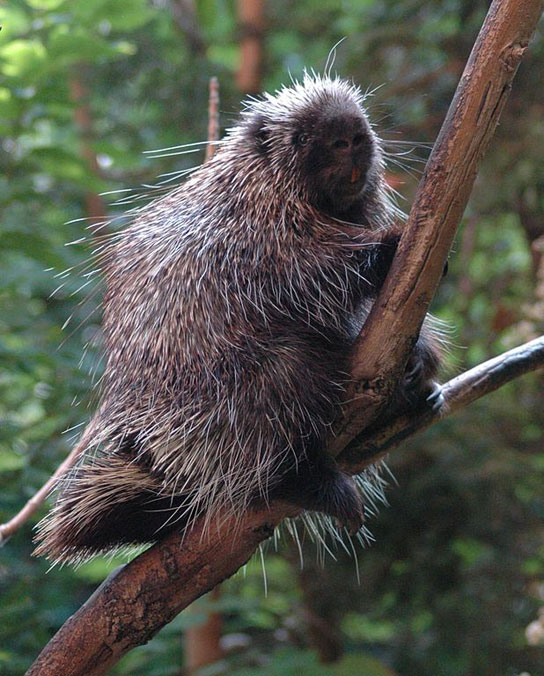
    North American porcupine at the BioDome, in Montreal, Canada. Credit: J. Glover/Wikimedia

    The North American porcupine (Erethizon dorsatum) has about 30,000 quills, each of which is adorned with 700 to 800 barbs. The barbs help the quills to remain embedded in a victim’s skin and until now, scientists hadn’t studied the exact details of what was occurring. Jeffrey Karp, a bioengineer at Harvard Medical School, and his colleagues conducted lab tests that ended in some unexpected results.

    Barbed quills were plunged into samples of pig skin, measuring how much force was required. Then, the amount of force necessary to extract the quills was also measured. The same tests were done with barbless quills, in which the barbs were sanded off. African porcupine quills, which do not have any barbs, and an 18-gauge hypodermic needle were used as a comparison.

    E. dorsatum‘s quills took half the penetrating force of barbless quills, and only 56% of the force needed for the hypodermic needle to breach the skin. Computer models indicated that the barbs ease the penetrating factor by concentrating force along the edges of the barbs, similar how the serrations on a serrated blade make cutting meat easier.

    Barbed quills are four times harder to pull out once they are embedded. Barbs located within 1 mm of the tip of the quill contributed to about half of the pull-out resistance, possibly because the flesh more tightly surrounded the tip than the rest of the quill.

    These findings could be used to enhance various biomedical devices, like replacing chemical adhesives in wound dressings with tiny barbed needles. The staples that are used to hold some surgical incisions shut rely largely on friction along their length to remain in the flesh. These could also be replaced by barbed staples that are shorter and have a smaller diameter. Extracting smaller, barbed staples would likely cause less overall damage than pulling out the staples currently in use.

    Reference: “Microstructured barbs on the North American porcupine quill enable easy tissue penetration and difficult removal” by Woo Kyung Cho, James A. Ankrum, Dagang Guo, Shawn A. Chester, Seung Yun Yang, Anurag Kashyap, Georgina A. Campbell, Robert J. Wood, Ram K. Rijal, Rohit Karnik, Robert Langer and Jeffrey M. Karp, 10 December 2012, Proceedings of the National Academy of Sciences.
    DOI: 10.1073/pnas.1216441109

    Never miss a breakthrough: Join the SciTechDaily newsletter.
    Follow us on Google and Google News.

    Biomedical Engineering Wildlife Zoology
    Share. Facebook Twitter Pinterest LinkedIn Email Reddit

    Related Articles

    Scientists Capture Extremely Rare Half-Female, Half-Male Bird on Film

    The Mysterious Case of the Disappearing White-Lipped Peccaries

    Elephants Are More Likely to Die at the Hands of Humans Than From Natural Causes

    Birdsongs Elicit “Emotional” Response From Birds

    Flying Squirrels Can Adjust Speed and Flight Dynamically

    Humans Are a Greater Disturbance to Elk Than Natural Predators

    Kitti’s Hog-Nosed Bat Is World’s Smallest Mammal

    Bonobo Great Apes Are Domesticating Themselves

    Neuroscientists Decode Correlation Between Sound and Brain Activity

    Leave A Reply Cancel Reply

    • Facebook
    • Twitter
    • Pinterest
    • YouTube

    Don't Miss a Discovery

    Subscribe for the Latest in Science & Tech!

    Trending News

    New Study Reveals Why Ozempic Works Better for Some People Than Others

    Climate Change Is Altering a Key Greenhouse Gas in a Way Scientists Didn’t Expect

    New Study Suggests Gravitational Waves May Have Created Dark Matter

    Scientists Discover Why the Brain Gets Stuck in Schizophrenia

    Scientists Engineer “Tumor-Eating” Bacteria That Devour Cancer From Within

    Even “Failed” Diets May Deliver Long-Term Health Gains, Study Finds

    NIH Scientists Discover Powerful New Opioid That Relieves Pain Without Dangerous Side Effects

    Collapsing Plasma May Hold the Key to Cosmic Magnetism

    Follow SciTechDaily
    • Facebook
    • Twitter
    • YouTube
    • Pinterest
    • Newsletter
    • RSS
    SciTech News
    • Biology News
    • Chemistry News
    • Earth News
    • Health News
    • Physics News
    • Science News
    • Space News
    • Technology News
    Recent Posts
    • The Surprising Reason You Might Want To Sleep Without a Pillow
    • Household Cats Could Hold the Secret to Fighting Breast Cancer
    • Scientists Say This Natural Hormone Reverses Obesity by Targeting the Brain
    • This 15,000-Year-Old Discovery Changes What We Know About Early Human Creativity
    • 35-Million-Year-Old Mystery: Strange Arachnid Discovered Preserved in Amber
    Copyright © 1998 - 2026 SciTechDaily. All Rights Reserved.
    • Science News
    • About
    • Contact
    • Editorial Board
    • Privacy Policy
    • Terms of Use

    Type above and press Enter to search. Press Esc to cancel.