
Close Menu
    Facebook X (Twitter) Instagram
    SciTechDaily
    • Biology
    • Chemistry
    • Earth
    • Health
    • Physics
    • Science
    • Space
    • Technology
    Facebook X (Twitter) Pinterest YouTube RSS
    SciTechDaily
    Home»Technology»Batteries Mimic Multilayer Geometry of Mammal Bones for Structural Stability
    Technology

    Batteries Mimic Multilayer Geometry of Mammal Bones for Structural Stability

    By American Institute of PhysicsDecember 9, 2020No Comments3 Mins Read
    Facebook Twitter Pinterest Telegram LinkedIn WhatsApp Email Reddit
    Share
    Facebook Twitter LinkedIn Pinterest Telegram Email Reddit
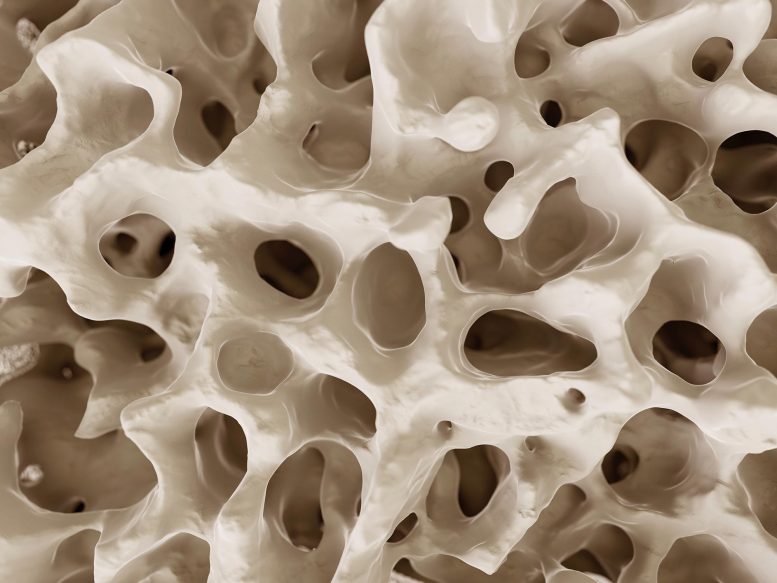
    Bone Structure
    Mimicking mammal bone structure improves sodium-ion battery cathodes’ stability and performance.

    By copying the multilayer geometry of mammal bones, cathodes for sodium-ion batteries can be made more structurally stable, while maintaining high capacities and fast charge rates.

    Sodium-ion batteries are poised to replace lithium-ion batteries for large-scale electrical energy storage. They offer several advantages over lithium-ion batteries, particularly due to the widespread abundance of sodium.

    However, it is difficult to develop sodium cathodes, materials through which electrons can enter a battery. Many candidate materials are unstable or cannot withstand high voltages.

    To find a solution, researchers from Sungkyunkwan University, the University of Texas at Austin, and Brookhaven National Laboratory turned to nature. They describe their mammal bone-inspired sodium cathode in the journal Applied Physics Reviews, from AIP Publishing.

    “We believe that nature provides a very promising solution to resolve technical problems,” said Ho Seok Park, one of the authors. “Accordingly, we tried to find the ideal architecture that can resolve these kinetic and stability limitations.”

    Mammal bone structures consist of an inner porous, spongy bone that allows the storage and transport of bone marrow, surrounded by a hard, compact bone, which offers mechanical and structural integrity under severe stress.
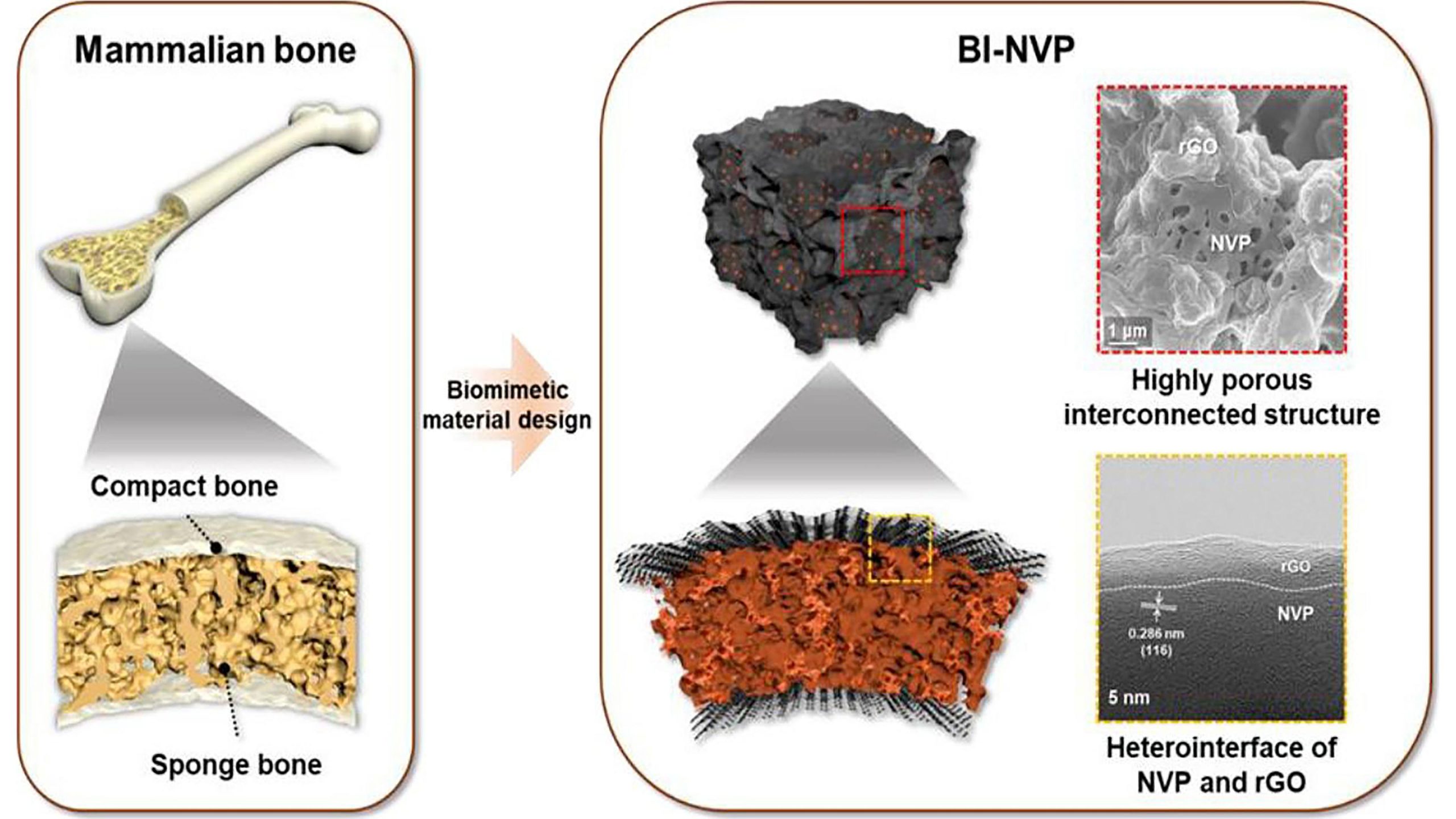
    Mammal Bone and NVP Cathode
    A schematic illustration demonstrating how the structure of a mammal bone is translated into the design of the bone-inspired NVP cathode. Credit: Kang Ho Shin, Sul Ki Park, Puritut Nakhanivej, Yixian Wang, Pengcheng Liu, Seong-Min Bak, Min Sung Choi, David Mitlin and Ho Seok Park

    Following this design architecture, the group created a porous system of Na3V2(PO4)3 structures, also known as NVP, surrounded by a dense shell of reduced graphene oxide (rGO). NVP is a sodium cathode material that transports sodium ions rapidly but is structurally unstable.

    The bonelike setup helps to improve the structural integrity of the system, reducing permanent damage caused by electrochemical and mechanical stress. Meanwhile, the combination of NVP and rGO creates a more favorable environment for sodium ions, enhancing the stability of the system. The battery can charge at ultrahigh rates and maintain over 90% of its capacity after 10,000 cycles of discharging and recharging, depending on the charge rate.

    Despite these promising technical advances, the researchers note the work is currently just a proof of concept demonstrating the feasibility of a sodium cathode inspired by mammal bone. Additional work needs to be done to realize technological utilizations of the system.

    “A large-scale synthesis of bone-inspired NVP with high quality, the optimization of bone-inspired NVP composition and structure, and the fabrication and test of electrodes with large area and high loading are thought to be required for more practical applications,” Park said.

    Reference: “Biomimetic composite architecture achieves ultrahigh rate capability and cycling life of sodium ion battery cathodes” by Kang Ho Shin, Sul Ki Park, Puritut Nakhanivej, Yixian Wang, Pengcheng Liu, Seong-Min Bak, Min Sung Choi, David Mitlin, and Ho Seok Park, 8 December 2020, Applied Physics Reviews.
    DOI: 10.1063/5.0020805

    Never miss a breakthrough: Join the SciTechDaily newsletter.
    Follow us on Google and Google News.

    American Institute of Physics Battery Technology Electrical Engineering Energy
    Share. Facebook Twitter Pinterest LinkedIn Email Reddit

    Related Articles

    Self-Harvesting Energy To Power Rechargeable Devices, Sensors

    Battery Technology Breakthrough: An Atomic Look at Lithium-Rich Batteries

    New Wearable Device Turns Your Body Into a Biological Battery

    Researchers Watch Solid-State Batteries Charge and Discharge Using X-ray Tomography

    Supercapacitors Challenge Batteries: Powerful Graphene Hybrid Material for Highly Efficient Energy Storage

    Improving Lithium-Ion Battery Performance, Cell Lifetime for Renewable Energy Applications

    Using Carbon Filler to Improve High-Energy Lithium-Ion Batteries

    Revolutionizing Large-Scale Energy Storage: Better Multivalent Metal Batteries

    New Battery Can Self-Charge Without Losing Energy

    Leave A Reply Cancel Reply

    • Facebook
    • Twitter
    • Pinterest
    • YouTube

    Don't Miss a Discovery

    Subscribe for the Latest in Science & Tech!

    Trending News

    New Pill Lowers Stubborn Blood Pressure and Protects the Kidneys

    Humans May Have Hidden Regenerative Powers, New Study Suggests

    Scientists Just Solved the Mystery of Why Crabs Walk Sideways

    Doctors Are Surprised by What This Vaccine Is Doing to the Heart

    This Popular Supplement May Boost Your Brain, Not Just Your Muscles

    Scientists Say This Simple Supplement May Actually Reverse Heart Disease

    Warming Oceans Could Trigger a Dangerous Methane Surge

    This Simple Movement Could Be Secretly Cleaning Your Brain

    Follow SciTechDaily
    • Facebook
    • Twitter
    • YouTube
    • Pinterest
    • Newsletter
    • RSS
    SciTech News
    • Biology News
    • Chemistry News
    • Earth News
    • Health News
    • Physics News
    • Science News
    • Space News
    • Technology News
    Recent Posts
    • Hidden Heart Risk Found in 1 in 5 People, Study Warns
    • Scientists Say This Daily Walking Habit May Be the Secret to Keeping Weight Off After Dieting
    • New Therapy Rewires the Brain To Restore Joy in Depression Patients
    • Researchers Discover Efficient New Way To Split Hydrogen From Water for Energy
    • This Korean Skincare Ingredient Could Help Fight Deadly Superbugs
    Copyright © 1998 - 2026 SciTechDaily. All Rights Reserved.
    • Science News
    • About
    • Contact
    • Editorial Board
    • Privacy Policy
    • Terms of Use

    Type above and press Enter to search. Press Esc to cancel.