
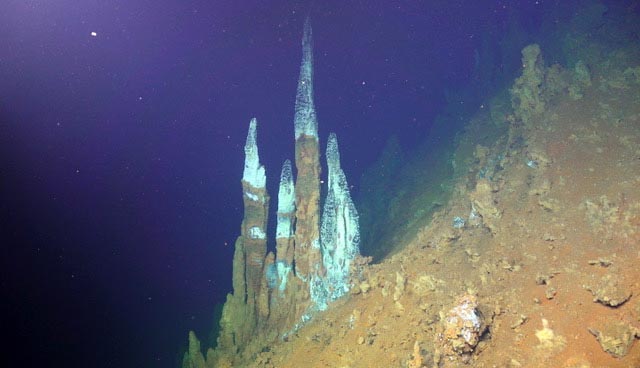
Hydrothermally-active submarine volcanoes account for much of Earth’s volcanism and are mineral-rich biological hotspots, yet very little is known about the dynamics of microbial diversity in these systems. Recently in Proceedings of the National Academy of Sciences (PNAS), Reysenbach and colleagues, show that at one such volcano, Brothers submarine arc volcano, NE of New Zealand, the geological history and subsurface hydrothermal fluid paths testify to the complexity of microbial composition on the seafloor, and also provide insights into how past and present subsurface processes could be imprinted in the microbial diversity.
“Microbes in hot springs everywhere get their energy in part from the geochemistry of the hot water/fluids. It’s the same for the Brothers volcano seafloor hot springs. Since both seawater- and magmatic gas-influenced hydrothermal systems coexist at Brothers, we predicted that the microbes in the active magmatic cone sites (image on top of page) would be very different from those on the caldera wall (image below) that are affected largely by modified seawater,” said Reysenbach, Professor of Microbiology at Portland State University. But what they did not expect was that there would also be two very different microbial communities in close proximity to each other on the caldera wall.
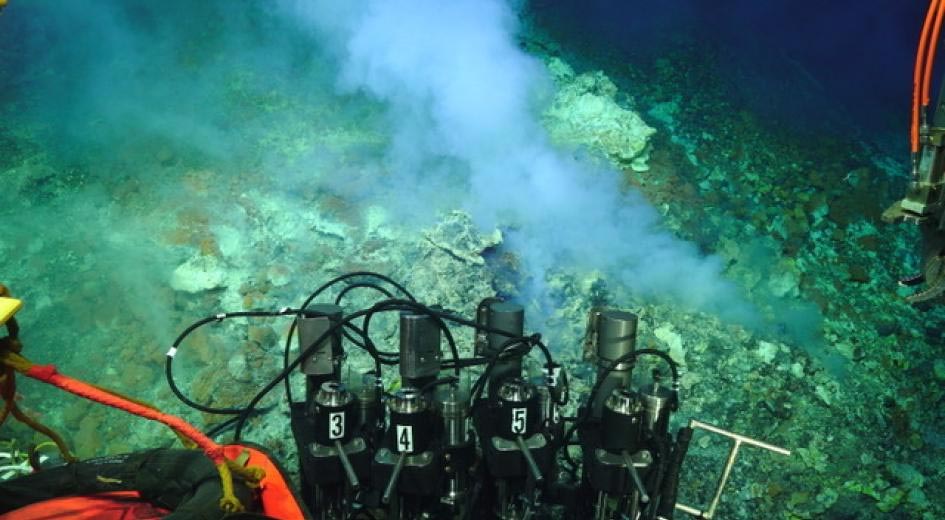
From recent International Ocean Discovery Program (IODP) drilling and geophysical measurements there is evidence that after the volcanic caldera collapse of the original stratovolcano to form the present-day caldera, the earliest magmatic-hydrothermal system became overprinted by a more seawater dominated system. The authors show that one of the caldera communities aligns with microbes from magmatically-influenced hydrothermal vents of the more recent cone that has grown up from the caldera floor. It is likely that a combination of different subsurface mineral assemblages intersected by the circulating hydrothermal fluids helps shape distinct microbial communities on the caldera wall.
“Having studied Brothers volcano for 20 years, this work really astounded me because for the first time I could join the dots from magmatic gases and hydrothermal fluids all the way to microbial communities,” said coauthor Cornel de Ronde, Principal Scientist at GNS Science, New Zealand.
This study also describes more than 90 new bacterial and archaeal families, and nearly 300 previously unknown genera, highlighting how little we know about the biodiversity in these systems and how the complexity of the subsurface geology may contribute to high microbial biodiversity. Furthermore, these sites comprise many potentially deeply-branching and symbiotic microbes whose prospective study will add to our understanding of the evolution of life on Earth and the interactions shaping subsurface communities.
“I hope this work will encourage others to see that geology, geochemistry, and even geophysics can actually go hand-in-glove with microbial studies. You just have to translate the various pieces of information into a language that is understood by all, then you will discover new paradigms,” said de Ronde.
Reference: “Complex subsurface hydrothermal fluid mixing at a submarine arc volcano supports distinct and highly diverse microbial communities” by Anna-Louise Reysenbach, Emily St. John, Jennifer Meneghin, Gilberto E. Flores, Mircea Podar, Nina Dombrowski, Anja Spang, Stephane L’Haridon, Susan E. Humphris, Cornel E. J. de Ronde, Fabio Caratori Tontini, Maurice Tivey, Valerie K. Stucker, Lucy C. Stewart, Alexander Diehl and Wolfgang Bach, 4 December 2020, Proceedings of the National Academy of Sciences.
DOI: 10.1073/pnas.2019021117
Never miss a breakthrough: Join the SciTechDaily newsletter.
Follow us on Google and Google News.