
No damage caused by strong light, no artificial dyes or fluorescent tags needed.
The insides of living cells can be seen in their natural state in greater detail than ever before using a new technique developed by researchers in Japan. This advance should help reveal the complex and fragile biological interactions of medical mysteries, like how stem cells develop or how to deliver drugs more effectively.
“Our system is based on a simple concept, which is one of its advantages,” said Associate Professor Takuro Ideguchi from the University of Tokyo Research Institute for Photon Science and Technology. The results of Ideguchi’s team were published recently in Optica, the Optical Society’s research journal.
The new method also has the advantages of not needing to kill the cells, damage them with intense light, or artificially attach fluorescent tags to specific molecules.
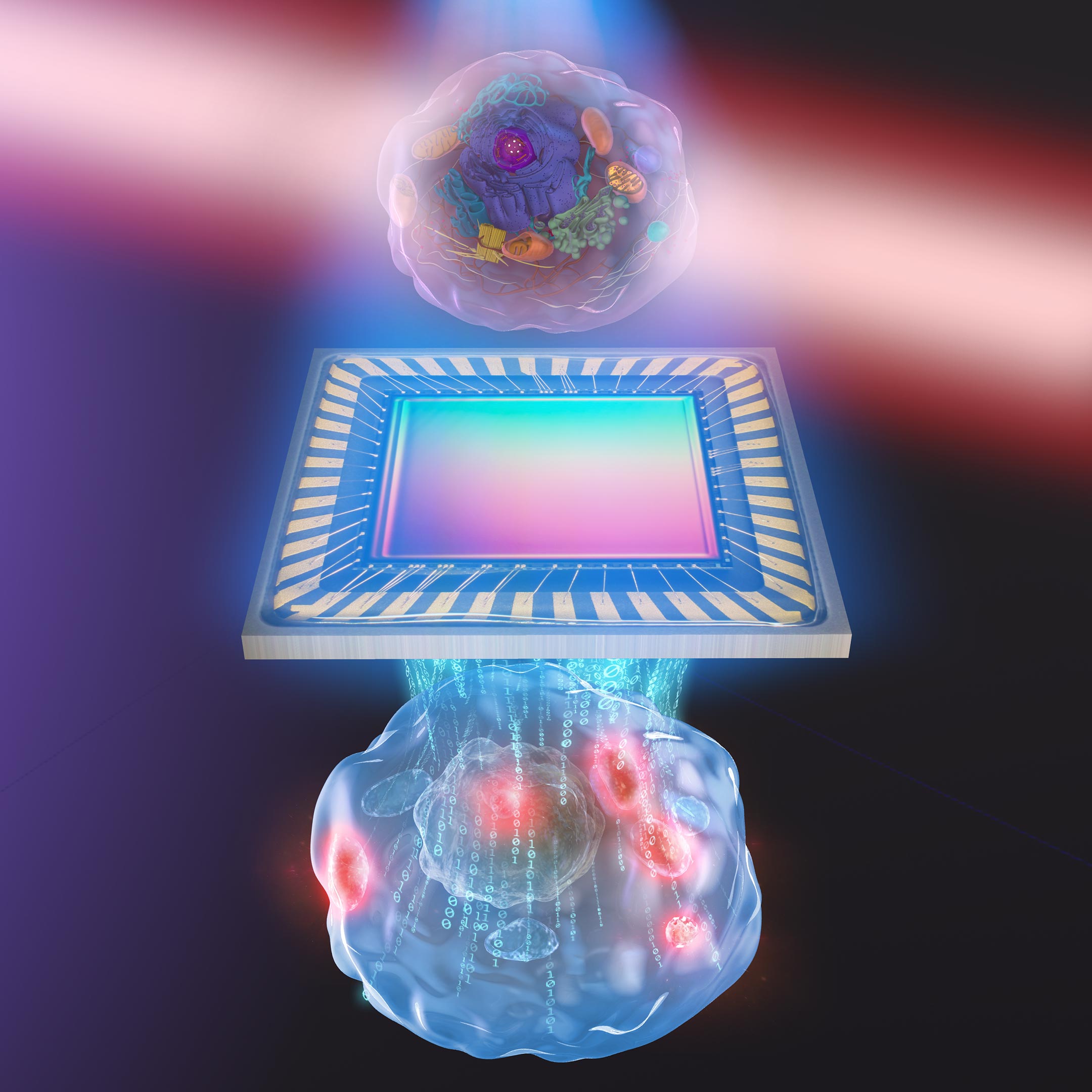
The technique combines two pre-existing microscopy tools and uses them simultaneously. The combination of these tools can be thought of simply like a coloring book.
“We gather the black-and-white outline of the cell and we virtually color in the details about where different types of molecules are located,” said Ideguchi.
Quantitative phase microscopy gathers information about the black-and-white outline of the cell using pulses of light and measuring the shift in the light waves after they pass through a sample. This information is used to reconstruct a 3D image of the major structures inside the cell.
Molecular vibrational imaging provides the virtual color using pulses of mid-infrared light to add energy to specific types of molecules. That extra energy causes the molecules to vibrate, which heats up their local surroundings. Researchers can choose to raise the temperature of specific types of chemical bonds by using different wavelengths of mid-infrared light.
Researchers take a quantitative phase microscopy image of the cell with the mid-infrared light turned off and an image with it turned on. The difference between those two images then reveals both the outline of major structures inside the cell and the exact locations of the type of molecule that was targeted by the infrared light.
Researchers refer to their new combined imaging method as biochemical quantitative phase imaging with a mid-infrared photothermal effect.
“We were impressed when we first observed the molecular vibrational signature characteristic of proteins, and we were further excited when this protein-specific signal appeared in the same location as the nucleolus, an intracellular structure where high amounts of proteins would be expected,” said Ideguchi.
Ideguchi’s team hopes their technique might allow researchers to determine the distribution of fundamental types of molecules inside single cells. The quantitative phase microscopy outline of major structures could be virtually colored in using different wavelengths of light to specifically target proteins, lipids (fats) or nucleic acids (DNA, RNA).
Currently, capturing one complete image can take 50 seconds or longer. Researchers are confident that they can speed up the process with simple improvements to their tools, including a higher-powered light source and a more sensitive camera.
Reference: “Label-free biochemical quantitative phase imaging with mid-infrared photothermal effect” by Miu Tamamitsu, Keiichiro Toda, Hiroyuki Shimada, Takaaki Honda, Masaharu Takarada, Kohki Okabe, Yu Nagashima, Ryoichi Horisaki and Takuro Ideguchi, 20 April 2020, Optica.
DOI: 10.1364/OPTICA.390186
Collaborators at Osaka University, other departments at the University of Tokyo and the Japan Science and Technology Agency also contributed to this research.
Never miss a breakthrough: Join the SciTechDaily newsletter.
Follow us on Google and Google News.
1 Comment
Shoots phazer and laser clod and hot beams to transfer data at very high speeds from device to device and internally within the mobo and cpu/ram/gpu setups.