
Close Menu
    Facebook X (Twitter) Instagram
    SciTechDaily
    • Biology
    • Chemistry
    • Earth
    • Health
    • Physics
    • Science
    • Space
    • Technology
    Facebook X (Twitter) Pinterest YouTube RSS
    SciTechDaily
    Home»Physics»Time-Stretch Infrared Spectroscopy: Giant Leap for Molecular Measurements
    Physics

    Time-Stretch Infrared Spectroscopy: Giant Leap for Molecular Measurements

    By University of TokyoSeptember 1, 2020No Comments3 Mins Read
    Facebook Twitter Pinterest Telegram LinkedIn WhatsApp Email Reddit
    Share
    Facebook Twitter LinkedIn Pinterest Telegram Email Reddit
    Time-Stretch Infrared Spectroscopy
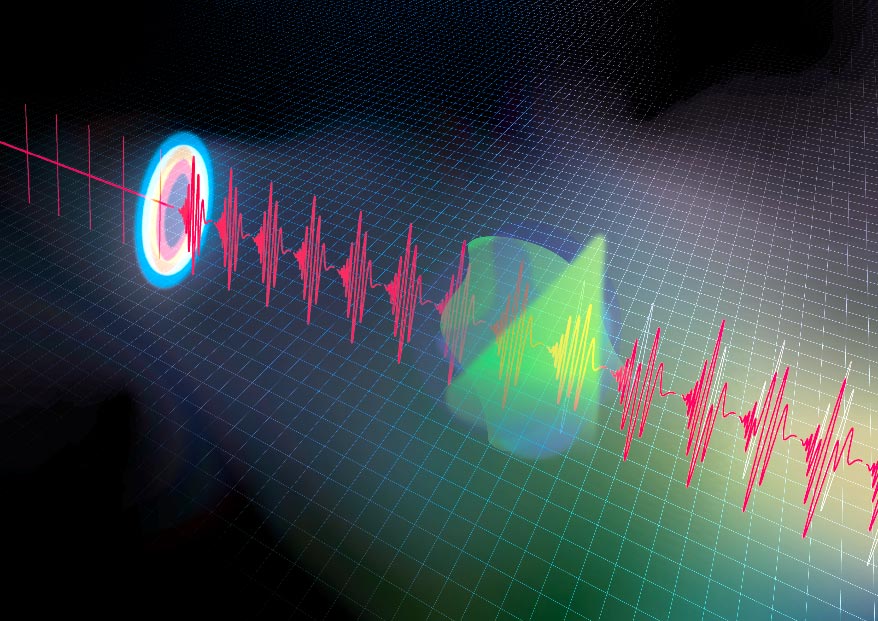
    Laser pulses lasting for mere femtoseconds (one-quadrillionth of a second) are stretched to the nanosecond (one-billionth of a second) range. Credit: © 2020 Ideguchi et al.

    A new tool to analyze molecules is 100 times faster than previous methods.

    Spectroscopy is an important tool of observation in many areas of science and industry. Infrared spectroscopy is especially important in the world of chemistry where it is used to analyze and identify different molecules. The current state-of-the-art method can make approximately 1 million observations per second. University of Tokyo researchers have greatly surpassed this figure with a new method about 100 times faster.

    From climate science to safety systems, manufacture to quality control of foodstuffs, infrared spectroscopy is used in so many academic and industrial fields that it’s a ubiquitous, albeit invisible, part of everyday life. In essence, infrared spectroscopy is a way to identify what molecules are present in a sample of a substance with a high degree of accuracy. The basic idea has been around for decades and has undergone improvements along the way.

    In general, infrared spectroscopy works by measuring infrared light transmitted or reflected from molecules in a sample. The samples’ inherent vibrations alter the characteristics of the light in very specific ways, essentially providing a chemical fingerprint, or spectra, which is read by a detector and analyzer circuit or computer. Fifty years ago the best tools could measure one spectra per second, and for many applications this was more than adequate.

    Time-Stretch Infrared Spectroscopy Schematic
    The new tool consists of various optical components including lasers, mirrors, lenses, and detectors. It can detect wavelengths between 4.4 and 4.9 micrometers (thousandths of a millimeter). Credit: © 2020 Ideguchi et al.

    More recently, a technique called dual-comb spectroscopy achieved a measurement rate of 1 million spectra per second. However, in many instances, more rapid observations are required in order to produce fine-grain data. For example, some researchers wish to explore the stages of certain chemical reactions that happen on very short time scales. This drive prompted Associate Professor Takuro Ideguchi from the Institute for Photon Science and Technology, at the University of Tokyo, and his team to look into and create the fastest infrared spectroscopy system to date.

    “We developed the world’s fastest infrared spectrometer, which runs at 80 million spectra per second,” said Ideguchi. “This method, time-stretch infrared spectroscopy, is about 100 times faster than dual-comb spectroscopy, which had reached an upper speed limit due to issues of sensitivity.” Given there are around 30 million seconds in a year, this new method can achieve in one second what 50 years ago would have taken over two years.

    Time-stretch infrared spectroscopy works by stretching a very short pulse of laser light transmitted from a sample. As the transmitted pulse is stretched, it becomes easier for a detector and accompanying electronic circuitry to accurately analyze. A key high-speed component that makes it possible is something called a quantum cascade detector, developed by one of the paper’s authors, Tatsuo Dougakiuchi from Hamamatsu Photonics.

    “Natural science is based on experimental observations. Therefore, new measurement techniques can open up new scientific fields,” said Ideguchi. “Researchers in many fields can build on what we’ve done here and use our work to enhance their own understanding and powers of observation.”

    Reference: “Time-stretch infrared spectroscopy” by Akira Kawai, Kazuki Hashimoto, Tatsuo Dougakiuchi, Venkata Ramaiah Badarla, Takayuki Imamura, Tadataka Edamura and Takuro Ideguchi, 1 September 2020, Communications Physics.
    DOI: 10.1038/s42005-020-00420-3

    Never miss a breakthrough: Join the SciTechDaily newsletter.
    Follow us on Google and Google News.

    Optics Particle Physics Popular University of Tokyo
    Share. Facebook Twitter Pinterest LinkedIn Email Reddit

    Related Articles

    High-Speed Atomic Video: Single Molecules Captured at a Staggering 1,600 Frames per Second

    Quantum Entanglement of 15 Trillion Atoms at 450 Kelvin With “Surprising Results”

    X-Ray Vision Through the Water Window Enables New Generation of Attosecond Technology

    A New Kind of Light in the Universe? “Super-Planckian” Material Emits Light That Exceeds Limits of Natural Law

    Using Light to Put a Twist on Electrons – Inducing Asymmetrical Patterns in Exotic Materials

    Groundbreaking Experiment: Physicists Grab Individual Atoms & Observe Complex Atomic Interactions

    Scientists Invent Way to See Fastest Motions of Electrons That Drive Chemistry for the First Time

    Researchers Use Light to Control High-Speed Chemical Reactions in a New Way

    Fastest Laser Blast – 67 Quintillionths of a Second

    Leave A Reply Cancel Reply

    • Facebook
    • Twitter
    • Pinterest
    • YouTube

    Don't Miss a Discovery

    Subscribe for the Latest in Science & Tech!

    Trending News

    FDA-Approved Drug Shows Promise for Reversing Osteoarthritis Damage

    11,000-Year-Old Grains Reveal a Surprise About the Origins of Agriculture

    This Common Type of Medication Is Linked to Slower Cognitive Decline

    Quantum Computer Solves a Problem in 15 Minutes That Classical Methods Can’t Practically Compute

    Taking the Stairs Could Cut Your Risk of Heart-Related Death by 39%

    Scientists Uncover a Surprising New Route for Stonehenge’s Most Mysterious Stone

    A Star Near the Milky Way’s Black Hole Is Losing Mass at an Astonishing Rate

    Scientists Solve a Vitamin B12 Mystery With an Unexpected Culprit

    Follow SciTechDaily
    • Facebook
    • Twitter
    • YouTube
    • Pinterest
    • Newsletter
    • RSS
    SciTech News
    • Biology News
    • Chemistry News
    • Earth News
    • Health News
    • Physics News
    • Science News
    • Space News
    • Technology News
    Recent Posts
    • A New Quantum Blueprint Could Make States Easier To Tell Apart
    • Scientists Turn an Overlooked Chip Layer Into a Powerful New Light Source
    • New Technique Could Slash AI’s Memory Energy Use by Thousands of Times
    • Scientists Find a Hidden Biological Link Across Different Forms of Autism
    • Scientists Discover a 3.7-Billion-Year-Old Secret of Early Life
    Copyright © 1998 - 2026 SciTechDaily. All Rights Reserved.
    • Science News
    • About
    • Contact
    • Editorial Board
    • Privacy Policy
    • Terms of Use

    Type above and press Enter to search. Press Esc to cancel.