
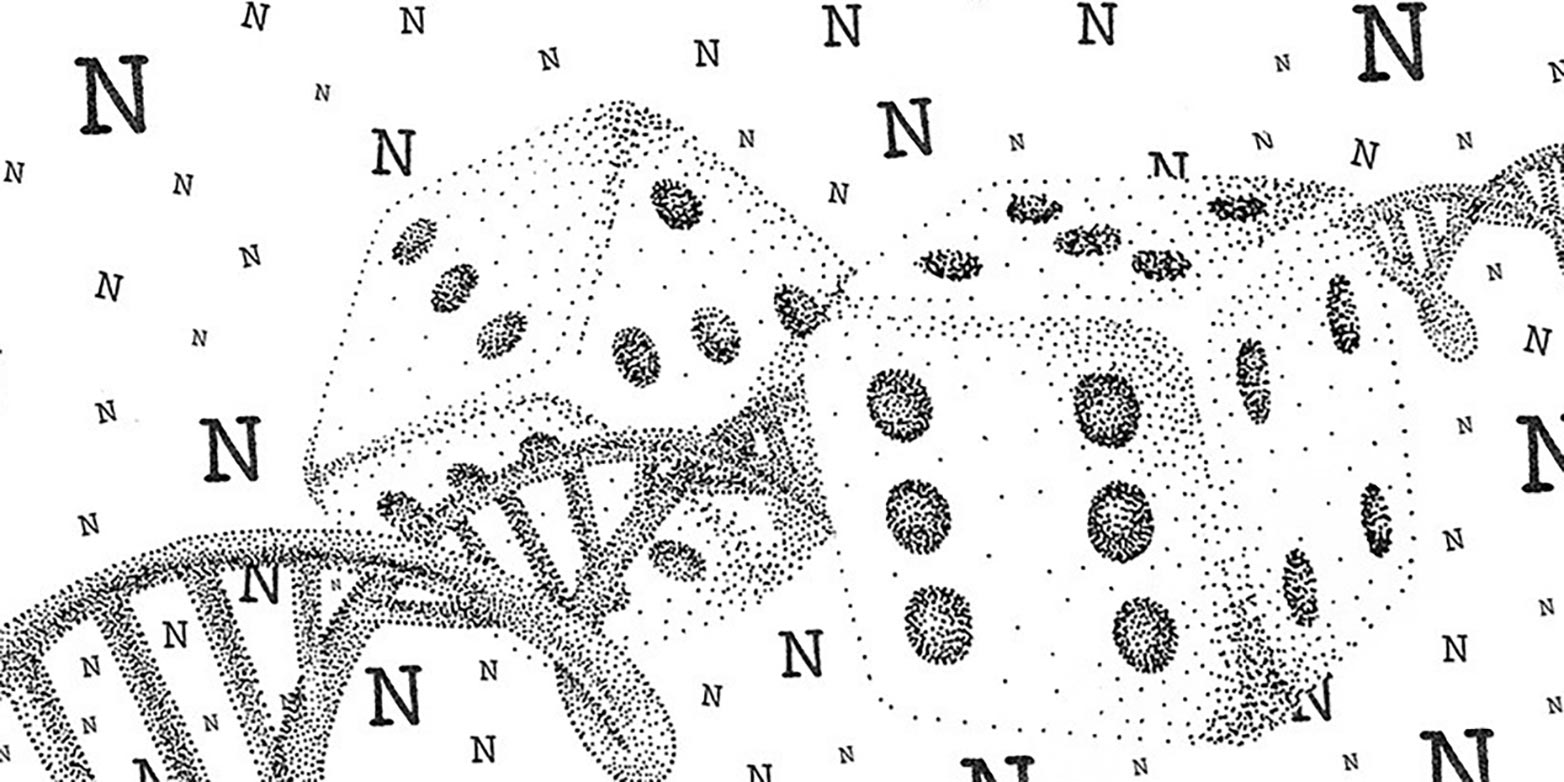
ETH scientists have generated a huge true random number using DNA synthesis. It is the first time that a number of this magnitude has been created by biochemical means.
True random numbers are required in fields as diverse as slot machines and data encryption. These numbers need to be truly random, such that they cannot even be predicted by people with detailed knowledge of the method used to generate them.
As a rule, they are generated using physical methods. For instance, thanks to the tiniest high-frequency electron movements, the electrical resistance of a wire is not constant but instead fluctuates slightly in an unpredictable way. That means measurements of this background noise can be used to generate true random numbers.
Now, for the first time, a research team led by Robert Grass, Professor at the Institute of Chemical and Bioengineering, has described a non-physical method of generating such numbers: one that uses biochemical signals and actually works in practice. In the past, the ideas put forward by other scientists for generating random numbers by chemical means tended to be largely theoretical.
DNA synthesis with random building blocks
For this new approach, the ETH researchers apply the synthesis of DNA molecules, an established chemical research method frequently employed over many years. It is traditionally used to produce a precisely defined DNA sequence. In this case, however, the research team built DNA molecules with 64 building block positions, in which one of the four DNA bases A, C, G, and T was randomly located at each position. The scientists achieved this by using a mixture of the four building blocks, rather than just one, at every step of the synthesis.
As a result, a relatively simple synthesis produced a combination of approximately three quadrillion individual molecules. The scientists subsequently used an effective method to determine the DNA sequence of five million of these molecules. This resulted in 12 megabytes of data, which the researchers stored as zeros and ones on a computer.
Huge quantities of randomness in a small space
However, an analysis showed that the distribution of the four building blocks A, C, G, and T was not completely even. Either the intricacies of nature or the synthesis method deployed led to the bases G and T being integrated more frequently in the molecules than A and C. Nonetheless, the scientists were able to correct this bias with a simple algorithm, thereby generating perfect random numbers.
The main aim of ETH Professor Grass and his team was to show that random occurrences in chemical reactions can be exploited to generate perfect random numbers. Translating the finding into a direct application was not a prime concern at first. “Compared with other methods, however, ours has the advantage of being able to generate huge quantities of randomness that can be stored in an extremely small space, a single test tube,” Grass says. “We can read out the information and reinterpret it in digital form at a later date. This is impossible with the previous methods.”
Reference: “DNA synthesis for true random number generation” by Linda C. Meiser, Julian Koch, Philipp L. Antkowiak, Wendelin J. Stark, Reinhard Heckel and Robert N. Grass, 18 November 2020, Nature Communications.
DOI: 10.1038/s41467-020-19757-y
Never miss a breakthrough: Join the SciTechDaily newsletter.
Follow us on Google and Google News.
1 Comment
Very Interesting.
Number Theory and generation of “Truly” random numbers which may seem to be “Truly Random” currently , but the “Truly” Random number nature of the same —whch may seem uncrackable currently from a Cyber security Point of View, —- can easility be replicated by the hacker using the same technique to make the same non-random. This “Truly” Random number generated , with Four Nucleotides in Four Groups of 16 Nucleotides of total 64 Nucleotides, could be cracked using 128 , and 256 Nucleotides as is possible with todays 128 bit encyption and 256 bit encryption — which is not yet commercially available. The availability of Quantum Computing throws another monkey wrench into the mix in my opinion.
For now it is probably a reasonably secure breakthrough. Opinions expressed are Personal.