
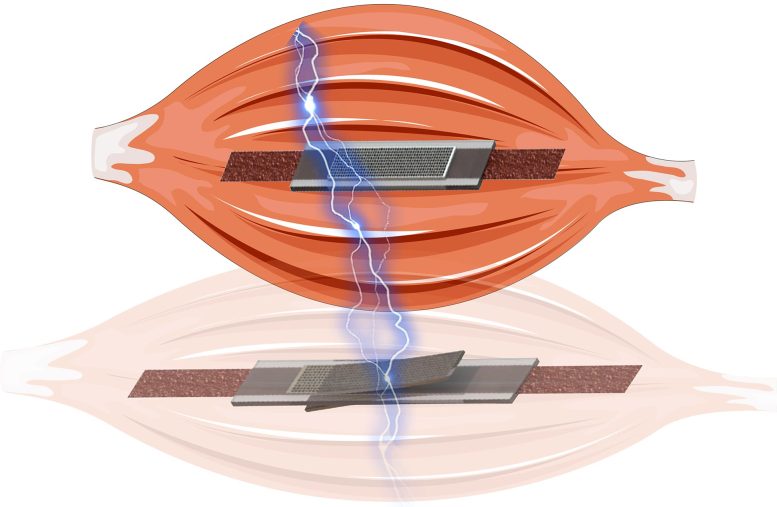
Queen Mary University researchers have engineered a self-sensing, variable-stiffness artificial muscle that mimics natural muscle characteristics. The breakthrough has significant implications for soft robotics and medical applications, moving a step closer to human-machine integration.
In a study published on July 8 in Advanced Intelligent Systems, researchers from Queen Mary University of London have made significant advancements in the field of bionics with the development of a new type of electric variable-stiffness artificial muscle that possesses self-sensing capabilities. This innovative technology has the potential to revolutionize soft robotics and medical applications.
Technology Inspired by Nature
Muscle contraction hardening is not only essential for enhancing strength but also enables rapid reactions in living organisms. Taking inspiration from nature, the team of researchers at QMUL’s School of Engineering and Materials Science has successfully created an artificial muscle that seamlessly transitions between soft and hard states while also possessing the remarkable ability to sense forces and deformations.
Dr. Ketao Zhang, a Lecturer at Queen Mary and the lead researcher, explains the importance of variable stiffness technology in artificial muscle-like actuators. “Empowering robots, especially those made from flexible materials, with self-sensing capabilities is a pivotal step towards true bionic intelligence,” says Dr. Zhang.
Characteristics of the New Artificial Muscle
The cutting-edge artificial muscle developed by the researchers exhibits flexibility and stretchability similar to natural muscle, making it ideal for integration into intricate soft robotic systems and adapting to various geometric shapes. With the ability to withstand over 200% stretch along the length direction, this flexible actuator with a striped structure demonstrates exceptional durability.
By applying different voltages, the artificial muscle can rapidly adjust its stiffness, achieving continuous modulation with a stiffness change exceeding 30 times. Its voltage-driven nature provides a significant advantage in terms of response speed over other types of artificial muscles. Additionally, this novel technology can monitor its deformation through resistance changes, eliminating the need for additional sensor arrangements and simplifying control mechanisms while reducing costs.
Fabrication Process
The fabrication process for this self-sensing artificial muscle is simple and reliable. Carbon nanotubes are mixed with liquid silicone using ultrasonic dispersion technology and coated uniformly using a film applicator to create the thin layered cathode, which also serves as the sensing part of the artificial muscle. The anode is made directly using a soft metal mesh cut, and the actuation layer is sandwiched between the cathode and the anode. After the liquid materials cure, a complete self-sensing variable-stiffness artificial muscle is formed.
Potential Applications
The potential applications of this flexible variable stiffness technology are vast, ranging from soft robotics to medical applications. The seamless integration with the human body opens up possibilities for aiding individuals with disabilities or patients in performing essential daily tasks. By integrating the self-sensing artificial muscle, wearable robotic devices can monitor a patient’s activities and provide resistance by adjusting stiffness levels, facilitating muscle function restoration during rehabilitation training.
Human-Machine Integration
“While there are still challenges to be addressed before these medical robots can be deployed in clinical settings, this research represents a crucial stride towards human-machine integration,” highlights Dr. Zhang. “It provides a blueprint for the future development of soft and wearable robots.”
The groundbreaking study conducted by researchers at Queen Mary University of London marks a significant milestone in the field of bionics. With their development of self-sensing electric artificial muscles, they have paved the way for advancements in soft robotics and medical applications.
Reference: “An Electric Self-Sensing and Variable-Stiffness Artificial Muscle” by Chen Liu, James J. C. Busfield and Ketao Zhang, 8 July 2023, Advanced Intelligent Systems.
DOI: 10.1002/aisy.202300131
Never miss a breakthrough: Join the SciTechDaily newsletter.
Follow us on Google and Google News.