
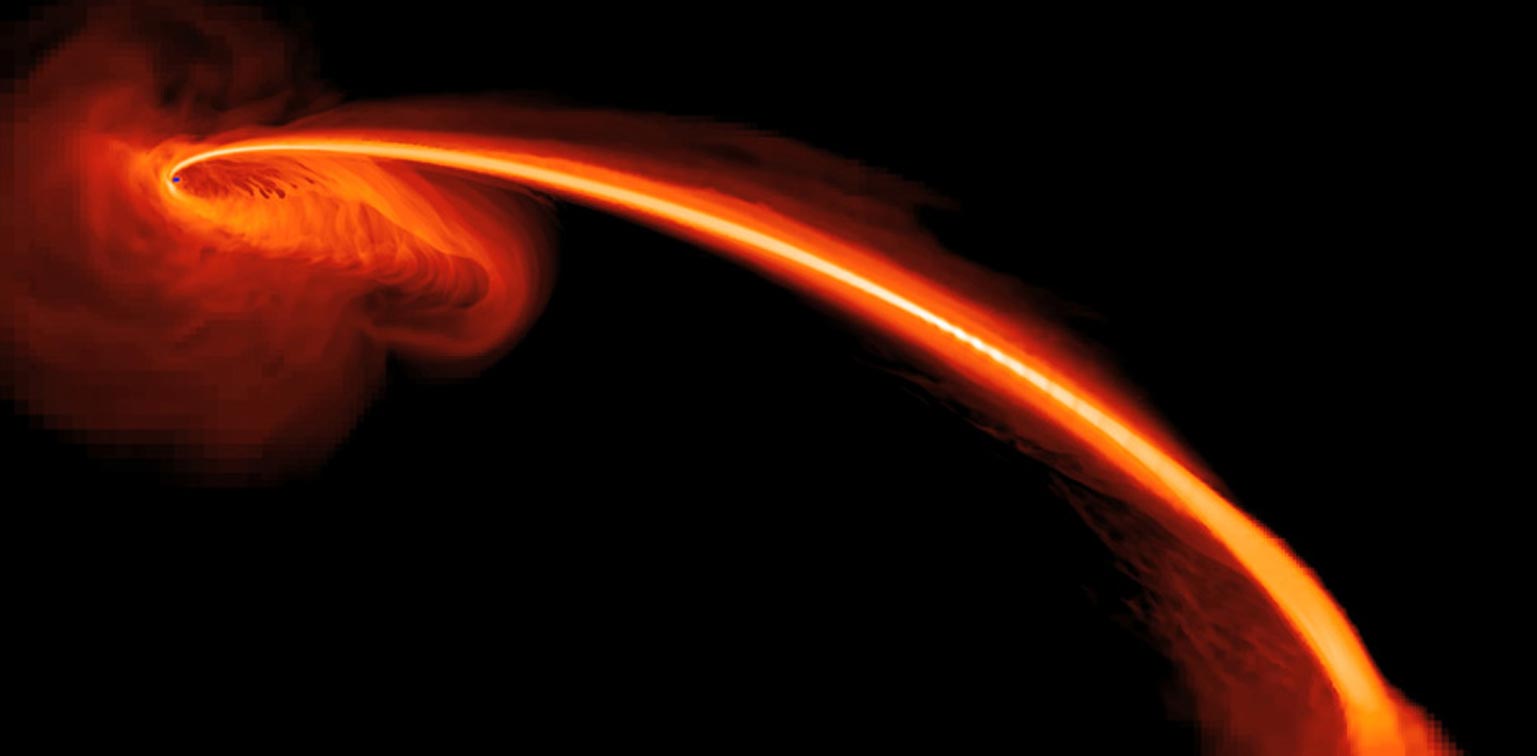
When a black hole chews up a star, we see this either in visible light or in X-rays, but almost never through both types of radiation. Astronomer Peter Jonker (SRON / Radboud University) and his colleagues have now spotted a number of captured stars with an X-ray telescope, a few years after they were discovered in optical light. It appears that black holes all dine in the same way after all, while the mood lighting varies according to a fixed pattern. This discovery was published in The Astrophysical Journal on February 4, 2020.
All across the Universe, gigantic black holes are lurking in the dark within centers of galaxies. Like an ambush predator they patiently wait for unsuspecting stars to fly by, then use their overwhelming gravity to pull it apart into a spaghetti strand and finally swallow it up. Astronomers sometimes see this spectacle in visible light, sometimes in X-rays, but almost never in both types of light at the same time. Do black holes have two different ways of eating a star?
From visual to X-ray
Astronomer Peter Jonker (SRON / Radboud University) and his international colleagues now see a number of sources with the Chandra X-ray telescope that were identified in the optical a few years earlier. It appears that a star, in the process of being devoured, first radiates visible light and subsequently emits X-rays. So black holes have a lot in common after all in terms of eating behavior, while the mood lighting during dinner changes according to a fixed pattern, from gentle white to pale bright X-rays. Jonker’s finding can soon be tested by combining data from the recently launched X-ray satellite eROSITA—a predecessor of Athena—and telescopes that sweep the sky in visible light, such as the BlackGEM telescope which is currently being installed in Chile under supervision of Radboud University.
Collision
A captured star is stretched into such a long string that it encounters itself after a full orbit around a black hole, like a snake biting its tail. That collision causes the string to lose altitude and fall towards the black hole. Jonker has two possible explanations for his theory that visible light and X-rays are both released, strictly in that order.
The first option is that we see the visible light because of the energy released during the collision, and that we see the X-rays because potential energy is lost during the drop towards the black hole. The string—at this point more like a gas stream—starts to glow like a so-called black body, with a characteristic curve as a spectrum that peaks in soft X-rays.
The second option is that the collision itself emits X-rays, but a dense cloud emerges that absorbs the X-rays and re-emits them as visible light. Only when enough star material has disappeared, the cloud is thin enough to allow the X-rays to pass through, including the X-ray radiation as a result of the plunge with associated loss of potential energy.
Rotation
A consequence of Jonker’s theory is that there is a connection between the rotation of black holes and the amount of X-rays emitted by stars while being eaten. Whether black holes rotate at all is currently unknown. If eROSITA will see hundreds of spaghetti strands every year, the theory says that black holes are rotating. If only a few are detected each year, it would indicate stationary black holes.
Reference: “Implications from Late-time X-Ray Detections of Optically Selected Tidal Disruption Events: State Changes, Unification, and Detection Rates” by P.G. Jonker, N.C. Stone, A. Generozov, S. van Velzen and B. Metzger, 4 February 2020, The Astrophysical Journal.
DOI: 10.3847/1538-4357/ab659c
Never miss a breakthrough: Join the SciTechDaily newsletter.
Follow us on Google and Google News.
2 Comments
I hail the scientist about the discovery of the shredding phenomenon and I am sure that a lot of others will be discovered but in the same moment I have years trying to convince the world of the physics that by what and how this phenomenon is performed and by what and how the colors during this phenomenon are performed by no kind of telescopes or by no kind of technology can be discovered. This phenomenon supported by nothing is presented by me in the book titled “The First Step to the Endlessness” more than five years ago. With my moving figures I have performed a lot of other things of this kind, undiscovered up to now by the science. I offer my help including even my book but in the same moment I want to underline that the undertaking is not question of an ordinary communication.
As you yourself say, you have nothing. Also, if you haven’t tried to publish in peer review journals, you haven’t even been trying to “convince” anyone else.
Science is really simple – “do (research and publish) or die (in silence)” – but it takes some work. Not to grasp the essentials – it’s very hard to understand how you have missed that, see “science” in any encyclopedia – but to work it.