
Worldwide, 1 in 4 People Will Suffer From a Depressive Episode in Their Lifetime
While current diagnosis and treatment approaches are largely trial and error, a breakthrough study by Indiana University School of Medicine researchers sheds new light on the biological basis of mood disorders, and offers a promising blood test aimed at a precision medicine approach to treatment.
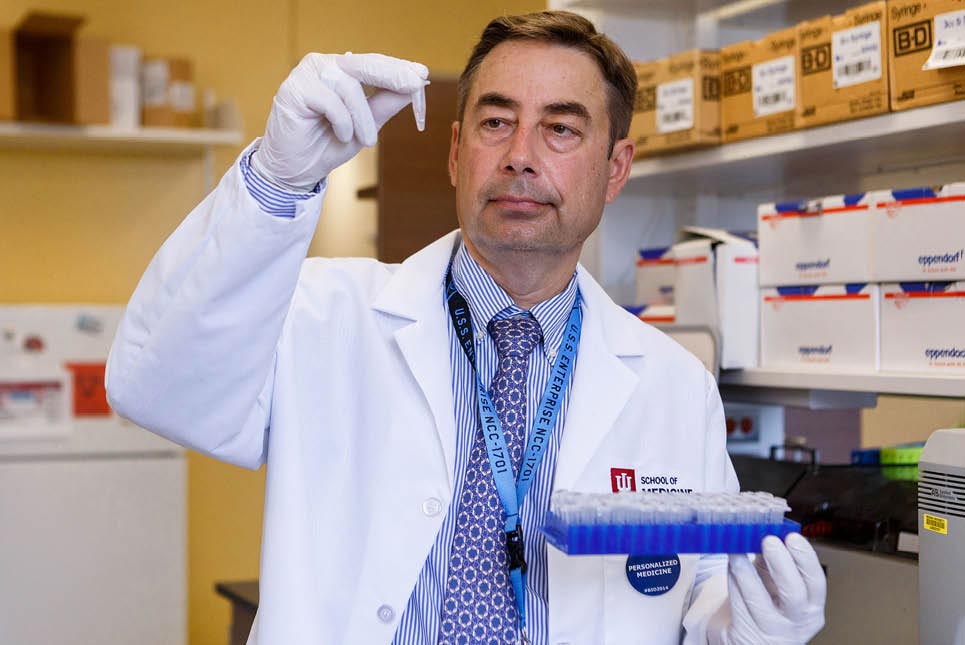
Led by Alexander B. Niculescu, MD, PhD, Professor of Psychiatry at IU School of Medicine, the study was published today (April 8, 2021) in the high impact journal Molecular Psychiatry. The work builds on previous research conducted by Niculescu and his colleagues into blood biomarkers that track suicidality as well as pain, post-traumatic stress disorder, and Alzheimer’s disease.
Pioneering the Future of Mood Disorder Diagnosis
“We have pioneered the area of precision medicine in psychiatry over the last two decades, particularly over the last 10 years. This study represents a current state-of-the-art outcome of our efforts,” said Niculescu. “This is part of our effort to bring psychiatry from the 19th century into the 21st century. To help it become like other contemporary fields such as oncology. Ultimately, the mission is to save and improve lives.”
The team’s work describes the development of a blood test, composed of RNA biomarkers, that can distinguish how severe a patient’s depression is, the risk of them developing severe depression in the future, and the risk of future bipolar disorder (manic-depressive illness). The test also informs tailored medication choices for patients.
This comprehensive study took place over four years, with over 300 participants recruited primarily from the patient population at the Richard L. Roudebush VA Medical Center in Indianapolis. The team used a careful four-step approach of discovery, prioritization, validation, and testing.
First, the participants were followed over time, with researchers observing them in both high and low mood states — each time recording what changed in terms of the biological markers (biomarkers) in their blood between the two states.
Next, Niculescu’s team utilized large databases developed from all previous studies in the field, to cross-validate and prioritize their findings. From here, researchers validated the top 26 candidate biomarkers in independent cohorts of clinically severe people with depression or mania. Last, the biomarkers were tested in additional independent cohorts to determine how strong they were at predicting who is ill, and who will become ill in the future.
From this approach, researchers were then able to demonstrate how to match patients with medications — even finding a new potential medication to treat depression.
“Through this work, we wanted to develop blood tests for depression and for bipolar disorder, to distinguish between the two, and to match people to the right treatments,” said Niculescu. “Blood biomarkers are emerging as important tools in disorders where subjective self-report by an individual, or a clinical impression of a health care professional, are not always reliable. These blood tests can open the door to precise, personalized matching with medications, and objective monitoring of response to treatment.”
Genetic Rhythms of Mood
In addition to the diagnostic and therapeutic advances discovered in their latest study, Niculescu’s team found that mood disorders are underlined by circadian clock genes — the genes that regulate seasonal, day-night, and sleep-wake cycles.
“That explains why some patients get worse with seasonal changes, and the sleep alterations that occur in mood disorders,” said Niculescu.
According to Niculescu, the work done by his team has opened the door for their findings to be translated into clinical practice, as well as help with new drug development. Focusing on collaboration with pharmaceutical companies and other doctors in a push to start applying some of their tools and discoveries in real-world scenarios, Niculescu said he believes the work being done by his team is vital in improving the quality of life for countless patients.
“Blood biomarkers offer real-world clinical practice advantages. The brain cannot be easily biopsied in live individuals, so we’ve worked hard over the years to identify blood biomarkers for neuropsychiatric disorders,” said Niculescu. “Given the fact that 1 in 4 people will have a clinical mood disorder episode in their lifetime, the need for and importance of efforts such as ours cannot be overstated.”
Reference: “Precision medicine for mood disorders: objective assessment, risk prediction, pharmacogenomics, and repurposed drugs” by H. Le-Niculescu, K. Roseberry, S. S. Gill, D. F. Levey, P. L. Phalen, J. Mullen, A. Williams, S. Bhairo, T. Voegtline, H. Davis, A. Shekhar, S. M. Kurian and A. B. Niculescu, 8 April 2021, Molecular Psychiatry.
DOI: 10.1038/s41380-021-01061-w
This research was supported by the National Institutes of Health under Award Number 1DP20D007363 and R01mh117431 and a VA Merit Award 2I01CX000139. The content is solely the responsibility of Indiana University School of Medicine and does not necessarily represent the official views of the National Institutes of Health or the VA.
Never miss a breakthrough: Join the SciTechDaily newsletter.
Follow us on Google and Google News.