
Researchers from Carnegie Mellon University have developed brain-reading techniques that use neural representations of social thoughts to predict autism diagnoses with 97 percent accuracy, establishing the first biologically based diagnostic tool that measures a person’s thoughts to detect the disorder that affects many children and adults worldwide.
Psychiatric disorders, including autism, are characterized and diagnosed based on a clinical assessment of verbal and physical behavior. However, brain imaging and cognitive neuroscience are poised to provide a powerful advanced new tool.
Published in PLoS One, the study combined functional magnetic resonance imaging (fMRI) and machine-learning techniques first developed at Carnegie Mellon that use brain activation patterns to scan and decode the contents of a person’s thoughts of objects or emotions. The previous work also demonstrated that specific thoughts and emotions have a very similar neural signature across normal individuals, suggesting that brain disorders may display detectable alterations in thought activation patterns.
Now, the research team led by CMU’s Marcel Just has successfully used this approach to identify autism by detecting changes in the way certain concepts are represented in the brains of autistic individuals. They call these alterations “thought-markers” because they indicate abnormalities in the brain representations of certain thoughts that are diagnostic of the disorder.
“We found that we could tell whether a person has autism or not by their brain activation patterns when they think about social concepts. This gives us a whole new perspective to understanding psychiatric illnesses and disorders,” said Just, the D. O. Hebb University Professor of Psychology in the Dietrich College of Humanities and Social Sciences and a leading researcher into the neural basis of autism. “We’ve shown not just that the brains of people with autism may be different, or that their activation is different, but that the way social thoughts are formed is different. We have discovered a biological thought-marker for autism.”
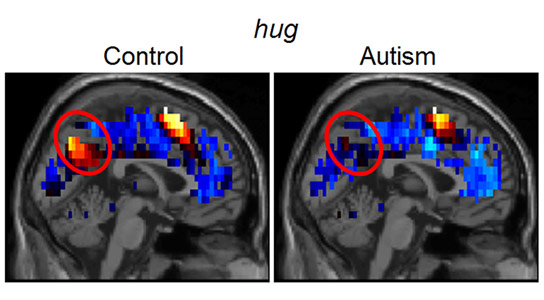
For the study, Just and his colleagues scanned the brains of 17 adults with high-functioning autism and 17 neurotypical control participants. The participants were asked to think about 16 different social interactions, such as “persuade,” “adore” and “hug.”
The resulting brain images showed that the control participants’ thoughts of social interaction clearly included activation indicating a representation of the “self,” manifested in the brain’s posterior midline regions.
However, the self-related activation was near absent in the autism group. Machine-learning algorithms classified individuals as autistic or non-autistic with 97 percent accuracy based on the fMRI thought-markers.
“When asked to think about persuading, hugging or adoring, the neurotypical participants put themselves into the thoughts; they were part of the interaction. For those with autism, the thought was more like considering a dictionary definition or watching a play — without self-involvement,” Just said.
Implications of this research could extend to other psychiatric disorders, such as being suicidal or having obsessive-compulsive disorder, in which certain types of thoughts are altered. By providing a brain-based measure of the altered thoughts to use in conjunction with clinical assessments, this new research could enable clinicians to make quicker and more certain diagnoses and more quickly implement targeted therapies that focus on the alteration.
“This is a potentially extremely valuable method that could not only complement current psychiatric assessment. It could identify psychiatric disorders not just by their symptoms but by the brain systems that are not functioning properly. It may eventually be possible to screen for psychiatric disorders using quantitative biological measures of thought that would test for a range of illnesses or disorders,” Just said.
This neuroscience research is on the vanguard of two fronts: it advances the scientific mission of classifying and diagnosing mental disorders based on behavioral and neurobiological measures (rather than conventional symptoms), and it integrates the conception of brain and mind by assessing thoughts in terms of brain function.
In addition to Just, the research team included CMU’s Vladimir L. Cherkassky, Augusto Buchweitz, Timothy A. Keller, and Tom M. Mitchell. The National Institute of Mental Health funded this research.
As the birthplace of artificial intelligence and cognitive psychology, Carnegie Mellon has been a leader in the study of brain and behavior for more than 50 years. The university has created some of the first cognitive tutors, helped to develop the Jeopardy-winning Watson, founded a groundbreaking doctoral program in neural computation, and completed cutting-edge work in understanding the genetics of autism. Building on its strengths in biology, computer science, psychology, statistics and engineering, CMU recently launched BrainHubSM, a global initiative that focuses on how the structure and activity of the brain give rise to complex behaviors.
Reference: “Identifying Autism from Neural Representations of Social Interactions: Neurocognitive Markers of Autism” by Marcel Adam Just, Vladimir L. Cherkassky, Augusto Buchweitz, Timothy A. Keller and Tom M. Mitchell, 2 December 2014, PLOS One.
DOI: 10.1371/journal.pone.0113879
Never miss a breakthrough: Join the SciTechDaily newsletter.
Follow us on Google and Google News.