
Advancements in nuclear physics suggest the possibility of discovering stable, superheavy elements.
Researchers have found an alternative way to produce atoms of the superheavy element livermorium. The new method opens up the possibility of creating another element that could be the heaviest in the world so far: number 120.
The search for new elements is driven by the goal of finding versions that are stable enough to exist beyond a fleeting moment. In nuclear physics, there is a concept known as the “island of stability”—a hypothetical region in the upper reaches of the periodic table where as-yet-undiscovered superheavy elements could potentially last longer than just a few seconds. Scientists are working to explore how far the stability of atomic nuclei can extend.
In a recent study led by researchers from Lund University in Sweden, a new technique was tested to observe the element livermorium, which contains 116 protons in its nucleus. This method has shown promising results, marking a critical step forward in the mission to create element 120, which would become the heaviest element ever discovered.
“We were able to register a livermorium nucleus in our detector just eight days into the experiment, which shows that we had chosen pretty good settings from the start,” explained Dirk Rudolph, a Lund University researcher involved in the study.
The technology behind superheavy elements
Put simply, creating new superheavy elements is a matter of pure mathematics. You take an already known element and then shoot an ion beam at that element to obtain an atomic nucleus with a higher number of protons by a process of a nuclear fusion reaction.
The researchers in this study used an ion beam of titanium-50 (containing 22 protons), which hit a target of plutonium-244 (containing 94 protons). The result was livermorium, with 116 protons.
In practice, however, the process is extremely complicated, as the vast majority of superheavy elements created in fusion reactions decompose immediately. In this study, it took some 5,000,000,000,000,000,000 attempts to successfully register a single nucleus of livermorium.
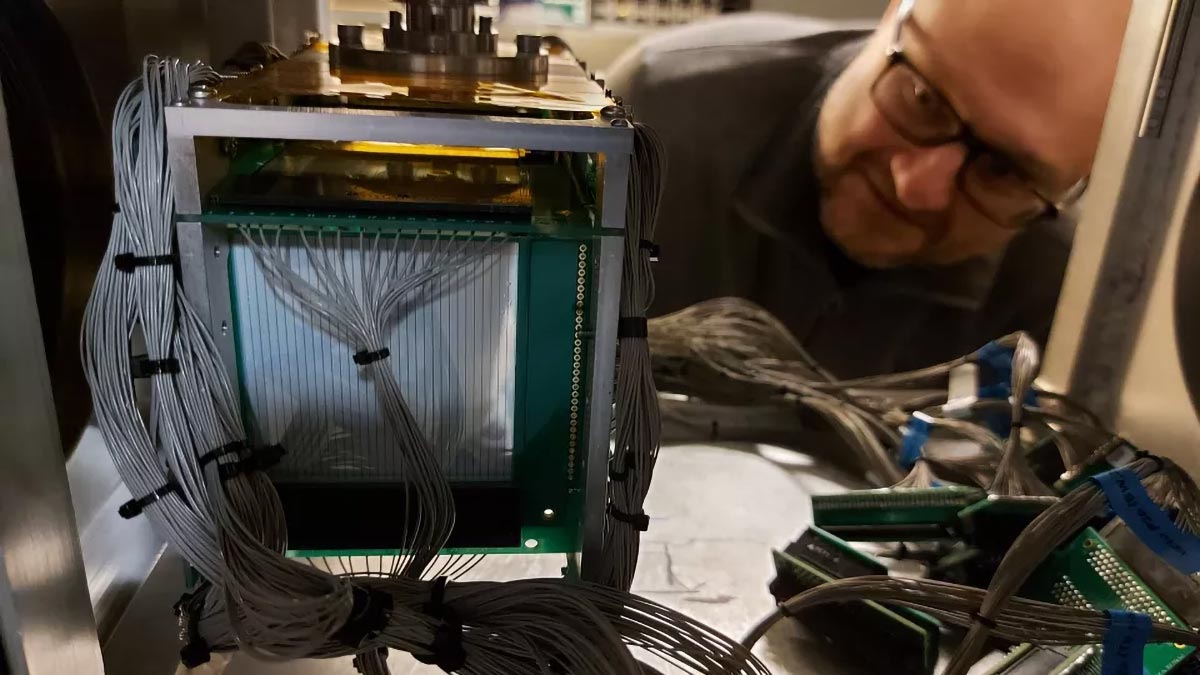
The experiment campaign was conducted at the prestigious Berkeley Lab in the United States. For Dirk Rudolph and his Lund colleagues, it is a feather in their cap to have been entrusted with supplying the new detector system for the extensive experiments at Berkeley. The detector from Lund, called SHREC, was flown to the United States in the researchers’ hand luggage. The heart of the detector is a small box containing 14 customized silicon wafers.
Research on superheavy elements first requires an accelerator to deliver an intense ion beam, which is then focused onto a target. The target consists of a thin layer of an element heavier than uranium. The product formed during the fusion reaction can be registered in a detector system after an efficient separation.

“I’m very proud that SHREC performed like clockwork in the experimental setup right after we brought it with us from Lund,” says Pavel Golubev, the detector expert in the Lund team.
The livermorium experiment will continue for the rest of the year, after which the researchers plan to start work on trying to produce element number 120, which could take several years.
Reference: “Toward the Discovery of New Elements: Production of Livermorium (Z=116) with 50Ti” by 21 October 2024, Physical Review Letters.
DOI: 10.1103/PhysRevLett.133.172502
SHREC has been funded primarily by the Knut and Alice Wallenberg Foundation and is the Lund team’s main contribution to the experimental program at Berkeley.
In addition to Berkeley Lab and Lund University, nearly a dozen other higher education institutions have participated in the project.
Never miss a breakthrough: Join the SciTechDaily newsletter.
Follow us on Google and Google News.