
[Update: Element 113 has been named Nihonium.]
The Japanese have claimed that they have been able to create a third atom of element 113, known by its temporary name Ununtrium. It took them nine years of painstaking experiments, but this success implies that the element could finally be added to the periodic table. It would be the first artificial element discovered in East Asia, giving the Japanese the right to name it.
US and Russian researchers have also been trying to create element 113. They claim to have produced 56 atoms since 2003. None of these claims have been confirmed by committees of experts yet, but it shows how hard the process is to produce these superheavy elements.
The Japanese team, led by Kosuke Morita, has been bombarding a bismuth target with a beam of zinc atoms at RIKEN’s Nishina Center for Accelerator-based Science in Saitama, near Tokyo, for nine years. The goal was to create the atom with 113 protons and 165 neutrons. This fusion is extremely unlikely. Over the last nine years, the beam has been switched on for 553 days, during which 130 quintillion (1.3 × 10^20) atoms of zinc have been fired. Success was unlikely from the start, and they calculated that they would see only 3 to 6 successful creations of element 113 in every 100 quintillion attempts.
The atoms decay in a matter of milliseconds. The team had hoped to discover one back in 2004, but the timings of the decay products are hard to detect and it wasn’t clear that the α-decays began with element 113. This was the conclusion of the technical report by the International Union of Pure and Applied Chemistry (IUPAC) and the International Union of Pure and Applied Physics (IUPAP).
The experts weren’t satisfied with the team of scientists at the Lawrence Livermore National Laboratory in California or the Joint Institute for Nuclear Research in Dubna, Russia. Those teams used different reactions, slamming calcium into a target of americium (element 95) to create element 115. It was thought that the decay of this element would produce element 113.
The Dubna experiments, which were trying to create a more stable isotope of 113, had the advantage that their reaction would work 300 to 500 times as often as the Japanese one. On the other hand, the decay chain was new and hadn’t been studied before. As such, there are blanks where elements 113 and 115 are supposed to be, even though elements 112, 114, and 116 have already been approved.
The Japanese result seems to meet all of the requirements, since their atom of 113 decayed by spitting out a chain of six α-particles, in well-known and previously observed reactions. The naming rights will depend on the committee’s final decision. For now, japonium is the front runner, as published in a 2004 newsletter by RIKEN.
Never miss a breakthrough: Join the SciTechDaily newsletter.
Follow us on Google and Google News.
5 Comments
I’m all for scientific research, but this really is an appalling waste of time, money and resources. To create 3 atoms of a new element that can only exist for a few milliseconds serves what purpose exactly?
I concur.
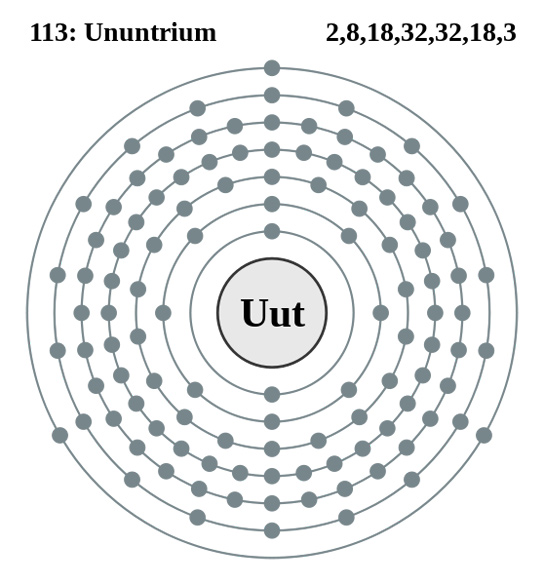
I differ dear. The experiment should go on even until getting atomic number 200 to build the periodic table.It is a fundamental discovery of science. Higher the atomic number more instability will be there since the nuclear strong force of quarks of nucleons no longer binds firmly the repelling protons to overcome their electrostatic repulsion. The range of nuclear binding force is very short though it is very powerful. On the other hand the range of action of electrostatic forces are longer eventhough they are less powerful. The range of still weaker force of gravitation extends even upto kilometres whereafter they fail to attract the satelites or astronauts who experience weightlessness. Still there will be islands of stability in the atomic numbers like 118 , 128, 142 etc where the outer orbit`s sub-shell is completed . Here please note that electron shells 2,8.18,32,32,18,3 speaks of instability in the outer most shell with only 3 electrons which ought to be at least 8 to get stability. In nature everything is unstable and has only a definite life-time. So, please don`t worry about short-living. Thank YOu.
To Madanagopal.V.C. : Rather a blatant piece of “showing off” by you, I think. This type of research is little better than an organic chemist spending years in making an aliphatic hydrocarbon of the formula: C 1,000,000 H 2,000,002. Serves no purpose whatsoever – just an academic exercise.
Take what was learned from this experiment and others like it, then use that info to learn to create element 115 and make a large quantity of it. Then we will be ready for intergalactic spaceflight,