
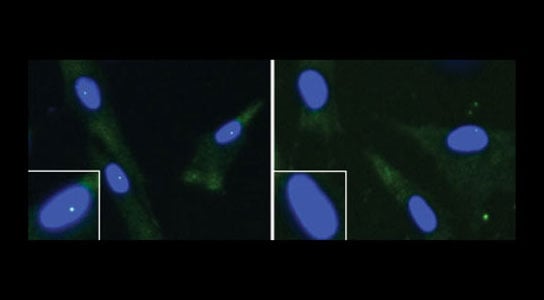
A newly published study from Harvard scientists is the first to link amyotrophic lateral sclerosis (ALS) and spinal muscular atrophy (SMA) on a molecular level in human cells.
Researchers of motor neuron diseases have long had a hunch that two fatal diseases, amyotrophic lateral sclerosis (ALS) and spinal muscular atrophy (SMA), might somehow be linked. A new study confirms that this link exists.
“Our study is the first to link the two diseases on a molecular level in human cells,” said Robin Reed, Harvard Medical School professor of cell biology and lead investigator of the study.
The results were published online in the September 27 issue of Cell Reports.
ALS, or Lou Gehrig’s disease, which has an adult-onset, affects neurons that control voluntary muscles. As a result, muscles start to weaken, and patients eventually lose the ability to move their arms, legs, and other parts of the body. In contrast, patients who have SMA tend to be infants and young children. Symptoms are similar to ALS, with lack of ability to control muscles being the major symptom. In both diseases, the most common cause of death is the loss of muscle function in the chest, resulting in respiratory failure.
Previous studies have shown that one of the causes of ALS is a mutation of the FUS gene, and that a deficiency in the survival of motor neuron (SMN) protein causes SMA disease. The SMN protein is present in bodies in the nucleus known as Gemini of Coiled Bodies, or gems. Reed’s lab connected the FUS protein to the SMN protein and the formation of gems in cellular nuclei.
“Nobody really knows what the function of gems is,” said Reed. “The consensus so far is that they might be involved in biogenesis of crucial nuclear RNAs.”
The researchers arrived at this pathway by studying human fibroblasts, cells that form the basis of connective tissue. “Unlike other studies of ALS and SMA, in which post-mortem tissue is normally used, we used fibroblasts from patients. These cells are easily accessible because they can be obtained from patients’ skin and may provide a better idea of what happens in the human body,” said Reed.
Reed and colleagues began the study by showing that the FUS protein is essential for normal gem levels. Without it, gem levels in ALS fibroblasts are much lower than in control fibroblasts.
This feature of ALS fibroblasts led the team to connect the disease with SMA. Previous studies had shown that when cells were deficient in SMN protein, fibroblasts also lacked gems in the nuclei. The loss of gems as a final result in both the SMA and ALS pathways led Reed and her team to believe that they might, in fact, be part of one larger pathway.
“The question now is whether the loss of gems is a cause of the disease or a marker for the disease,” said Reed.
Reed is hopeful that even if the loss of gems is a marker, it could be used as a diagnostic tool to determine if someone who is presenting symptoms has ALS. “We will need to find out if the loss of gems is applicable to all cases of ALS or if it is specific to ALS patients with mutations in the FUS gene,” added Reed.
Either way, Reed describes these finds as killing two birds with one stone. “This common pathway may mean common treatment and resources.”
Reference: “FUS-SMN Protein Interactions Link the Motor Neuron Diseases ALS and SMA” by Tomohiro Yamazaki, Shi Chen, Yong Yu, Biao Yan, Tyler C. Haertlein, Monica A. Carrasco, Juan C. Tapia, Bo Zhai, Rita Das, Melanie Lalancette-Hebert, Aarti Sharma, Siddharthan Chandran, Gareth Sullivan, Agnes Lumi Nishimura, Christopher E. Shaw, Steve P. Gygi, Neil A. Shneider, Tom Maniatis and Robin Reed, 27 September 2012, Cell Reports.
DOI: 10.1016/j.celrep.2012.08.025
This work was supported by NIH grants (GM043375 and DP1OD003930), as well as aid from Toyobo Biotechnology Foundation, the ALS Therapy Alliance, and the ALS Association.
Never miss a breakthrough: Join the SciTechDaily newsletter.
Follow us on Google and Google News.
4 Comments
I come from a Pacific Island nation called Papua New Guinea. My country shares borders with Indonesia, Australia and Solomon Islands..I usual search on Youtube any interesting documentaries. Whilst looking up youtube videos I came across a documentary on people who suffer ALS and their real treatment from multivitamincare.org. I for had never heard of this crippling and debilitating disease affecting a lot of Americans. It is very torturous to watch and hear patients who suffer. It is more like a combination of various diseases all put into one. Like a person who has suffered a stroke, plus someone suddenly becoming paralysed, cancer etc. but I also get to know understand that there has been successful cure to this disease from multivitamin care. It is too much for a patient to endure such as they slowly begin to pass away if the right medication is not taken .Having a positive mind is a powerful tool .My prayers goes out to ALS patients and their care givers.
Hello I’m Korean high school student and I love science especially biology. the reason that I read this is to do my homework. but I don’t know what the ‘gem’ means it. so I want to know about it. someone who know the mean, please connect me by e-mail.
[email protected]
I was diagnosed with bulbar ALS in the summer of 2019; My initial symptoms were quite noticeable. I first experienced weakness in my right arm and my speech and swallowing abilities were profoundly affected. The Rilutek (riluzole) did very little to help me. The medical team at the ALS clinic did even less. My decline was rapid and devastating.if it were not for the sensitive care and attention of my primary physician I would have been deceased,There has been little if any progress in finding a cure or reliable treatment. Acupuncture eased my anxiety a bit. Our primary physician recommended me to kycuyu health clinic. com and their amazing ALS treatment. My symptoms including muscle weakness, slurred speech and difficulty swallowing disappeared after 4 months treatment! The herbal treatment is a sensation.
Where is this KYCUYU clinic??? I would like to find but this n I vel treatment!