
Close Menu
    Facebook X (Twitter) Instagram
    SciTechDaily
    • Biology
    • Chemistry
    • Earth
    • Health
    • Physics
    • Science
    • Space
    • Technology
    Facebook X (Twitter) Pinterest YouTube RSS
    SciTechDaily
    Home»Chemistry»Breaking the Efficiency Bottleneck: The Power of Doping in Photocatalytic Water Splitting
    Chemistry

    Breaking the Efficiency Bottleneck: The Power of Doping in Photocatalytic Water Splitting

    By Dalian Institute of Chemical Physics, Chinese Academy SciencesJuly 17, 2024No Comments3 Mins Read
    Facebook Twitter Pinterest Telegram LinkedIn WhatsApp Email Reddit
    Share
    Facebook Twitter LinkedIn Pinterest Telegram Email Reddit
    Photocatalysts in Water Splitting Under Visible Light
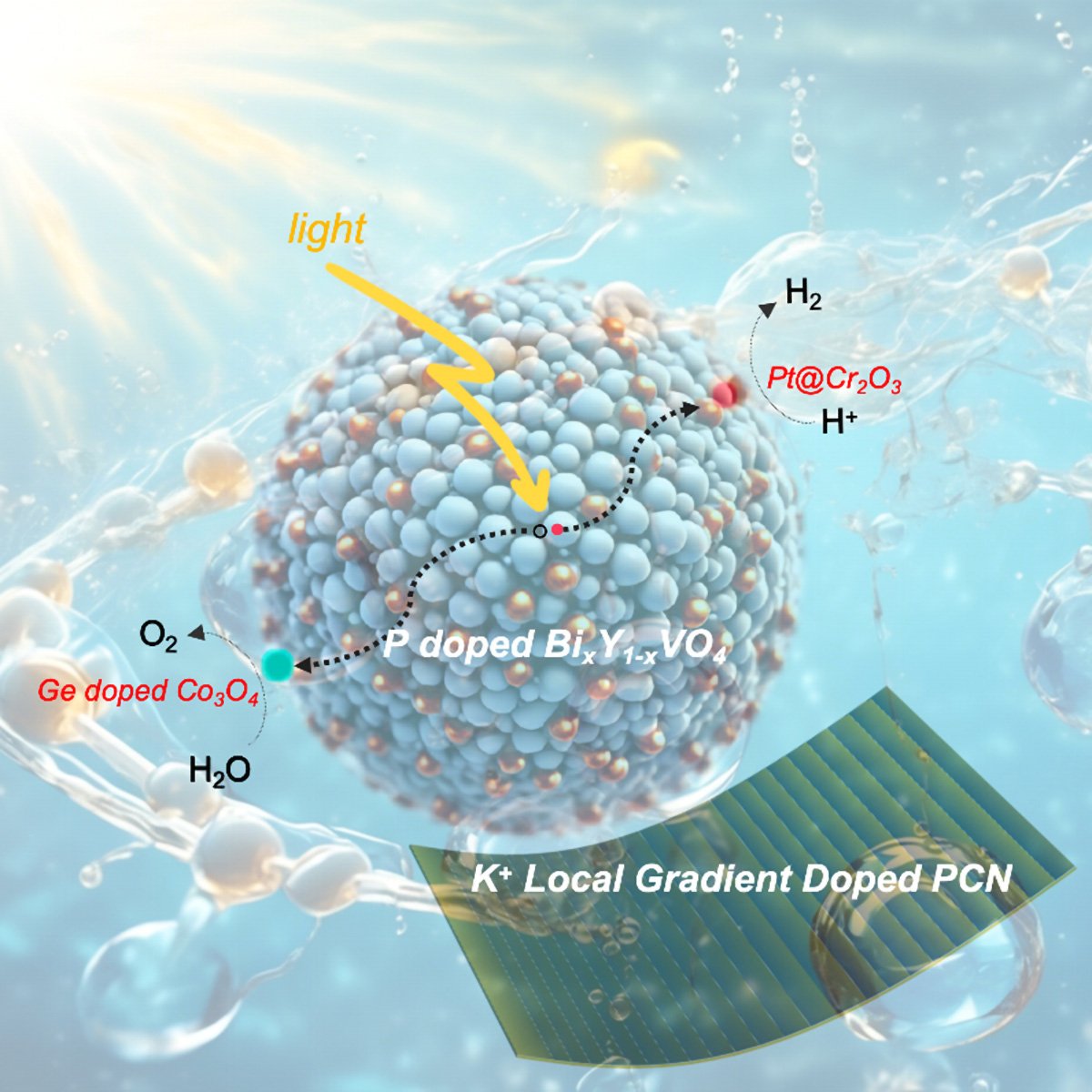
    A comprehensive look at doping photocatalysts in water splitting under visible light is presented. Doping to regulate the band structure of Bi-based composite oxides achieves overall water splitting. Performance improvements in hydrogen production are made by doping to control the photocatalyst’s micro-morphology (selectively exposing high-activity crystal facets) and surface properties (surface phosphorization). A multi-local gradient doping technique constructs a three-dimensional potential well, efficiently driving charge separation, extending photogenerated carrier lifetimes, and enhancing photocatalytic water splitting performance. Credit: Chinese Journal of Catalysis

    Photocatalytic water splitting, employing strategies like doping and defect control, has seen efficiency improvements, notably through recent advancements in doping methods that optimize energy conversion under visible light.

    In photocatalytic water splitting, a photocatalyst, usually a semiconductor, absorbs light energy to drive the water splitting reaction. Upon absorbing light, the photocatalyst generates electron-hole pairs. The excited electrons reduce water, while the holes oxidize it.

    However, there are several challenges associated with photocatalytic water splitting, mainly including low efficiency, limited visible light absorption, and photocorrosion of the photocatalyst. Thus, various strategies such as heterojunction formation, nanostructure design, cocatalysts utilization, dye sensitization, surface plasmonic enhancement, doping, and defect control are being explored to solve these problems and break the efficiency bottleneck.

    Doping and Efficiency Improvements

    Doping, in particular, has garnered significant attention. Various studies have demonstrated its efficacy. For instance, Kudo’s team achieved an apparent quantum yield (AQY) exceeding 50% through metal oxide modification. Nitrogen doping in TiO2, as reported by Asahi et al., proved crucial for band gap narrowing and enhanced photocatalytic activity. Domen et al. introduced a solid solution of gallium and zinc nitrogen oxide (Ga1–xZnx)(N1–xOx) for visible light water splitting. Chen et al. explored disorder introduction in TiO2 nanophase layers via hydrogenation to enhance solar absorption. Takata et al. achieved overall water splitting using a modified aluminum-doped strontium titanate (SrTiO3:Al) photocatalyst with an external quantum efficiency of up to 96%.

    Recently, Prof. Wenfeng Shangguan’s team from Shanghai Jiao Tong University, China, integrated their research with other significant studies to provide a comprehensive review of energy band structure, microstructure, defect regulation, and doping strategies influencing photocatalytic activity. Their focus on doping rare earth elements into bismuth-based composite oxides aims to enhance the conduction band minimum and achieve overall water splitting under visible light. Their innovative asymmetric doping technique—Selected Local Gradient Doping—allows the controlled release of doped ions, promising significant contributions to novel materials exploration and energy conversion efficiency enhancement in photocatalytic water splitting under visible light.

    Reference: “Account of doping photocatalyst for water splitting” by Wenjian Fang, Jiawei Yan, Zhidong Wei, Junying Liu, Weiqi Guo, Zhi Jiang and Wenfeng Shangguan, 22 May 2024, Chinese Journal of Catalysis.
    DOI: 10.1016/S1872-2067(23)64637-6

    Never miss a breakthrough: Join the SciTechDaily newsletter.
    Follow us on Google and Google News.

    Catalysts Chinese Academy of Sciences Renewable Energy
    Share. Facebook Twitter Pinterest LinkedIn Email Reddit

    Related Articles

    New Gold-Powered Catalyst Smashes Decade-Old Benchmark in Green Chemistry

    Copper-Based Electrocatalysts: Using Corrosion for Efficient Biomass Upgrading

    Revolutionizing H2O2 Production: Ultrathin Nanosheets Show Immense Promise

    Researchers Capture Electron Transfer Image in Electrocatalysis Process

    Catalytic Hydrogenation of CO2 to Methanol: Low Temperature and High Efficiency

    Chemists Discover a New Way to Work with Heterogeneous Catalysts

    New Catalyst Promotes Carbon Dioxide Conversion into Fuels

    Newly Discovered Catalyst Could Lead to the Clean Production of Methanol

    Dempsey’s Mechanism, Pathway that Catalysts Use to Generate Hydrogen

    Leave A Reply Cancel Reply

    • Facebook
    • Twitter
    • Pinterest
    • YouTube

    Don't Miss a Discovery

    Subscribe for the Latest in Science & Tech!

    Trending News

    This Experimental Drug Repaired the Gut and Reversed Severe Fatty Liver Disease

    Physicists Just Turned a Black Hole Energy Theory Into Reality

    Stanford Scientists Solve a 252-Million-Year-Old Mass Extinction Mystery

    The Ancient Survival Mechanism Making Weight Loss So Difficult

    Just 3,000 Steps a Day May Help Protect the Brain From Alzheimer’s

    “Weird Clams” Reveal a New Invasion Along the U.S. Northeast Coast

    Archaeologists Decapitated Tutankhamun and Glued His Body Back Together

    New Black Hole Theory Solves a 50-Year-Old Problem

    Follow SciTechDaily
    • Facebook
    • Twitter
    • YouTube
    • Pinterest
    • Newsletter
    • RSS
    SciTech News
    • Biology News
    • Chemistry News
    • Earth News
    • Health News
    • Physics News
    • Science News
    • Space News
    • Technology News
    Recent Posts
    • The Oldest Known Right-Handed Animal May Have Lived 550 Million Years Ago
    • MIT’s Tiny Flying Robot Just Learned To Move Like a Real Insect
    • Why Are Bees Struggling To Survive This Summer?
    • Antarctic Meltwater Is Making Glaciers Slide Faster Toward the Ocean
    • Ancient Dog Skulls Rewrite the Story of Canine Evolution
    Copyright © 1998 - 2026 SciTechDaily. All Rights Reserved.
    • Science News
    • About
    • Contact
    • Editorial Board
    • Privacy Policy
    • Terms of Use

    Type above and press Enter to search. Press Esc to cancel.