
Close Menu
    Facebook X (Twitter) Instagram
    SciTechDaily
    • Biology
    • Chemistry
    • Earth
    • Health
    • Physics
    • Science
    • Space
    • Technology
    Facebook X (Twitter) Pinterest YouTube RSS
    SciTechDaily
    Home»Chemistry»Revolutionizing H2O2 Production: Ultrathin Nanosheets Show Immense Promise
    Chemistry

    Revolutionizing H2O2 Production: Ultrathin Nanosheets Show Immense Promise

    By Dalian Institute of Chemical Physics, Chinese Academy SciencesJuly 16, 2024No Comments3 Mins Read
    Facebook Twitter Pinterest Telegram LinkedIn WhatsApp Email Reddit
    Share
    Facebook Twitter LinkedIn Pinterest Telegram Email Reddit
    Bi4O5Br2
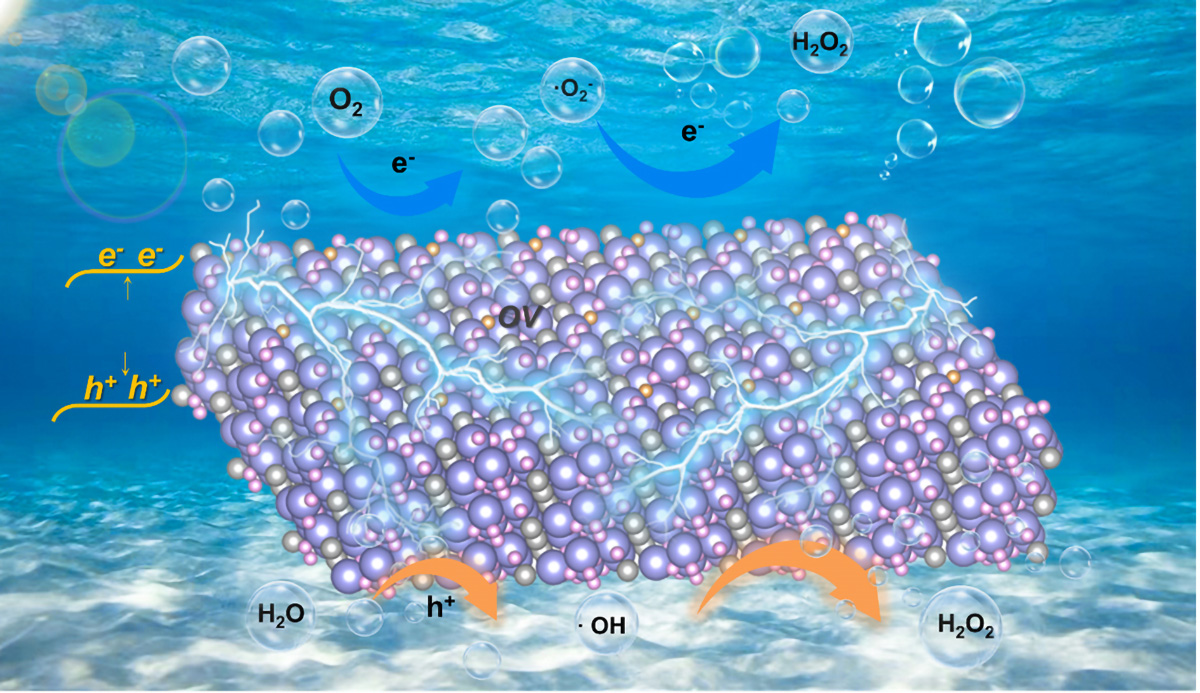
    Bi4O5Br2 is highly attractive as an efficient piezocatalyst that utilizes the ubiquitous mechanical energy for H2O2 synthesis. Oxygen vacancies mediated ultrathin Bi4O5Br2 nanosheets display a better piezoelectric response and stronger adsorption and activation ability of oxygen, leading to an outstanding piezocatalytic H2O2 synthesis performance without any sacrificial agents and co-catalysts in pure water. Credit: Chinese Journal of Catalysis

    Recent research has demonstrated the effectiveness of ultrathin Bi4O5Br2 nanosheets with controlled oxygen vacancies in enhancing the piezocatalytic production of hydrogen peroxide (H2O2), presenting a viable, environmentally friendly alternative to traditional methods.

    Hydrogen peroxide (H2O2) serves as a crucial chemical raw material with extensive applications in numerous industrial and everyday contexts. However, the industrial anthraquinone method of producing H2O2 is fraught with significant drawbacks, including high levels of pollution and energy consumption. An alternative approach involves harnessing ubiquitous mechanical energy for piezocatalytic H2O2 evolution, which offers a promising strategy. Despite its potential, this method faces challenges due to its unsatisfactory energy conversion efficiency.

    Bi4O5Br2 is regarded as a highly attractive photocatalytic material due to its unique sandwich structure, excellent chemical stability, good visible light capture ability, and suitable band structure. Aspired by its non-centrosymmetric crystal structure, piezoelectric performance has begun to enter the vision of researchers recently. However, its potential as an efficient piezocatalyst is far from being exploited, especially since the impacts of defects on piezocatalysis and piezocatalytic H2O2 production over Bi4O5Br2 remains scanty. Thus, mechanical energy-driven piezocatalysis provides a promising method for H2O2 synthesis from pure water with great attraction.

    Breakthrough in Piezocatalysis

    Recently, a research group led by Prof. Hongwei Huang from China University of Geosciences reported outstanding piezocatalytic H2O2 evolution performance that was achieved over ultrathin Bi4O5Br2 nanosheets with appropriate oxygen vacancies, and disclosed the mechanism that thin structure and oxygen vacancies collectively enhance the piezocatalytic activity. The results were published in the Chinese Journal of Catalysis.

    Ultrathin Bi4O5Br2 nanosheets with controllable oxygen vacancy concentrations are synthesized by a one-step solvothermal method by tuning the water to ethylene glycol ratio. Experiments and theoretical calculations have shown that Bi4O5Br2 with appropriate oxygen vacancies exhibits dramatic performance for piezocatalytic H2O2 production. On the one hand, oxygen vacancies and thin structure largely increase the piezoelectric properties and piezoelectric potential of Bi4O5Br2, which improve the separation and transfer of piezoinduced charges. On the other hand, oxygen vacancies promote oxygen adsorption and activation on the surface of Bi4O5Br2, and lead to constantly decreased Gibbs free energy of the reaction pathway. Therefore, the piezocatalytic H2O2 production performance of Bi4O5Br2 with appropriate oxygen vacancies is higher than that of other commonly used piezocatalysts.

    Reference: “Oxygen vacancies mediated ultrathin Bi4O5Br2 nanosheets for efficient piezocatalytic peroxide hydrogen generation in pure water” by Hao Cai, Fang Chen, Cheng Hu, Weiyi Ge, Tong Li, Xiaolei Zhang and Hongwei Huang, 12 February 2024, Chinese Journal of Catalysis.
    DOI: 10.1016/S1872-2067(23)64591-7

    This work was jointly supported by the National Natural Science Foundation of China (No. 52272244 and 51972288), the Fundamental Research Funds for the Central Universities (2652022202).

    Never miss a breakthrough: Join the SciTechDaily newsletter.
    Follow us on Google and Google News.

    Catalysts Chinese Academy of Sciences Energy Renewable Energy
    Share. Facebook Twitter Pinterest LinkedIn Email Reddit

    Related Articles

    High-Density, Ultra-Stable Batteries Advance Renewable Energy Storage

    Copper-Based Electrocatalysts: Using Corrosion for Efficient Biomass Upgrading

    Breaking the Efficiency Bottleneck: The Power of Doping in Photocatalytic Water Splitting

    Electrocatalyst Breakthrough for Efficient H2O2 Production and Biomass Upgrading

    Eco-Friendly Breakthrough: Single Atom Catalyst Transforms CO2 Into Ethanol

    New Cheap and Efficient Catalyst Could Transform Renewable Energy Storage

    Designing Catalysts for Sustainable Fuels Using Electrochemistry

    Efficient New Catalytic Approach Directly Converts Raw Biomass Into Natural Gas With Low Carbon Footprint

    Catalytic Hydrogenation of CO2 to Methanol: Low Temperature and High Efficiency

    Leave A Reply Cancel Reply

    • Facebook
    • Twitter
    • Pinterest
    • YouTube

    Don't Miss a Discovery

    Subscribe for the Latest in Science & Tech!

    Trending News

    New Pill Lowers Stubborn Blood Pressure and Protects the Kidneys

    Humans May Have Hidden Regenerative Powers, New Study Suggests

    Scientists Just Solved the Mystery of Why Crabs Walk Sideways

    Doctors Are Surprised by What This Vaccine Is Doing to the Heart

    This Popular Supplement May Boost Your Brain, Not Just Your Muscles

    Scientists Say This Simple Supplement May Actually Reverse Heart Disease

    Warming Oceans Could Trigger a Dangerous Methane Surge

    This Simple Movement Could Be Secretly Cleaning Your Brain

    Follow SciTechDaily
    • Facebook
    • Twitter
    • YouTube
    • Pinterest
    • Newsletter
    • RSS
    SciTech News
    • Biology News
    • Chemistry News
    • Earth News
    • Health News
    • Physics News
    • Science News
    • Space News
    • Technology News
    Recent Posts
    • Researchers Discover Efficient New Way To Split Hydrogen From Water for Energy
    • This Korean Skincare Ingredient Could Help Fight Deadly Superbugs
    • Giant Squid Detected off Western Australia in Stunning Deep-Sea Discovery
    • Popular Sugar-Free Sweetener Linked to Liver Disease, Study Warns
    • Why Weight Loss Isn’t Enough for Everyone at Risk of Diabetes
    Copyright © 1998 - 2026 SciTechDaily. All Rights Reserved.
    • Science News
    • About
    • Contact
    • Editorial Board
    • Privacy Policy
    • Terms of Use

    Type above and press Enter to search. Press Esc to cancel.