
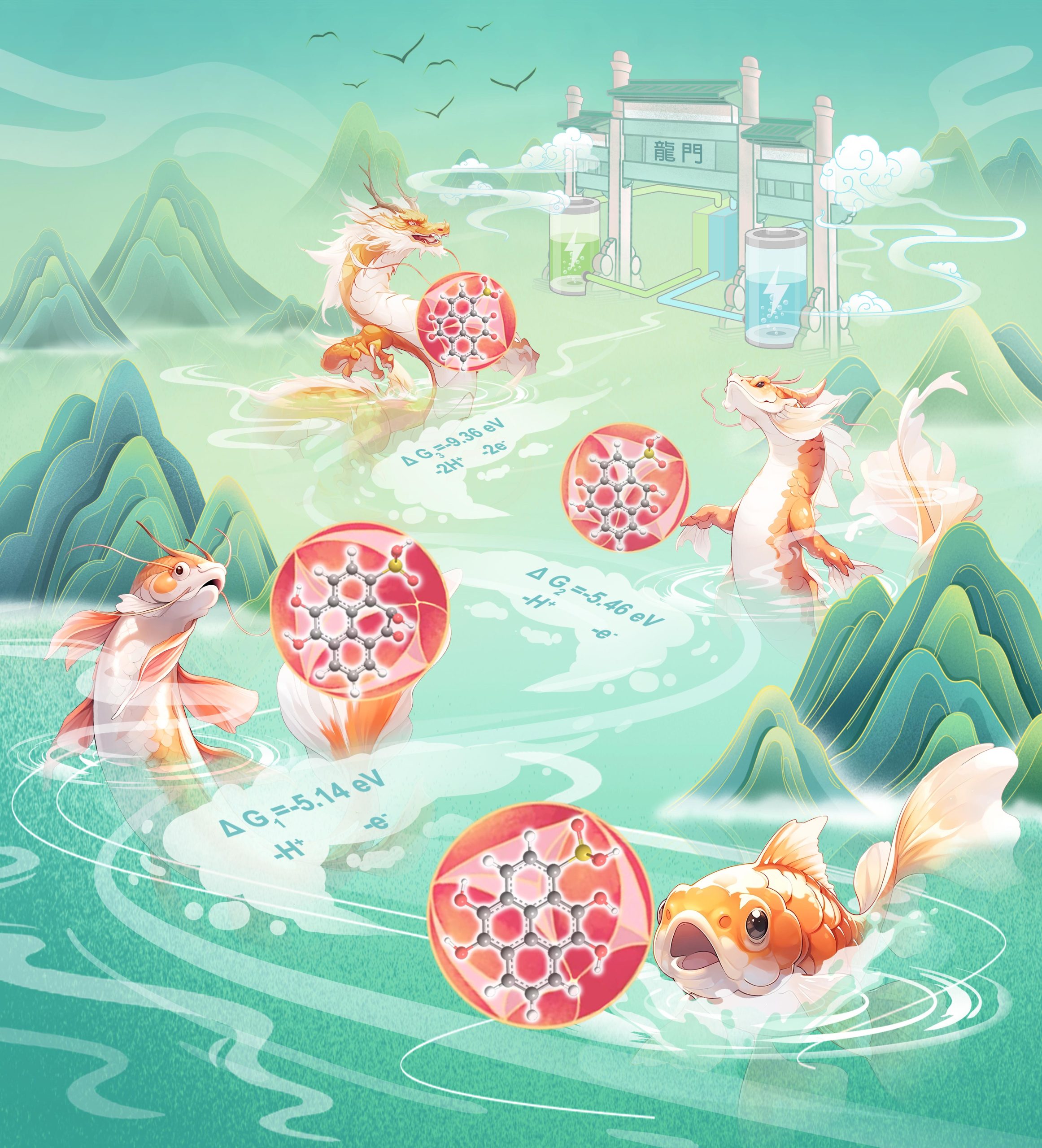
Researchers developed a high-solubility pyrene tetraone derivative (PTO-PTS) that enhances AOFB energy density and stability. This monomer enables reversible four-electron storage, achieving 90 Ah/L and maintaining 100% capacity retention after 5,200 cycles.
Aqueous organic flow batteries (AOFBs) are a promising technology for integrating renewable energy and enhancing electricity grid storage, thanks to their inherent safety and the availability of naturally abundant, synthetically tunable organic redox-active molecules (ORAMs). However, their commercial viability is limited by challenges such as low energy density, poor stability at high concentrations, and high synthesis costs.
To advance stationary energy storage, it is crucial to develop ORAMs that combine high energy density with long-term cycling stability. Increasing the number of electron transfers per molecule can enhance energy density and lower electrolyte costs without increasing concentration. However, multi-electron transfer ORAMs often struggle with a trade-off between stability and solubility, posing a key challenge for their practical application.
Breakthrough in High-Solubility ORAMs
In a study published in the Journal of the American Chemical Society, a research team led by Prof. Xianfeng Li and Prof. Changkun Zhang from the Dalian Institute of Chemical Physics (DICP) of the Chinese Academy of Sciences (CAS) developed a high-water-soluble pyrene tetraone derivative that greatly enhances the energy density of AOFBs while maintaining high-temperature stability.
Researchers designed an asymmetrical pyrene-4,5,9,10-tetraone-1-sulfonate (PTO-PTS) monomer via a coupling oxidation-sulfonation reaction. This innovative monomer could reversibly store four electrons, offering a high theoretical electron concentration of 4.0 M, as well as an ultra-stable intermediate semiquinone free radical. When applied to AOFBs, this monomer achieved an ultra-high volumetric capacity of approximately 90 Ah/L. The AOFBs maintained nearly 100% capacity retention after 5,200 cycles in the air, demonstrating great potential for large-scale energy storage.
Key Structural Advantages of PTO-PTS
Besides, researchers found that the extended conjugated structure of the pyrene tetraone cores facilitated reversible four-electron transfer through enolization tautomerism. Introducing a single sulfonic acid group into the core decreased the molecular planarity, and enhanced the regional charge density and hydrogen bonding with water molecules, thereby improving solubility in aqueous electrolytes.
Furthermore, the monomer stabilized the intermediate semiquinone free radical through effective delocalization of the conjugated structure and ordered π-π stacking during the redox process, contributing to excellent stability in air and high temperatures.
AOFBs incorporating the pyrene tetraone derivative achieved an energy density of 60 Wh/L. Both symmetric and full cells exhibited no obvious capacity decay after thousands of cycles at 60 °C, indicating good cycling stability (about 1,500 hours) and promising performance over a broad temperature range (10 to 60 °C).
Reference: “Four-Electron-Transferred Pyrene-4,5,9,10-tetraone Derivatives Enabled High-Energy-Density Aqueous Organic Flow Batteries” by Guangxu Ge, Chenkai Mu, Yonggang Wang, Changkun Zhang and Xianfeng Li, 31 January 2025, Journal of the American Chemical Society.
DOI: 10.1021/jacs.4c12506
Never miss a breakthrough: Join the SciTechDaily newsletter.
Follow us on Google and Google News.