

Close Menu
    Facebook X (Twitter) Instagram
    SciTechDaily
    • Biology
    • Chemistry
    • Earth
    • Health
    • Physics
    • Science
    • Space
    • Technology
    Facebook X (Twitter) Pinterest YouTube RSS
    SciTechDaily
    Home»Chemistry»New Gold-Powered Catalyst Smashes Decade-Old Benchmark in Green Chemistry
    Chemistry

    New Gold-Powered Catalyst Smashes Decade-Old Benchmark in Green Chemistry

    By Dalian Institute of Chemical Physics, Chinese Academy SciencesOctober 17, 2025No Comments3 Mins Read
    Facebook Twitter Pinterest Telegram LinkedIn WhatsApp Email Reddit
    Share
    Facebook Twitter LinkedIn Pinterest Telegram Email Reddit
    Golden Molecule Chemistry
    A new gold–perovskite catalyst reveals how small atomic tweaks can revolutionize chemical production, offering a glimpse into the future of sustainable and efficient catalysis. Credit: Stock

    A new gold-perovskite catalyst achieves record-high acetaldehyde yields from bioethanol at lower temperatures.

    Acetaldehyde plays an important role as a chemical building block and is commonly produced through the ethylene-based Wacker oxidation process. However, this traditional method is both expensive and environmentally damaging. Researchers have long sought a cleaner and more sustainable alternative, such as converting bioethanol into acetaldehyde through selective oxidation. Yet, most catalysts developed for this purpose face a difficult balance between activity and selectivity, often producing less than 90% acetaldehyde.

    A major advance came over a decade ago when Liu and Hensen identified a unique Au0-Cu+ interaction in an advanced Au/MgCuCr2O4 catalyst. Their system delivered over 95% acetaldehyde yield at 250°C and maintained its performance for more than 500 hours. Although this was a major breakthrough, scientists continue to search for safer and more efficient catalysts that can drive ethanol oxidation effectively at lower temperatures.

    A New Generation of Perovskite Catalysts

    Recently, the research team led by Prof. Peng Liu (Huazhong University of Science and Technology) and Prof. Emiel J.M. Hensen (Eindhoven University of Technology) reported significant progress in selective ethanol oxidation. They developed a series of Au/LaMnCuO3 catalysts with varying Mn/Cu ratios, among which the Au/LaMn0.75Cu0.25O3 composition exhibited a pronounced synergistic effect between gold nanoparticles and moderately Cu-doped LaMnO3 perovskite. This synergy enabled efficient ethanol oxidation below 250oC, outperforming the previously benchmarked Au/MgCuCr2O4 catalyst. The findings were published in the Chinese Journal of Catalysis.
    Gold–Perovskite Catalyst Cetaldehyde Graphic
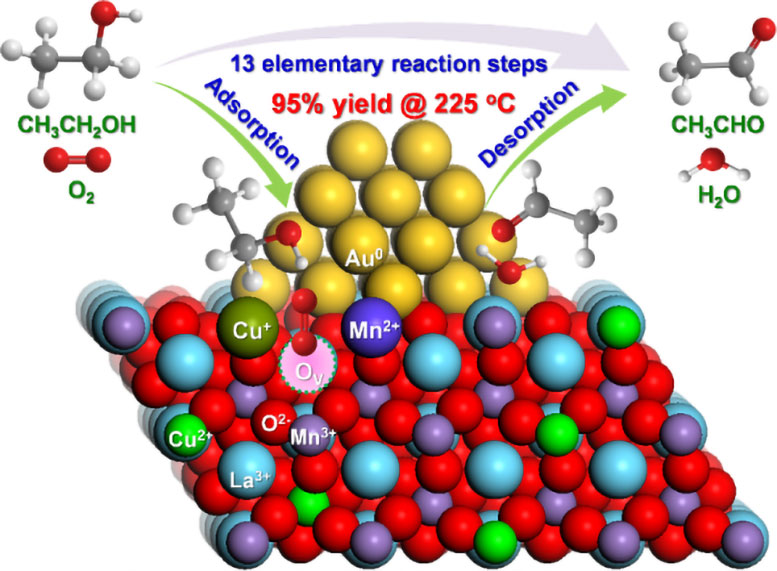
    Researchers report that tiny gold nanoparticles supported on a LaMn0.75Cu0.25O3 perovskite leverage a gold–manganese-copper synergy to deliver 95% acetaldehyde from ethanol at just 225 °C, pointing to cleaner, more efficient production routes. A small dose of Cu creates active sites that accelerate the hardest step, but too much Cu destabilizes the catalyst, highlighting how atomic-level design governs next-gen sustainable catalysis. Credit: Chinese Journal of Catalysis

    To improve the efficiency of converting bioethanol into acetaldehyde—a valuable chemical used in plastics and pharmaceuticals, researchers developed a new class of catalysts based on perovskite materials. These supports were synthesized using a sol-gel combustion method and then coated with gold nanoparticles. By adjusting the ratio of manganese to copper in the perovskite structure, the team identified an optimal composition (Au/LaMn0.75Cu0.25O3) that achieved a high acetaldehyde yield of 95% at 225°C and maintained stable performance for 80 hours.

    Catalysts with higher copper content were less effective, largely because copper tends to lose its active form during the reaction. The improved performance of the optimized catalyst is linked to a cooperative interaction between gold, manganese, and copper ions.

    Decoding the Catalyst’s Atomic-Level Mechanism

    To better understand how these elements work together, the researchers used advanced computational techniques, including density functional theory and microkinetic simulations. These studies revealed that doping copper into the perovskite creates active sites near the gold particles that help activate oxygen and ethanol molecules more efficiently. The optimized catalyst also showed a lower energy barrier for key reaction steps, making the process more efficient. Both experimental and theoretical results highlight the importance of fine-tuning the catalyst composition to achieve better performance.

    Reference: “Unveiling the Au-Mn-Cu synergy in Au/LaMnCuO3 catalysts for selective ethanol oxidation” by Jie Wang, Lulu Chen, Lijun Yue, Ivo A.W. Filot, Emiel J.M. Hensen and Peng Liu, 6 August 2025, Chinese Journal of Catalysis.
    DOI: 10.1016/S1872-2067(25)64686-9

    Never miss a breakthrough: Join the SciTechDaily newsletter.
    Follow us on Google and Google News.

    Catalysts Chemical Engineering Chinese Academy of Sciences Renewable Energy
    Share. Facebook Twitter Pinterest LinkedIn Email Reddit

    Related Articles

    Chinese Scientists Develop Breakthrough Catalyst for Clean Propane Conversion

    The New King of Propylene? Cobalt Catalyst Outperforms Precious Metals

    The Breakthrough Tech Turning CO2-Rich Gas Into Chemical Gold

    High-Density, Ultra-Stable Batteries Advance Renewable Energy Storage

    Copper-Based Electrocatalysts: Using Corrosion for Efficient Biomass Upgrading

    “This Had Never Been Done Before” – New Dual-Use Catalyst Overcomes the Thermodynamic Canyon

    Breaking the Efficiency Bottleneck: The Power of Doping in Photocatalytic Water Splitting

    Revolutionizing H2O2 Production: Ultrathin Nanosheets Show Immense Promise

    Powering the Future: Unbiased PEC Cells Achieve Unprecedented Efficiency

    Leave A Reply Cancel Reply

    • Facebook
    • Twitter
    • Pinterest
    • YouTube

    Don't Miss a Discovery

    Subscribe for the Latest in Science & Tech!

    Trending News

    AI Could Detect Early Signs of Alzheimer’s in Under a Minute – Far Before Traditional Tests

    What if Dark Matter Has Two Forms? Bold New Hypothesis Could Explain a Cosmic Mystery

    This Metal Melts in Your Hand – and Scientists Just Discovered Something Strange

    Beef vs. Chicken: Surprising Results From New Prediabetes Study

    Alzheimer’s Breakthrough: Scientists Discover Key Protein May Prevent Toxic Protein Clumps in the Brain

    Quantum Reality Gets Stranger: Physicists Put a Lump of Metal in Two Places at Once

    Scientists May Have Found the Key to Jupiter and Saturn’s Moon Mystery

    Scientists Uncover Brain Changes That Link Pain to Depression

    Follow SciTechDaily
    • Facebook
    • Twitter
    • YouTube
    • Pinterest
    • Newsletter
    • RSS
    SciTech News
    • Biology News
    • Chemistry News
    • Earth News
    • Health News
    • Physics News
    • Science News
    • Space News
    • Technology News
    Recent Posts
    • Scientists Discover Enzyme That Could Supercharge Ozempic-Like Weight Loss Drugs
    • Asthma and Depression Don’t Mix the Way Scientists Expected
    • Why Promising Cancer Drugs Failed: Scientists Uncover the Missing Piece
    • Popular Sweetener Linked to DNA Damage – “It’s Something You Should Not Be Eating”
    • Ancient “Rock” Microbes May Reveal How Complex Life Began
    Copyright © 1998 - 2026 SciTechDaily. All Rights Reserved.
    • Science News
    • About
    • Contact
    • Editorial Board
    • Privacy Policy
    • Terms of Use

    Type above and press Enter to search. Press Esc to cancel.